


Key highlights:
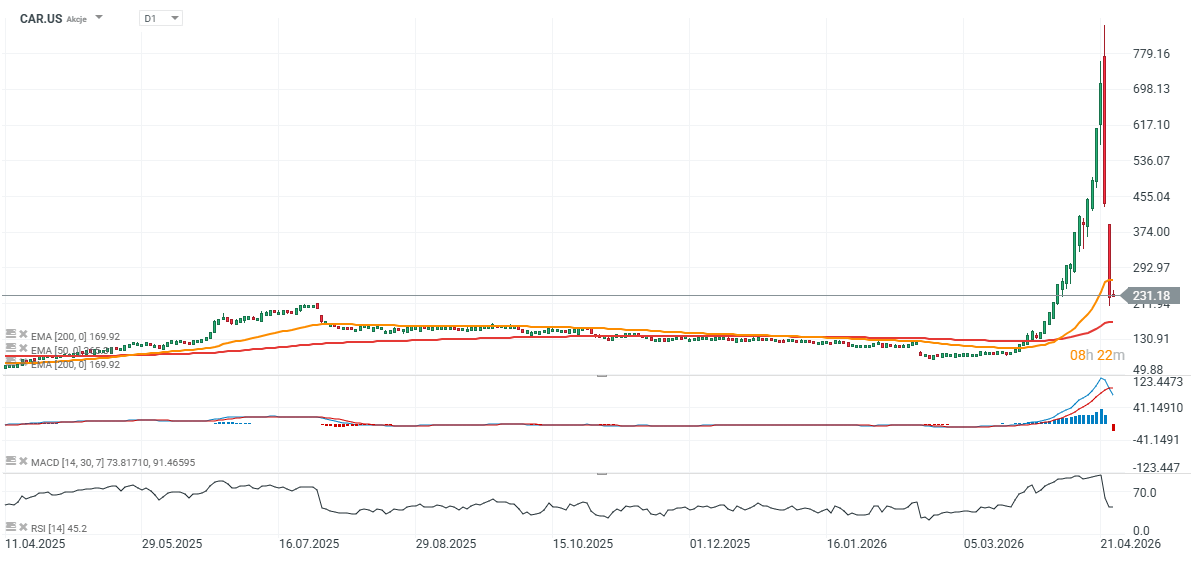
- peak rally at 600% (from <100 USD to >700 USD)
- decline of over 70% in two days after the peak
- one-day short seller profits: appx. $2.8 billion
- short interest reaching ~64% of free float
- implied volatility on options: 235%
The starting point: limited supply and mounting pressure on shorts
The story began with a very specific market structure. Avis Budget combined high short interest with a very limited free float. In practice, this meant a large number of investors were positioned for declines, while the actual supply of shares available for purchase remained constrained. This imbalance created ideal conditions for a sharp upward move. Even moderate demand could trigger outsized price reactions due to structurally limited supply.
Ownership concentration as a key catalyst
A critical factor behind the move was the company’s ownership structure. Two hedge funds controlled more than 70% of the shares combined, significantly restricting the free float. In such conditions, relatively small changes in demand can translate into disproportionately large price swings. An additional catalyst came from Pentwater Capital disclosing a large position, which the market interpreted as a signal of institutional backing.
The short squeeze: a self-reinforcing mechanism
As the stock price rose, a classic short squeeze dynamic took hold. Investors betting on declines were forced to close positions, buying back shares at increasingly higher prices. Each forced buyback generated additional demand, further pushing the price higher. At the peak, short interest climbed to around 64% of the free float, amplifying the effect. The takeaway is straightforward: the price surged not because of improving fundamentals, but because the market structure forced participants to buy.
CAR.US (D1 interval)
Source: xStation5
Turning point: the absence of new capital
The reversal began once that mechanism lost momentum. Pressure on short sellers started to ease, while fresh capital inflows failed to materialize. That was enough to break the trend. After peaking above 713 USD, the stock dropped 40% in a single session, followed by further declines in subsequent days. In total, the stock lost more than 70% in a very short period - a typical end to an exhausted short squeeze.
Role reversal: short sellers regain control
The sharp correction completely flipped the market dynamic. Investors who had previously been under pressure began generating profits.
According to S3 Partners, the sell-off produced around $2.8 billion in gains for short sellers in a single day, nearly offsetting earlier losses. At the same time, rising short interest suggests the market quickly returned to positioning for further downside.
Fundamentals in the background: a typical “meme stock” profile
The price action was not supported by improving financial performance. The company has posted net losses in recent years, indicating that the rally was largely disconnected from fundamentals.
This places Avis Budget within the broader “meme stock” category, where price movements are driven primarily by:
- market narrative
- retail investor activity
- market mechanics (short interest, liquidity), rather than earnings
Options activity and volatility: fuel for speculation
Derivatives activity reached levels typical of extreme speculative episodes. Options volume exceeded 200,000 contracts per day, while implied volatility surged to 235%. In response, brokers introduced 100% margin requirements, meaning positions had to be fully cash-funded - a measure reserved for periods of extreme market instability.
Following the surge and subsequent collapse, the market has begun shifting back toward a more fundamentals-driven valuation. This is also reflected in analyst sentiment, which has become increasingly cautious. The episode follows a familiar pattern seen in cases like GameStop or Hertz:
- high short interest
- limited share supply
- influx of speculative capital
- short squeeze
- exhaustion of demand and sharp correction
At present, uncertainty around the stock remains extremely high, and while a near-term rebound cannot be ruled out, the path forward is far less clear than during the peak of the rally.


Market wrap: ASML and Infineon support sentiments in Europe


PDD shares plunge over 7% following earnings report⏰


Nvidia and 150 Billion Reasons Why Taiwan Is Becoming the Center of the AI World


Space stocks surge as Wall Street awaits SpaceX IPO 📈
The material on this page does not constitute as financial advice and does not take into account your level of understanding, investment objectives, financial situation or any other particular needs.
All the information provided, including opinions, market research, mathematical results and technical analyses published on the website or transmitted to you by other means is provided for information purposes only and should in no event be interpreted as an offer of, or solicitation for, a transaction in any financial instrument, nor should the information provided be construed as advice of legal or fiscal nature.
Any investment decisions you make shall be based exclusively on your level of understanding, investment objectives, financial situation or any other particular needs. Any decision to act on information published on the website or transmitted to you by other means is entirely at your own risk. You are solely responsible for such decisions.
If you are in doubt or are not sure that you understand a particular product, instrument, service, or transaction, you should seek professional or legal advice before trading.
Investing in OTC Derivatives carries a high degree of risk, as they are leveraged based products and often small movements in the market could lead to much larger movements in the value of your investment and this could work against you or for you. Please ensure that you fully understand the risks involved, taking into account your investments objectives and level of experience, before trading, and if necessary, seek independent advice.
