



- Operational EBIT came in at DKK 273 million versus DKK 65 million a year earlier, but was around 35% below the LSEG consensus of DKK 421 million.
- Bakkafrost shares fell by more than 8% after the results were released, showing that investors had expected a much faster improvement in the group’s profitability.
- The Faroe Islands remain the strongest segment, with revenue rising to DKK 1.613 billion from DKK 1.144 billion a year earlier.
- Operational EBIT in the Faroe Islands nearly doubled to DKK 411 million from DKK 211 million, confirming the very strong economics of Bakkafrost’s core business.
- Scotland remains the main problem: revenue fell to DKK 213 million from DKK 431 million, while the segment posted an operational EBIT loss of DKK 139 million.
- The loss in Scotland was only slightly lower than the DKK 146 million recorded a year earlier, suggesting that the turnaround in this business is progressing more slowly than the market had likely expected.
- The weakness in Scotland was driven mainly by low harvest volumes and biological challenges affecting one batch of fish.
- Salmon prices also put additional pressure on results, falling sharply compared with Q1 due to higher global supply and inventory movements.
- On the positive side, demand remains strong according to the company, while the supply balance is expected to become more balanced in the second half of 2026.
The key issue today is not whether the Faroe Islands business is performing well, because it clearly is. The question is whether management can finally stabilize the Scottish operations. As long as Scotland remains structurally loss-making, it will continue to limit the group’s ability to fully monetize the strong operational quality of its core business.
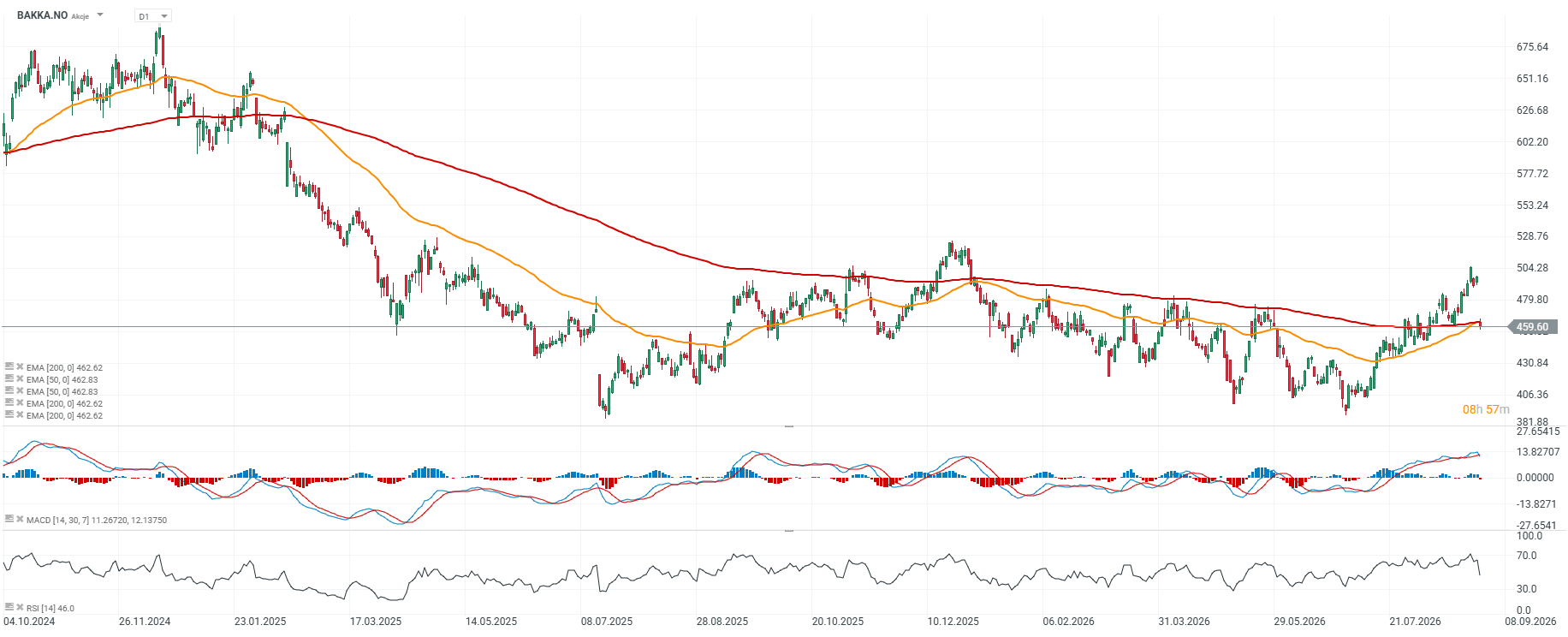
Bakkafrost shares (BAKKA.NO)
In response to the report, Bakkafrost shares are down nearly 6%, as investors have become less confident in a rapid improvement in the quality of the company’s business. The stock has slipped below the 200-session EMA200, moving back into a downward trend. The key level for bulls will now be holding around NOK 460, which could open the way for a rebound toward NOK 500. On the other hand, more persistent weakness in the stock could lead to a decline toward the NOK 400 area, where previous price reactions can be seen.
 Source: xStation5


Daily summary: Geopolitics and debt continue to weigh on valuations


US OPEN: Market Cornered After Jackson Hole


PG&E shares plunge 18% 🚩 Panic hits U.S. utility stocks exposed to wildfire liabilities


STRABAG shares reached record highs earnings 📈 What did the infrastructure giant report?
The material on this page does not constitute as financial advice and does not take into account your level of understanding, investment objectives, financial situation or any other particular needs.
All the information provided, including opinions, market research, mathematical results and technical analyses published on the website or transmitted to you by other means is provided for information purposes only and should in no event be interpreted as an offer of, or solicitation for, a transaction in any financial instrument, nor should the information provided be construed as advice of legal or fiscal nature.
Any investment decisions you make shall be based exclusively on your level of understanding, investment objectives, financial situation or any other particular needs. Any decision to act on information published on the website or transmitted to you by other means is entirely at your own risk. You are solely responsible for such decisions.
If you are in doubt or are not sure that you understand a particular product, instrument, service, or transaction, you should seek professional or legal advice before trading.
Investing in OTC Derivatives carries a high degree of risk, as they are leveraged based products and often small movements in the market could lead to much larger movements in the value of your investment and this could work against you or for you. Please ensure that you fully understand the risks involved, taking into account your investments objectives and level of experience, before trading, and if necessary, seek independent advice.
