



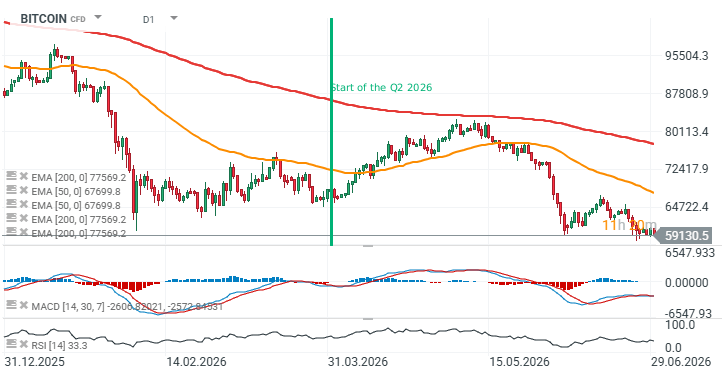
Bitcoin had a disastrous start to the year and an equally weak second quarter, during which the rally toward $81,000 completely faded. As a result, the cryptocurrency plunged to its lowest levels of 2026, while spot demand remains subdued, profit-taking continues to dominate, and derivatives positioning points to persistent caution among investors.
Key developments
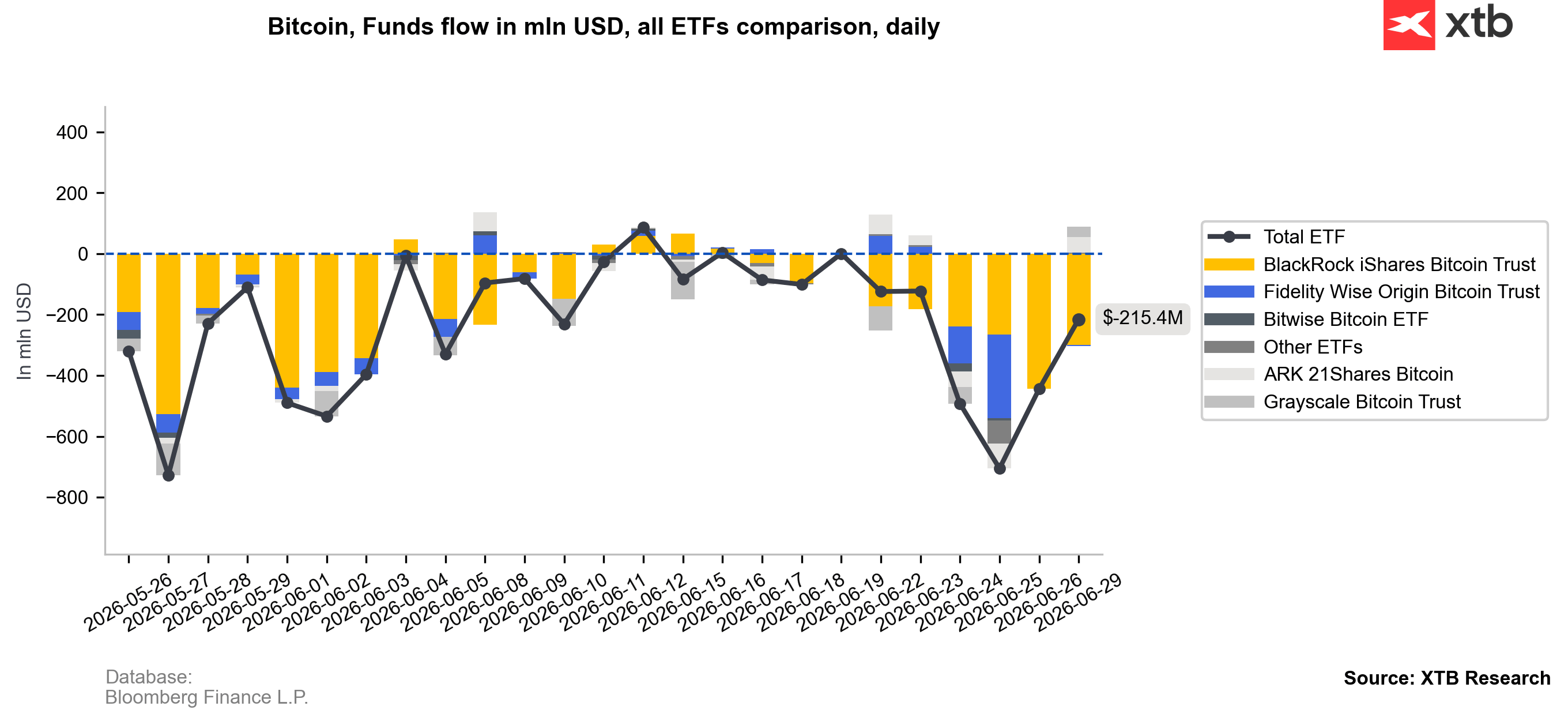
- In June, Bitcoin fell below $60,000 for the first time since 2024. The main drag has been persistent outflows from U.S. spot Bitcoin ETFs, which totaled an estimated $4.5–6 billion during the final weeks of the first half of the year.
- The weakness began early. In January, Bitcoin and Ethereum ETFs recorded nearly $1 billion in outflows in a single day, setting a negative tone for the year. Despite a strong rebound in March, when ETFs attracted $1.32 billion of inflows, spot Bitcoin ETFs still finished the first quarter with roughly $500 million in net outflows.
- Selling pressure intensified again in May and June. A six-day streak of more than $1.5 billion in ETF outflows reduced net inflows for 2026 to just around $536 million. At the same time, the ETF market became increasingly concentrated around BlackRock and Fidelity, which had previously attracted most of the inflows but also turned into net sellers in recent weeks.
- In June, Strategy sold a small portion of its Bitcoin holdings for the first time since 2022, weighing on sentiment surrounding the world's largest corporate Bitcoin holder.
- The decline in Bitcoin prices also hit the mining industry. For some miners, production costs exceeded the market price of Bitcoin, while the network's hashrate fell by around 5.8% at the beginning of 2026, highlighting mounting pressure across the mining sector.
- The narrative of Bitcoin as a hedge against U.S. dollar weakness lost momentum as markets priced in a more hawkish Federal Reserve, higher interest rates, and a rotation of capital away from cryptocurrencies toward AI and semiconductor stocks, as well as the highly anticipated SpaceX IPO.
- On the regulatory front, investors are still waiting for a breakthrough. Progress on the Clarity Act in the United States remains slow, limiting institutional appetite despite continued expansion of cryptocurrency services by major financial firms.
Bitcoin chart (D1 timeframe)
Source: xStation5
Source: XTB Research, Bloomberg Finance L.P.
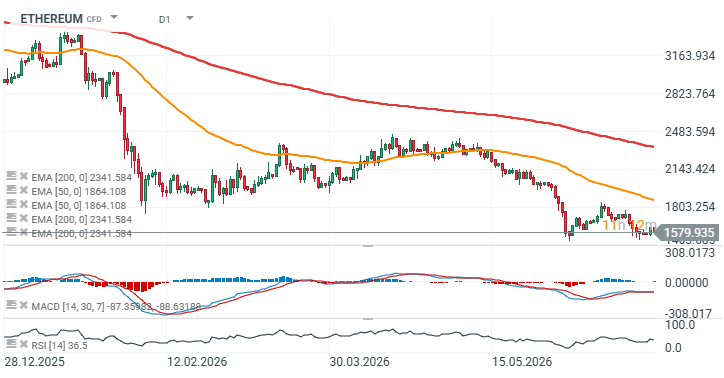
- Ethereum significantly underperformed Bitcoin during the first half of 2026, as investors favored Bitcoin ETFs while demand for ETH remained considerably weaker.
- Spot Ethereum ETFs continued to attract only modest institutional interest, with inflows remaining well below those seen in Bitcoin products despite periods of improving market sentiment.
- Ethereum staking reached another record high, with more than one-third of the total ETH supply locked in staking, reducing the amount of freely circulating coins.
- Layer-2 networks continued gaining traction, processing an increasing share of Ethereum transactions and helping lower fees on the main network.
- Decentralized finance (DeFi) activity remained resilient, although total value locked (TVL) stayed below previous cycle highs as investors remained cautious.
- Stablecoin usage on Ethereum continued to expand, reinforcing the network's position as the leading settlement layer for tokenized dollar transactions.
- Ethereum developers continued work on the Pectra upgrade, one of the network's most important upcoming protocol improvements, aimed at enhancing scalability, validator efficiency, and user experience.
- Despite improving on-chain fundamentals, ETH remained under pressure as higher U.S. interest rates and strong performance of AI-related equities continued to divert capital away from the broader cryptocurrency market.
Ethereum charts (D1 timeframe)
Source: xStation5



US Diesel Export Ban: Is It a problem for Europe?



Norges Bank raises intrest rates

Chart of the Day: OIL Returns to Gains 🔼 U.S.–Iran Talks Remain Deadlocked (24.09.2026)



Morning Wrap: Equity indices fall as bond yields surge 🚩 Mixed data from Australia (24.09.2026)
The material on this page does not constitute as financial advice and does not take into account your level of understanding, investment objectives, financial situation or any other particular needs.
All the information provided, including opinions, market research, mathematical results and technical analyses published on the website or transmitted to you by other means is provided for information purposes only and should in no event be interpreted as an offer of, or solicitation for, a transaction in any financial instrument, nor should the information provided be construed as advice of legal or fiscal nature.
Any investment decisions you make shall be based exclusively on your level of understanding, investment objectives, financial situation or any other particular needs. Any decision to act on information published on the website or transmitted to you by other means is entirely at your own risk. You are solely responsible for such decisions.
If you are in doubt or are not sure that you understand a particular product, instrument, service, or transaction, you should seek professional or legal advice before trading.
Investing in OTC Derivatives carries a high degree of risk, as they are leveraged based products and often small movements in the market could lead to much larger movements in the value of your investment and this could work against you or for you. Please ensure that you fully understand the risks involved, taking into account your investments objectives and level of experience, before trading, and if necessary, seek independent advice.