



The Australian dollar is sliding today against all G10 currencies in response to lower-than-expected CPI inflation data in Australia (AUD/USD, AUD/NZD: -0.3%). Both the latest reading for June and the full Q2 report came in below 4%, delivering the Reserve Bank of Australia (RBA) the first fruits of months of aggressive interest rate hikes.
Technical Analysis: AUDUSD (D1)
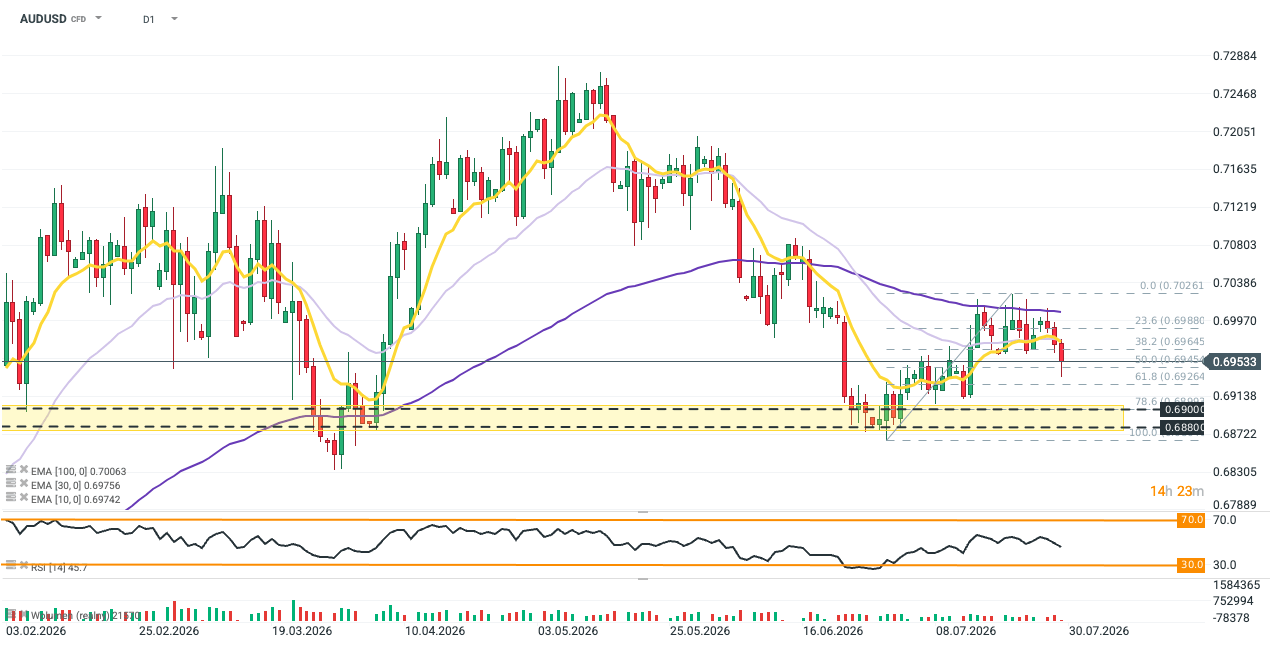
AUDUSD is testing key levels amidst intensifying selling pressure. Defending the 50.0% and 61.8% Fibonacci retracements is essential to prevent a deeper decline toward the 0.6900 area. A move below the yellow buffer zone (0.68800–0.69000) would signal a decisive return of the downtrend, potentially exacerbated by further disinflation in Australia. The RSI remains near the neutral 50 level, leaving room for further bearish pressure.
The only hope for the bulls remains a very dovish signal from the Fed and a return above the 100-day EMA (dark purple). However, this scenario seems unlikely given the strong US labor market (stable unemployment, record-low jobless claims), rising PMI readings, and Warsh's uncompromising stance on above-target inflation.
Source: xStation5
What is driving the AUDUSD decline today?
-
Inflation drops below 4%: Australia's annual CPI inflation rate fell to 3.8% YoY in June from 4.0% in May, dropping 0.1% month-on-month. In the second quarter, inflation slowed to 0.6% QoQ (4.0% YoY) compared to 1.4% QoQ in Q1. Crucially for the RBA, trimmed mean inflation came in at 3.6% YoY (0.8% QoQ), falling below the central bank's forecast (3.8%).
-
Cheaper fuel saves the reading: The main dampening factor was a nearly 11% drop in fuel prices in June, translating into disinflation in transport and goods. On the other hand, the housing sector weighed heavily (+6.8% YoY), where new home construction costs jumped 5.8% YoY due to higher material and labor costs. Furthermore, services inflation accelerated to 4.0% YoY, pointing to ongoing domestic price pressures in the economy.
-
Market wipes out rate hike expectations: The swap-market-implied probability of an August rate hike in Australia dropped to zero. In fact, expectations fell across all time horizons. Interest rates in Australia are currently the highest among all G10 economies (4.35%). The last rate hike occurred in May, while subsequent months brought dovish signals from the RBA governor, who indicated that the current rate level is a good place to take a breather.
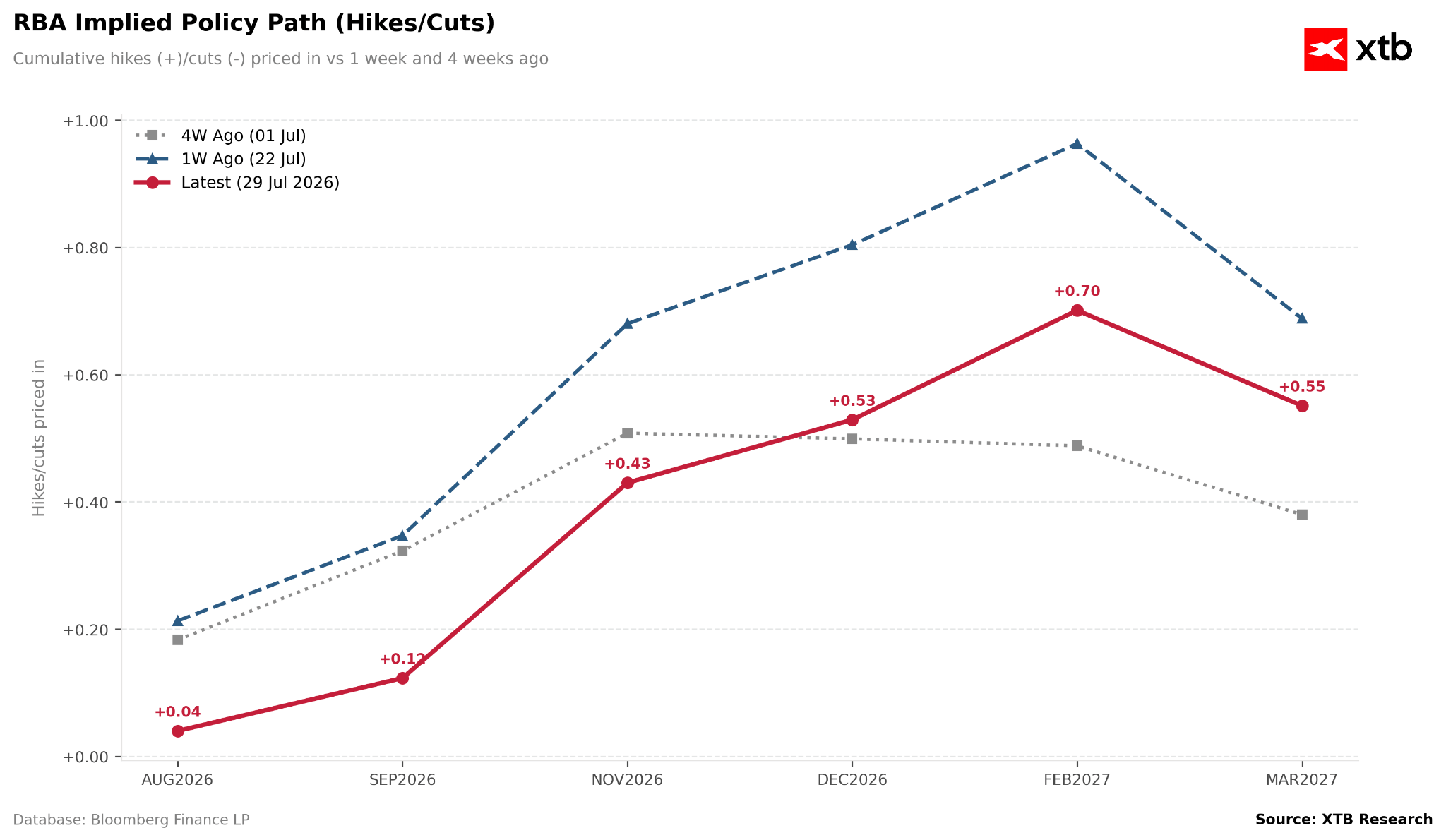
The market no longer pricing in a full interest rate hike in Australia until March 2027. Pricing from last week indicated a move in February with near certainty (blue line), whereas currently, we are approaching the flat curve from a month ago, which signaled a pause alongside hopes at the time for an end to the Middle East conflict. Source: XTB Research.



Daily Summary: Bitcoin Excites Investors Despite the Fed's Hawkish Shift🏛️


What could halt the uptrend❓


BREAKING: US industrial production & manufacturing data lower than expected



Market warp: Rate Forecasts and Semiconductors in the Spotlight
The material on this page does not constitute as financial advice and does not take into account your level of understanding, investment objectives, financial situation or any other particular needs.
All the information provided, including opinions, market research, mathematical results and technical analyses published on the website or transmitted to you by other means is provided for information purposes only and should in no event be interpreted as an offer of, or solicitation for, a transaction in any financial instrument, nor should the information provided be construed as advice of legal or fiscal nature.
Any investment decisions you make shall be based exclusively on your level of understanding, investment objectives, financial situation or any other particular needs. Any decision to act on information published on the website or transmitted to you by other means is entirely at your own risk. You are solely responsible for such decisions.
If you are in doubt or are not sure that you understand a particular product, instrument, service, or transaction, you should seek professional or legal advice before trading.
Investing in OTC Derivatives carries a high degree of risk, as they are leveraged based products and often small movements in the market could lead to much larger movements in the value of your investment and this could work against you or for you. Please ensure that you fully understand the risks involved, taking into account your investments objectives and level of experience, before trading, and if necessary, seek independent advice.