


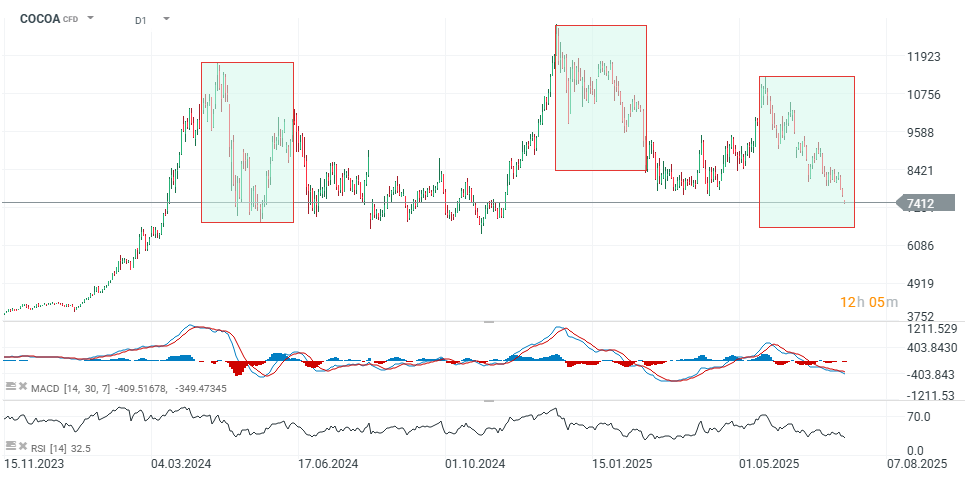
Thursday morning brings a sharp downturn in cocoa prices — ICE cocoa futures (COCOA) are down more than 3%, falling back to price levels last seen in autumn 2024. While prices remain historically elevated, market sentiment is cooling as signs of weakening demand, particularly across Europe, begin to weigh heavily. Alarming data from the European cocoa processing sector suggest a prolonged phase of demand destruction amid persistently high raw material costs.
Cocoa market highlights
-
European cocoa grindings dropped by 7.2% YoY in Q2 2025, continuing the downward trend that began in 2023 — the steepest decline in two decades. The quarter-over-quarter drop stood at 6.9%. Germany, Europe’s top cocoa processor, posted a 17% YoY plunge, with some firms like Hanseatisches Chocoladen Kontor exiting the market altogether.
-
Global cocoa output fell 12.9% in the 2023/24 season, mainly due to crop diseases, aging trees, and erratic weather in Côte d’Ivoire and Ghana — which together account for around 60% of global supply. These figures somewhat offset the negative impact of falling demand.
-
A production rebound of 7.8% is forecast for 2024/25, but high prices and ongoing logistical constraints continue to suppress demand. Cocoa hit a record of $12,000/tonne in early 2025, currently trading around $9,000, with futures pricing in levels near $7,300 — still far above historical averages.
-
The price spread between cocoa butter and cocoa powder is widening rapidly, with butter prices rising 25% faster than powder. This is squeezing margins for premium chocolate manufacturers and raising the risk of substitution (vegetable oils, alternative fats).
-
Energy costs have surged by 40% since 2020, further compressing profit margins across European processors — a trend reflected in the declining performance of companies like Barry Callebaut.
-
Cocoa inventories at ICE-monitored ports are rising, signaling easing supply-side stress. The balance between supply and demand has improved significantly, nearly eliminating fears of a severe cocoa shortage despite continued crop diseases and weather volatility in West Africa.
COCOA (Daily Chart – D1)
On the daily timeframe, cocoa contracts have pulled back to levels last seen in Q4 2024. A potential bearish head-and-shoulders pattern is forming, with significant resistance around $11,200 and $12,500, and a neckline near $6,300/tonne. A confirmed breakdown below this neckline could open the door for a test of the $5,000/tonne area.
Source: xStation5



Three Markets to Watch Next Week: USDJPY, US500, OIL (01.05.2026)


Market Wrap – Data Confirms BoJ Intervention. Waiting for US ISM (05.01.2026)
Chart of the Day: Intervention on the Yen? Tokyo Challenges Speculators (01.05.2026)


Morning Wrap- Wall Street Records and Oil Stabilization (01.05.2026)
The material on this page does not constitute as financial advice and does not take into account your level of understanding, investment objectives, financial situation or any other particular needs.
All the information provided, including opinions, market research, mathematical results and technical analyses published on the website or transmitted to you by other means is provided for information purposes only and should in no event be interpreted as an offer of, or solicitation for, a transaction in any financial instrument, nor should the information provided be construed as advice of legal or fiscal nature.
Any investment decisions you make shall be based exclusively on your level of understanding, investment objectives, financial situation or any other particular needs. Any decision to act on information published on the website or transmitted to you by other means is entirely at your own risk. You are solely responsible for such decisions.
If you are in doubt or are not sure that you understand a particular product, instrument, service, or transaction, you should seek professional or legal advice before trading.
Investing in OTC Derivatives carries a high degree of risk, as they are leveraged based products and often small movements in the market could lead to much larger movements in the value of your investment and this could work against you or for you. Please ensure that you fully understand the risks involved, taking into account your investments objectives and level of experience, before trading, and if necessary, seek independent advice.
