


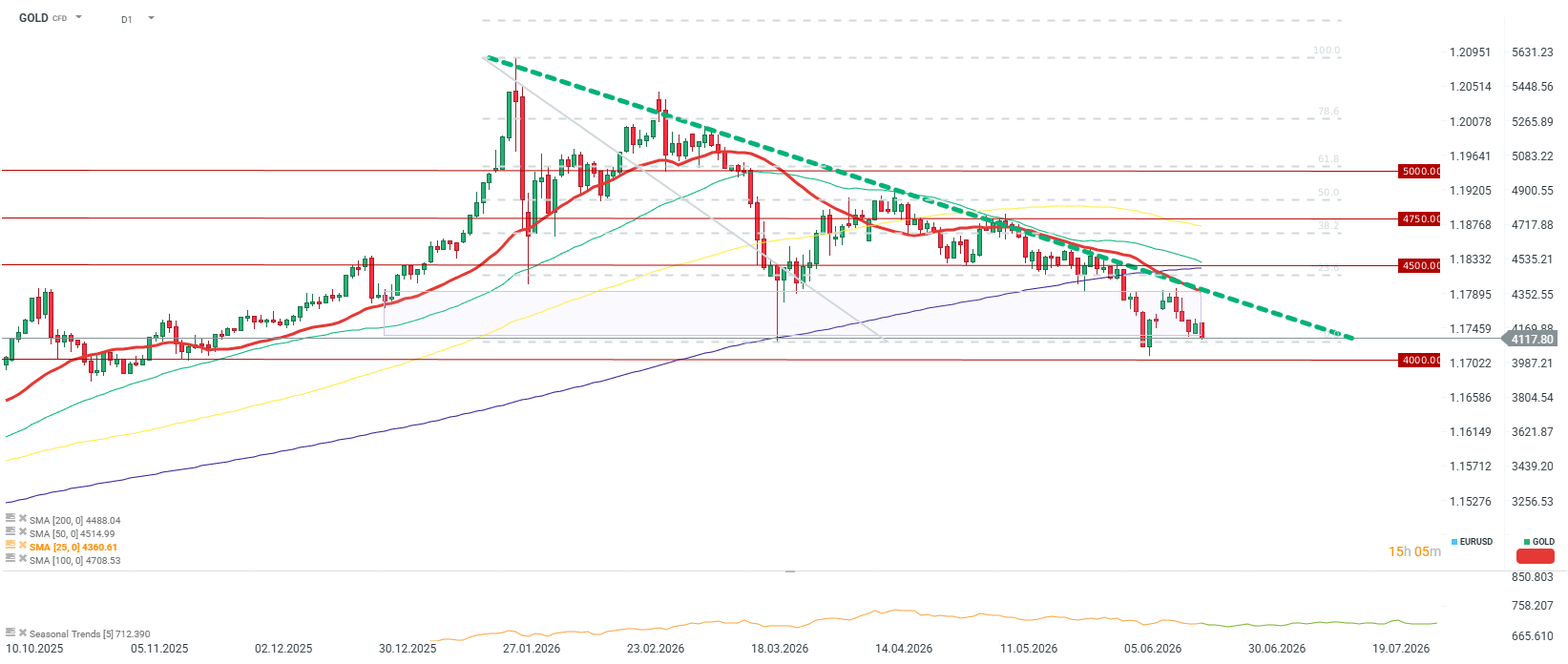
While market attention is often focused on large declines in index futures, primarily following the massive drop of SpaceX during yesterday's session, an equally dynamic sell-off is also taking place in the precious metals market. Gold is down 1.7% and is already close to $4,100 per ounce, while silver is down nearly 4% and is close to the $62 per ounce level.
Since reaching a record level around $5,600 at the end of January, gold has already lost about 5% since the beginning of the year, and in the current quarter alone, it has recorded a decline of almost 12%, wiping out all gains from this year. Concerns about persistent inflation have effectively overshadowed the temporary optimism associated with peace negotiations between the US and Iran, which have currently lowered the price of Brent crude oil below $78.
Inflationary pressure and the hawkish Fed
- Conflict in the Middle East: The conflict, which has been ongoing for almost four months, has caused an increase in consumer and energy prices, fueling concerns about inflation becoming entrenched.
- Prospect of higher rates: Rising prices increase the likelihood that central banks will decide to tighten monetary policy further. This is a direct inhibiting factor for gold, which, unlike bonds, does not pay interest.
- Hawkish tone of policymakers: The head of the Chicago Fed, Austan Goolsbee, expressed deep concern about inflation, which remains clearly above target and is heading in the wrong direction. The atmosphere is also being heated up by the new head of the Fed, Kevin Warsh, who adopted hawkish rhetoric and declared an absolute fight to restore price stability.
- Strong US dollar: Hawkish market expectations for interest rates, combined with resilient macro data from the US, have significantly strengthened the dollar. EURUSD fell to around 1.14
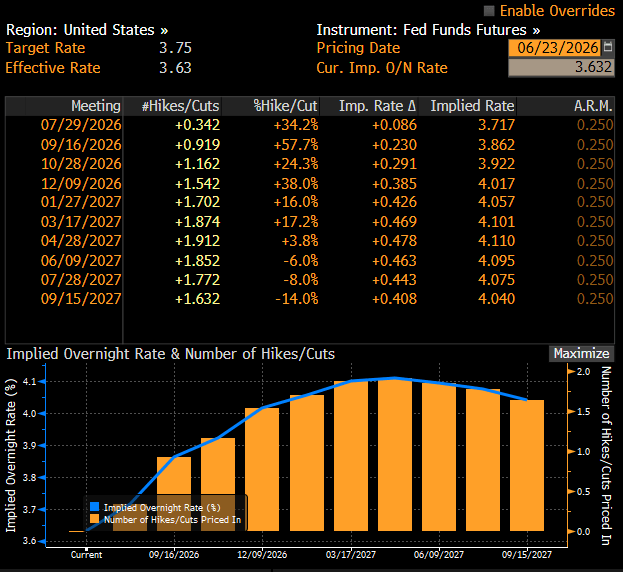 The market is pricing in a strong chance of a rate hike as early as September, although this will be difficult due to the upcoming midterm elections and the review of the entire Fed's operation, which is to be summarised by working groups appointed by Warsh at the end of this year. Source: Bloomberg Finance LP
Technical situation and capital outflow
- Below key moving averages: The technical picture of the market has clearly deteriorated. Gold prices have permanently slipped below four key moving averages: 25, 50, 100, and 200-session. The 25-period average, which coincides with the falling trend line, may currently constitute short-term resistance.
- Lack of fund support and imports: Traditional sources of investment demand remain inactive. Continuous capital outflows and sales of units by gold-backed ETFs are visible. At the same time, local prices in China are traded at a discount compared to the Comex exchange, which suggests that local imports will not support the market in the near future.
- The only strong pillar: The only stable element of the puzzle remains the high demand from central banks, which is forecast to continue for a longer time.
Drastic forecast cuts by financial institutions
In light of the change in expectations regarding interest rates in the US, key investment banks decided to drastically revise their models:
- Deutsche Bank lowered its gold price forecasts by more than 1/5. Analysts estimate the price in the third quarter at $4,300 and $4,800 in the fourth quarter. The bank warns that if the Fed implements a scenario of 3-4 subsequent rate hikes, gold could fall to as low as $3,800. However, the market is currently pricing in less than 2 hikes.
- Goldman Sachs cut its year-end forecast by $500, setting a new target of $4,900 per ounce. This change results from the assumption that the US central bank will not make a single rate cut this year.



Daily Summary: Bitcoin Excites Investors Despite the Fed's Hawkish Shift🏛️


What could halt the uptrend❓

BREAKING: US industrial production & manufacturing data lower than expected


Cocoa falls as African harvests rise and ICE inventories approach a two-year high
The material on this page does not constitute as financial advice and does not take into account your level of understanding, investment objectives, financial situation or any other particular needs.
All the information provided, including opinions, market research, mathematical results and technical analyses published on the website or transmitted to you by other means is provided for information purposes only and should in no event be interpreted as an offer of, or solicitation for, a transaction in any financial instrument, nor should the information provided be construed as advice of legal or fiscal nature.
Any investment decisions you make shall be based exclusively on your level of understanding, investment objectives, financial situation or any other particular needs. Any decision to act on information published on the website or transmitted to you by other means is entirely at your own risk. You are solely responsible for such decisions.
If you are in doubt or are not sure that you understand a particular product, instrument, service, or transaction, you should seek professional or legal advice before trading.
Investing in OTC Derivatives carries a high degree of risk, as they are leveraged based products and often small movements in the market could lead to much larger movements in the value of your investment and this could work against you or for you. Please ensure that you fully understand the risks involved, taking into account your investments objectives and level of experience, before trading, and if necessary, seek independent advice.