


USDJPY remains at the center of global currency market attention, with its price action increasingly driven not only by macroeconomic fundamentals but also by rising political risk. As the exchange rate approaches the psychological barrier at 160, the market is beginning to view this level as a potential tolerance threshold for Japanese authorities rather than just another point on the chart. As a result, the discussion around the next directional move is becoming less purely fundamental and increasingly focused on whether and when a response from Japan’s Ministry of Finance could materialize.
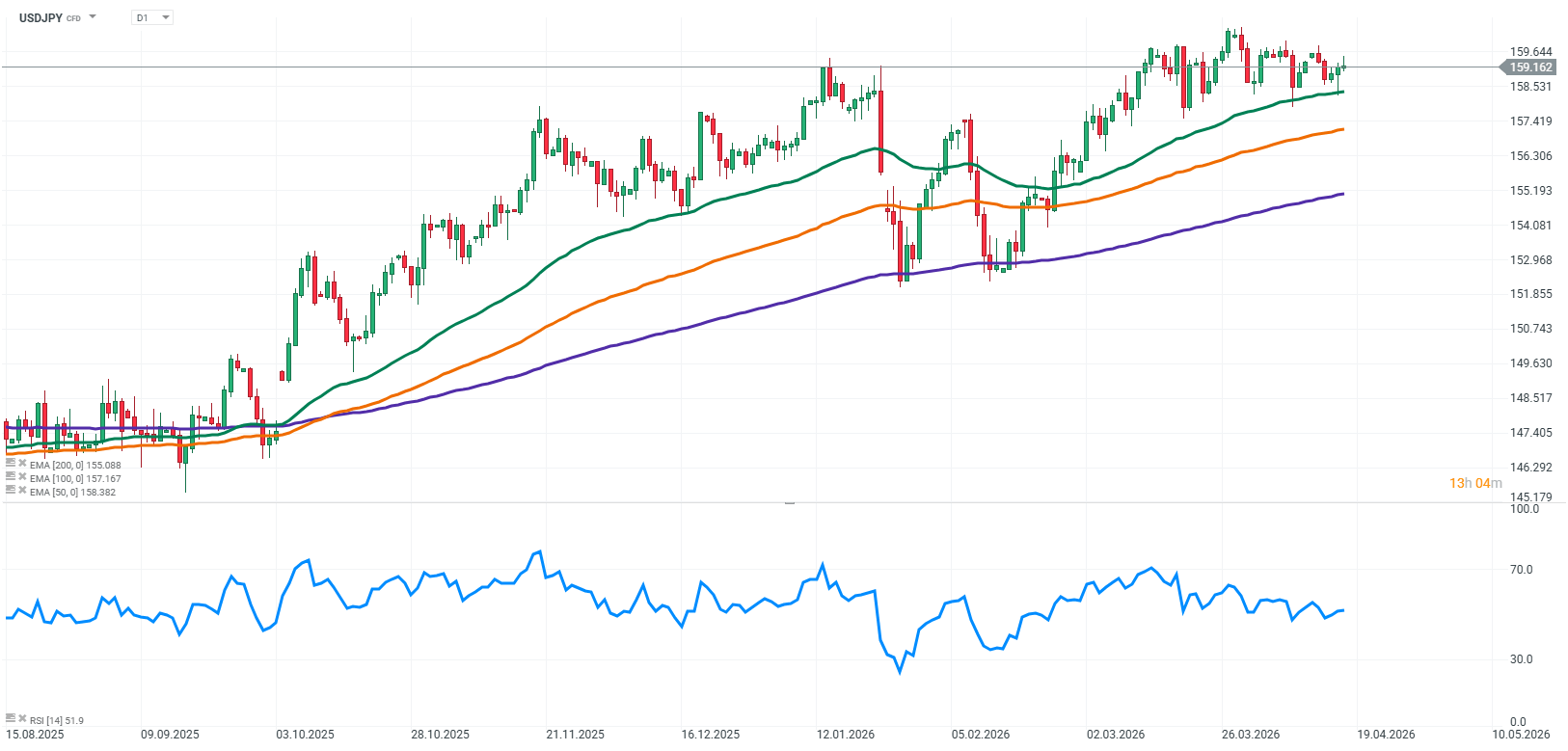
Source: xStation5
What Is Driving USDJPY today?
Rising Intervention Risk Around the 160 Area
As USDJPY moves closer to the 160 zone, sensitivity to potential currency intervention is clearly increasing. This level is widely seen as a boundary where Japanese authorities may step in, either through direct market operations or via strong verbal warnings. Historical experience suggests that such environments can trigger sharp and asymmetric market reactions, as speculative positions built on yen weakness become vulnerable to rapid unwinding once intervention signals emerge.
Bank of Japan Between Inflation Pressures and Growth Risks
At the same time, the Bank of Japan remains a key piece of the puzzle. On one hand, persistent inflation supports the case for gradual policy normalization. On the other hand, growing concerns about slowing economic momentum and emerging stagflation-like risks continue to weigh on the policy outlook. As a result, the BoJ remains cautious and avoids committing to aggressive tightening, which limits yen strength and sustains uncertainty about the future path of monetary policy.
Interest Rate Differentials as the Core Trend Driver
Despite rising volatility around key levels, the primary structural driver remains the wide interest rate differential between the United States and Japan. This gap continues to support US dollar strength and keeps carry trade strategies attractive. However, market participants are increasingly aware that such an environment can persist for an extended period without being stable, especially as USDJPY approaches levels perceived as potentially sensitive to intervention risk.
The Role of Oil and the Gulf Region for Japan
An often underestimated factor in the broader USDJPY picture is the oil market and Japan’s dependence on energy imports from the Gulf region. As a highly import-dependent economy, Japan is particularly sensitive to fluctuations in oil prices, with higher energy costs directly worsening its terms of trade and adding inflationary pressure domestically. In this context, developments in the Middle East and OPEC production policy can have a meaningful impact not only on Japan’s external balance but also on expectations regarding Bank of Japan policy.
Rising oil prices from the Gulf region act as an additional inflationary force for Japan. In such an environment, the FX market increasingly incorporates not only interest rate differentials but also external cost shocks that may influence the pace of monetary policy normalization and the broader outlook for the yen.
Key Takeways: A Market Defined by Boundaries and Event Risk
Overall, USDJPY is in a phase where traditional fundamental drivers still support higher levels, but their influence is increasingly counterbalanced by political risk and the possibility of intervention. As a result, the market is becoming less of a directional trend story and more of a range-bound, event-driven regime where asymmetry of risk and sudden volatility shifts play a dominant role.



Rallies in European airline valuations



US OPEN: The Strait of Hormuz is fully open 💥Euphoria in the markets 🚀


⬇️WTI Oil declines nearly 9%

OIL dips below $90 first time in a month🛢️ 📉 Iran will hand uranium to the US❓
The material on this page does not constitute as financial advice and does not take into account your level of understanding, investment objectives, financial situation or any other particular needs.
All the information provided, including opinions, market research, mathematical results and technical analyses published on the website or transmitted to you by other means is provided for information purposes only and should in no event be interpreted as an offer of, or solicitation for, a transaction in any financial instrument, nor should the information provided be construed as advice of legal or fiscal nature.
Any investment decisions you make shall be based exclusively on your level of understanding, investment objectives, financial situation or any other particular needs. Any decision to act on information published on the website or transmitted to you by other means is entirely at your own risk. You are solely responsible for such decisions.
If you are in doubt or are not sure that you understand a particular product, instrument, service, or transaction, you should seek professional or legal advice before trading.
Investing in OTC Derivatives carries a high degree of risk, as they are leveraged based products and often small movements in the market could lead to much larger movements in the value of your investment and this could work against you or for you. Please ensure that you fully understand the risks involved, taking into account your investments objectives and level of experience, before trading, and if necessary, seek independent advice.
