


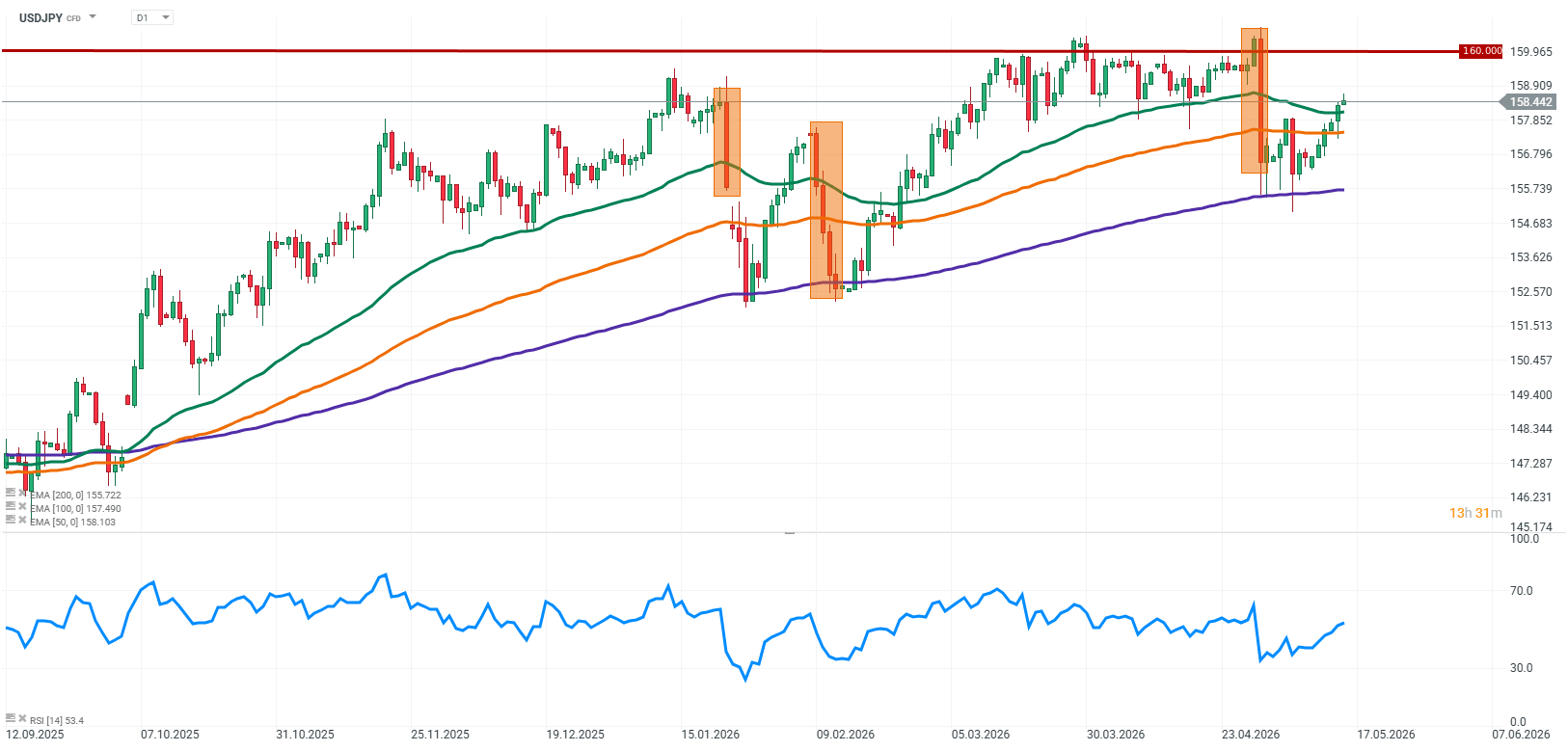
USDJPY today resembles a fight between two boxers, where one is desperately trying not to be pushed into the corner but is running out of strength and ideas, while successive blows coming from macroeconomics and geopolitics only make his situation worse. In this exchange, it becomes increasingly clear that this is no longer a fight for dominance, but a struggle for survival under the rhythm imposed by a stronger opponent, who is gradually taking control of the pace and space in the market.
Source: xStation5
Geopolitics and Energy
The key backdrop to current moves remains tensions around the Strait of Hormuz. Escalating geopolitical risk is pushing up oil prices and, more broadly, all energy commodities, directly hitting importing economies. Japan is in a particularly difficult position as it remains heavily dependent on imported energy resources. Rising energy costs are immediately feeding through into inflationary pressure across the entire production chain, increasing economic stress.
Inflation and the Surprise in Data
The latest producer inflation figures showed a clear acceleration. The PPI rose to 4.9% y/y versus 2.6% previously, significantly beating market expectations. This is not just a statistical deviation, but a signal that cost pressures in Japan are building faster than anticipated. Importantly, inflation is largely imported, meaning its source lies outside domestic policy and is strongly tied to global conditions.
Bank of Japan Under Pressure
Rising inflation is starting to materially reshape the narrative around the Bank of Japan. The market is increasingly pricing in the possibility of a rate hike as early as June, while some economists suggest this may not be a one-off move but the beginning of a broader normalization cycle. This marks a significant shift compared to years of ultra-loose monetary policy that defined Japan’s markets for decades. Inflationary pressure is putting the BOJ in a position where inaction could increasingly be seen as a policy mistake.
Interest Rate Differential and Dollar Strength
Despite rising expectations for policy tightening in Japan, the yen remains structurally weak. The key driver is the massive interest rate differential between Japan and the United States. The Federal Reserve System continues to maintain a relatively high interest rate environment, supporting the dollar and keeping carry trade strategies attractive. In practice, this means capital still has a strong incentive to stay positioned against the yen, limiting its ability to stage a sustained recovery despite shifting BOJ expectations.
Intervention Risk and Market Reaction
Another factor in play is speculation around potential currency intervention by Japanese authorities. Such actions can trigger sharp but typically short-lived yen strength. However, the market remains skeptical about their long-term effectiveness without a corresponding shift in monetary policy. As a result, interventions tend to act more as temporary disruptions in the trend rather than true reversals.
Market Picture
As a result, USDJPY is currently positioned at the intersection of three forces. On one side, the interest rate differential continues to support the dollar. On another, rising expectations of a more hawkish Bank of Japan are supporting the yen. Completing the picture is geopolitics, which through energy prices is fueling inflation and forcing continuous repricing of scenarios.
In the short term, the most likely environment remains elevated volatility, with the market reacting primarily to inflation data and Bank of Japan communications while searching for balance between these three competing forces.



Daily summary: Wall Street climbs higher as oil falls 📈 SpaceX surges 28%


Oil slides 2.5% to $88 as Middle East tensions ease 📉 Is the uptrend over?



Wall Street Rebounds as Oil Prices Fall 📈 Adobe Shares Drop 8% After Earnings


BREAKING: USDIDX decline despite strong University of Michigan data
The material on this page does not constitute as financial advice and does not take into account your level of understanding, investment objectives, financial situation or any other particular needs.
All the information provided, including opinions, market research, mathematical results and technical analyses published on the website or transmitted to you by other means is provided for information purposes only and should in no event be interpreted as an offer of, or solicitation for, a transaction in any financial instrument, nor should the information provided be construed as advice of legal or fiscal nature.
Any investment decisions you make shall be based exclusively on your level of understanding, investment objectives, financial situation or any other particular needs. Any decision to act on information published on the website or transmitted to you by other means is entirely at your own risk. You are solely responsible for such decisions.
If you are in doubt or are not sure that you understand a particular product, instrument, service, or transaction, you should seek professional or legal advice before trading.
Investing in OTC Derivatives carries a high degree of risk, as they are leveraged based products and often small movements in the market could lead to much larger movements in the value of your investment and this could work against you or for you. Please ensure that you fully understand the risks involved, taking into account your investments objectives and level of experience, before trading, and if necessary, seek independent advice.
