



China is once again sending markets a signal that it intends to accelerate the construction of its own technological ecosystem. In recent weeks, Beijing has surprised global markets with a series of developments related to artificial intelligence and semiconductors. First came reports about the advancement of domestically developed AI chips. Then global attention turned to Moonshot AI’s Kimi K3 model, which, according to available information, was said to offer capabilities comparable to some of the most advanced solutions developed by Western leaders such as OpenAI and Anthropic.
Now China is taking another, far more fundamental step. According to media reports, Beijing has begun producing domestic DUV lithography machines, equipment used in semiconductor manufacturing. This is precisely one of the areas that has remained one of the biggest limitations for China’s chip industry for years.
If these reports are confirmed, it would become one of the most significant developments in China’s technology sector, as it would represent an attempt to reduce dependence on foreign suppliers not only for semiconductor chips themselves but also for the equipment required to manufacture them.
The news was quickly reflected in financial markets. Shares of ASML, the world’s largest manufacturer of lithography machines, came under pressure as investors began reassessing the long term risks associated with the development of Chinese alternatives to Western technologies.
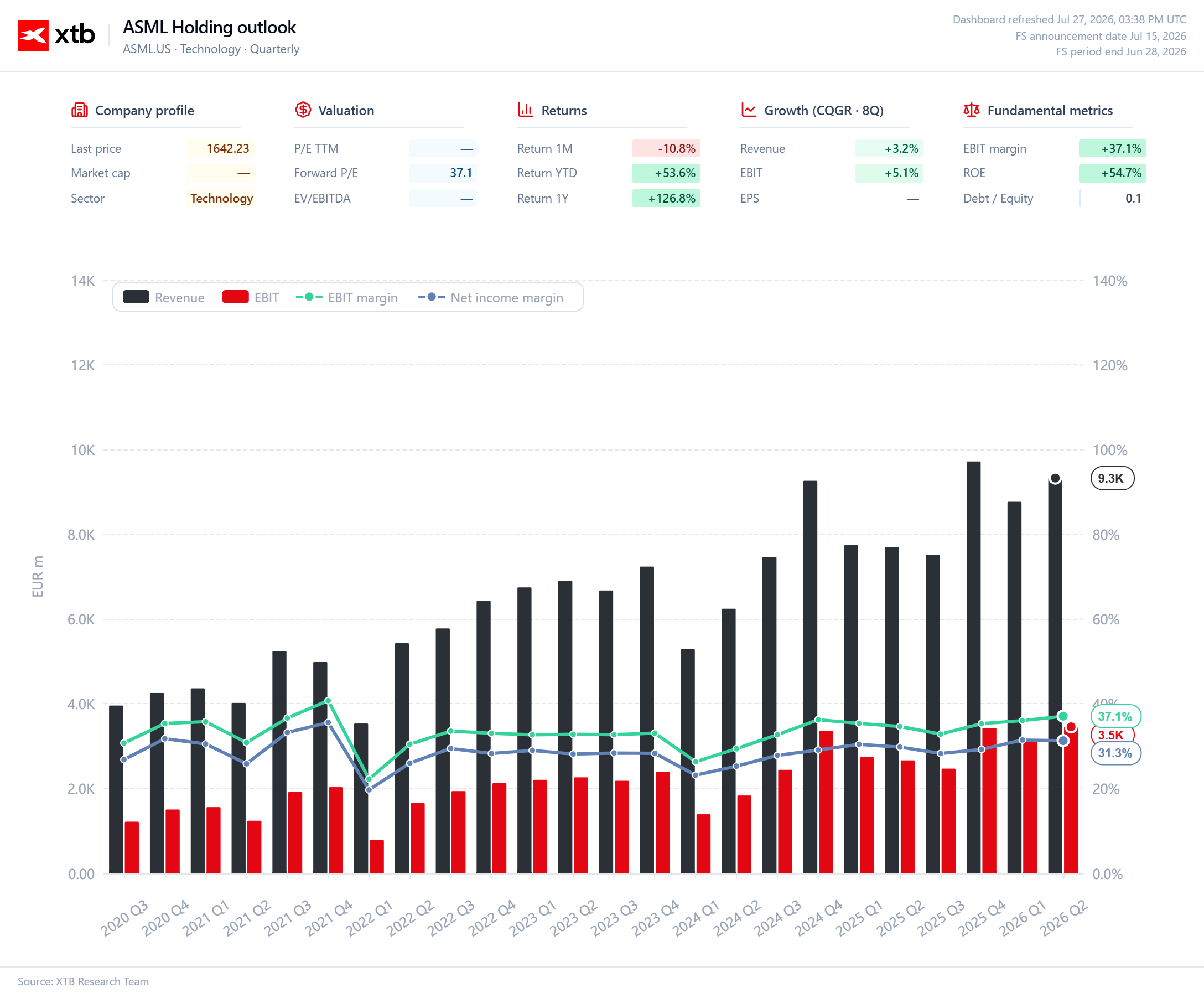
Source: XTB Research
However, this does not mean that ASML’s position has suddenly been threatened. The Dutch company still maintains an enormous technological advantage, particularly in the field of the most advanced EUV machines, which are essential for producing the world’s most sophisticated chips. Nevertheless, the market reaction shows that investors are paying increasingly close attention to how quickly China is attempting to reduce its dependence on foreign suppliers.
Lithography machines are among the most complex industrial systems in the world. They make it possible to imprint extremely precise patterns onto silicon wafers, which are then used to create modern processors. For decades, this market has been dominated by only a handful of companies, with ASML achieving a unique position whose technologies have become one of the foundations of the global semiconductor industry.
Access to these technologies has also become one of the key elements of the rivalry between the United States and China. Export restrictions were designed to slow Beijing’s development of the most advanced chips, but the outcome has been more complicated. Instead of halting China’s technological ambitions, they accelerated investment in domestic solutions.
China has begun building its own supply chain covering not only chip design but also semiconductor manufacturing and the equipment used in chip factories.
In this context, the development of domestic DUV machines is highly significant. It is not merely about creating a single piece of equipment, but about acquiring capabilities that for decades have been concentrated mainly in the hands of Western companies.
Of course, this does not mean that China has reached the level of global technology leaders. The most advanced EUV machines remain beyond the reach of Chinese industry, and ASML’s advantage in this area remains substantial. Developing a truly competitive technology would require many more years of progress.
However, Beijing does not necessarily need to achieve complete technological superiority immediately. Its goal is to build a sufficiently advanced ecosystem that will allow it to reduce dependence on foreign suppliers and protect its domestic industry from future restrictions.
This approach has also been visible in the field of artificial intelligence. The success of DeepSeek, followed by the development of Moonshot AI and the Kimi K3 model, sent markets a signal that Chinese companies are capable of creating solutions that are far more competitive than previously expected.
Until recently, Western technological superiority was viewed as a deep moat that China would need many years to overcome. Recent developments suggest, however, that the gap may be significantly smaller than previously assumed.
This does not mean, of course, that China has already caught up with the United States and its allies. Western companies still maintain enormous advantages in key areas. Nvidia remains the leader in the market for the most advanced AI chips, TSMC controls the production of the world’s most sophisticated semiconductors, and ASML retains its unique position in cutting edge lithography.
However, the very nature of the competition is changing. China is demonstrating that it is willing to invest enormous resources into developing its own technologies and gradually reducing its dependence on foreign suppliers.
For the global semiconductor market, this could mark the beginning of a more fragmented technological world. For years, the chip industry operated as one interconnected global ecosystem, with different countries specialising in specific parts of the supply chain. The United States focused on chip design, Taiwan on manufacturing the most advanced semiconductors, and Europe on critical technologies related to lithography equipment.
Now China is attempting to build its own version of this system.
The greatest significance of beginning domestic DUV machine production therefore does not lie solely in the technology itself, but in the fact that Beijing is attempting to take control of another crucial part of the semiconductor supply chain.
For ASML, this does not mean the immediate end of its dominance. Chinese technologies still have a long way to go before they can realistically compete with the most advanced systems. However, for investors, it is an important signal that the structure of the global semiconductor market may gradually begin to change.
The technology war between the United States and China is no longer only about who can create the best chip or the most advanced artificial intelligence model. It is about controlling the entire infrastructure that makes these technologies possible.
The start of domestic DUV machine production shows that Beijing does not want to remain merely a customer of Western technology. China is attempting to become one of its producers.
And that is precisely why this development could become one of the most important events for the entire semiconductor market.
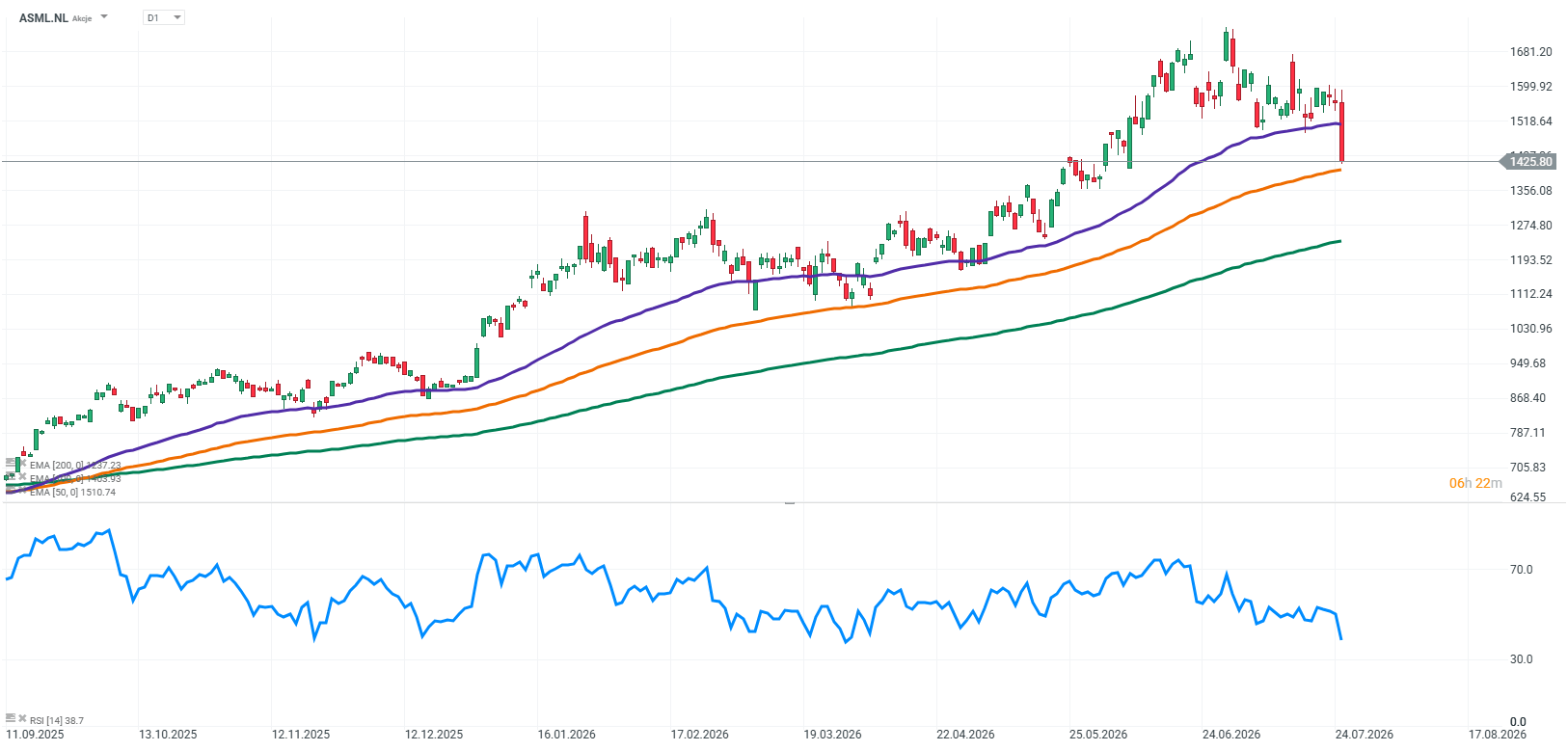
Source: xStation5



Daily Summary: Bitcoin Excites Investors Despite the Fed's Hawkish Shift🏛️



What could halt the uptrend❓


Russia is taking over Nestlé's domestic assets 🍫 Shares are down nearly 3% 💥


BREAKING: US industrial production & manufacturing data lower than expected
The material on this page does not constitute as financial advice and does not take into account your level of understanding, investment objectives, financial situation or any other particular needs.
All the information provided, including opinions, market research, mathematical results and technical analyses published on the website or transmitted to you by other means is provided for information purposes only and should in no event be interpreted as an offer of, or solicitation for, a transaction in any financial instrument, nor should the information provided be construed as advice of legal or fiscal nature.
Any investment decisions you make shall be based exclusively on your level of understanding, investment objectives, financial situation or any other particular needs. Any decision to act on information published on the website or transmitted to you by other means is entirely at your own risk. You are solely responsible for such decisions.
If you are in doubt or are not sure that you understand a particular product, instrument, service, or transaction, you should seek professional or legal advice before trading.
Investing in OTC Derivatives carries a high degree of risk, as they are leveraged based products and often small movements in the market could lead to much larger movements in the value of your investment and this could work against you or for you. Please ensure that you fully understand the risks involved, taking into account your investments objectives and level of experience, before trading, and if necessary, seek independent advice.