

Despite Jensen Huang’s determined efforts, including traveling to China alongside Donald Trump to negotiate easing restrictions on the export of American AI chips, it increasingly appears the mission ended in failure. Huang seemingly failed to secure any concessions, while Beijing is now sending one of its clearest signals in months. China’s technology sector is expected to rely more heavily on domestic solutions rather than American semiconductors.
According to the latest media reports, Chinese authorities have added Nvidia’s RTX 5090D V2 gaming GPU to a list of banned products. At first glance, this may appear to target only the gaming market, but the implications run far deeper. The chip was not only used by gamers, but also by certain AI engineers and companies developing artificial intelligence systems. The card provided access to Nvidia’s Blackwell architecture and was viewed by part of the market as a workaround to U.S. export restrictions.
This is where the biggest irony of the entire situation emerges. Washington has spent months trying to limit China’s access to the world’s most advanced AI chips, while Nvidia attempted to find a compromise by creating specially downgraded versions of its products exclusively for the Chinese market. The issue, however, is that even these restricted chips proved powerful enough to support AI development in China. Now Beijing appears ready to respond with its own measures, officially limiting Chinese companies’ access to Nvidia’s latest hardware while simultaneously promoting domestic alternatives from local manufacturers.
The timing of the decision is also highly symbolic. Reports about the RTX 5090D V2 being added to the banned list surfaced during the visit of Donald Trump and Jensen Huang to China. It is difficult not to interpret this as both a political statement and a demonstration of strength from Beijing. China is signaling that it no longer intends to depend on American technology suppliers and is prepared to accelerate the development of its own AI ecosystem.
For Nvidia, the issue is highly significant, as China has long been one of the company’s most important sources of demand for advanced AI hardware. If Beijing truly begins administratively restricting Nvidia chips while prioritizing domestic solutions, it could eventually lead to a permanent loss of part of the Chinese market for the American giant.
That is precisely why the market will be watching Nvidia’s quarterly earnings today even more closely than usual. Expectations remain enormous, the company’s valuation is extremely demanding, and investors have spent months pricing in a near-perfect growth scenario. The problem is that at Nvidia’s current scale, even the smallest crack in the narrative of unlimited AI demand could be quickly noticed by the market.
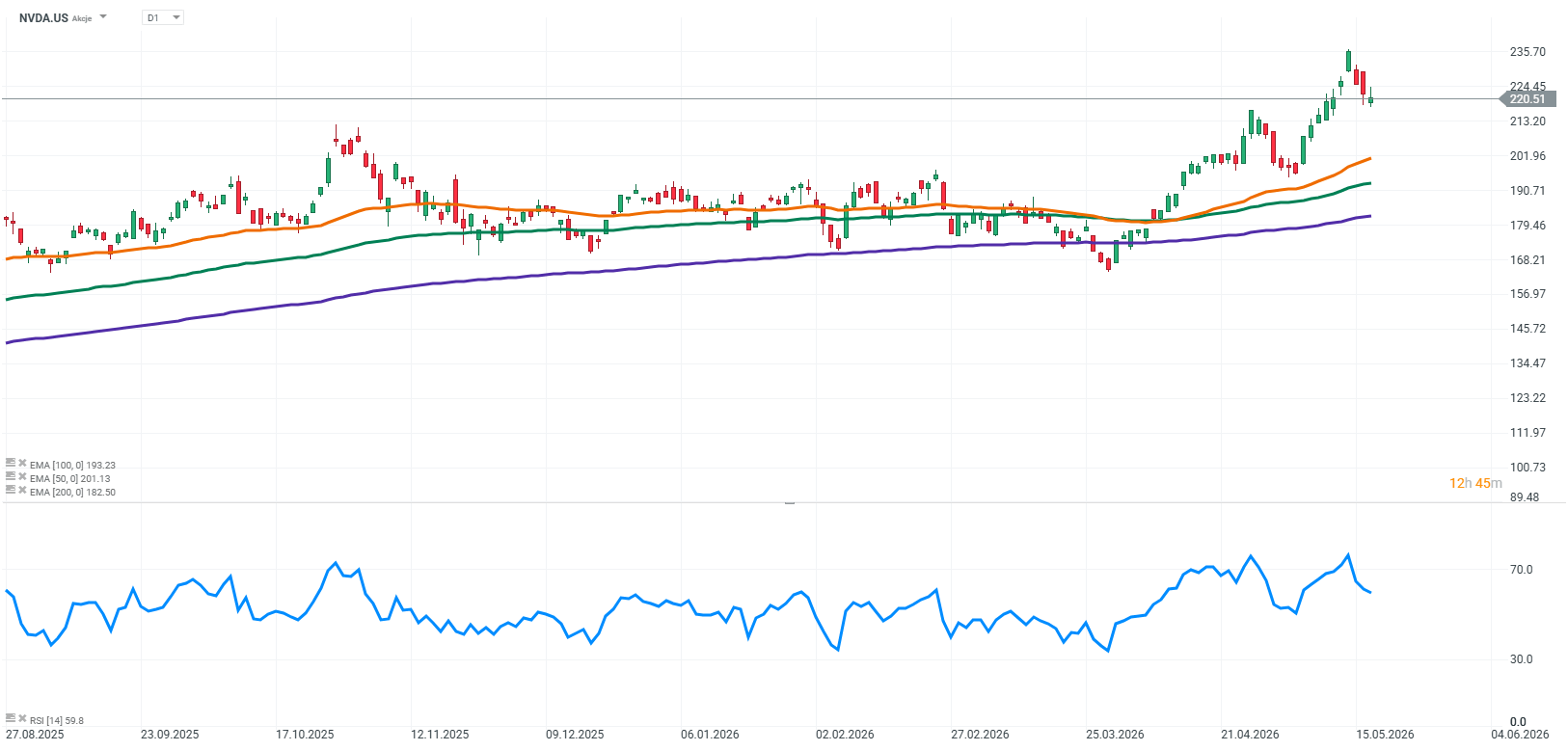
Source: xStation5



Market Wrap: The “Bulls” Are Back on the European Trading Floor 💥


Apple shares fall amid WWDC conference 📉 No AI breakthrough?



The World Cup on the Market: Is There an Opportunity for Profit?

Intel gains 10% after talks with Google and Nvidia
The material on this page does not constitute as financial advice and does not take into account your level of understanding, investment objectives, financial situation or any other particular needs.
All the information provided, including opinions, market research, mathematical results and technical analyses published on the website or transmitted to you by other means is provided for information purposes only and should in no event be interpreted as an offer of, or solicitation for, a transaction in any financial instrument, nor should the information provided be construed as advice of legal or fiscal nature.
Any investment decisions you make shall be based exclusively on your level of understanding, investment objectives, financial situation or any other particular needs. Any decision to act on information published on the website or transmitted to you by other means is entirely at your own risk. You are solely responsible for such decisions.
If you are in doubt or are not sure that you understand a particular product, instrument, service, or transaction, you should seek professional or legal advice before trading.
Investing in OTC Derivatives carries a high degree of risk, as they are leveraged based products and often small movements in the market could lead to much larger movements in the value of your investment and this could work against you or for you. Please ensure that you fully understand the risks involved, taking into account your investments objectives and level of experience, before trading, and if necessary, seek independent advice.
