


After a weak session at the end of last week, ICE coffee futures (COFFEE) have begun an upward move, climbing to the highest levels in a week. The 50% tariff on Brazilian imports, announced by former President Trump, will include coffee and is set to take effect on August 6, 2025. This is the primary catalyst behind the sharp rebound following recent declines. Additional support comes from adverse weather conditions in Brazil’s key coffee-growing region, Minas Gerais
- On Friday, August 1, Arabica futures in New York dropped by nearly 4.5%, mainly due to the near-completion of Brazil’s coffee harvest—90% of the total crop had already been collected. Markets rebounded strongly on Monday, driven by the tariff news and the expansion of Brazilian coffee exports to China.
- China's decision to open its market may serve as compensation for Brazil and could act as a long-term bullish catalyst. Should U.S. demand weaken, it might be offset by increased exports to Asia. Notably, China has authorized 183 Brazilian companies to export coffee to the country over the next five years.
- This move significantly expands Brazil’s access to one of the fastest-growing (but still nascent) coffee markets globally. China's per capita consumption currently stands at just 16 cups per year, compared to the global average of 240 cups.
- Weather developments also remain a non-negligible factor. Last week, Minas Gerais received only 31% of normal rainfall, and late July saw severe hailstorms that affected approximately 1,500 hectares of coffee plantations. While this represents just 0.2% of the region’s total acreage, it has nonetheless added stress to an already tight global supply chain.
If the U.S. tariffs are implemented, American roasters may be forced to seek alternative sources—Colombia, Africa, or Asia. The problem? Limited inventories and constrained supply. According to analysts at Pine Agronegócios, without a viable substitute for the 7–8 million bags of Brazilian coffee imported annually by the U.S., the mainstream coffee blend market could face serious disruption. Moreover, the tight spread between September and December contracts on the ICE suggests growing interest in immediate delivery. Some speculate that a portion of Europe’s ICE-certified stocks may eventually be redirected to the U.S. market.
Coffee Price Chart (H1, D1)
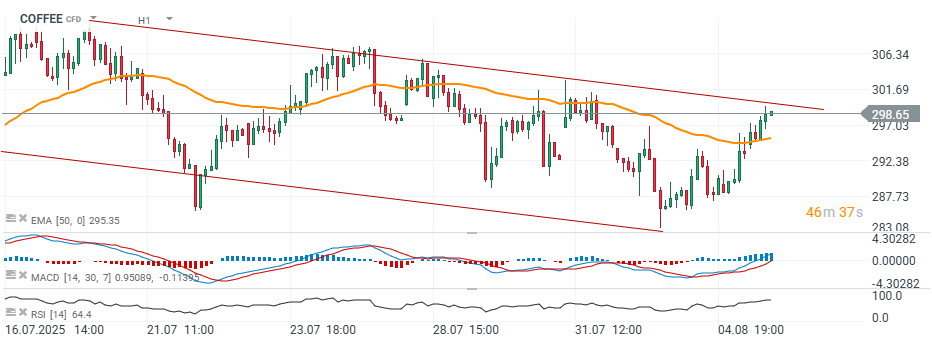
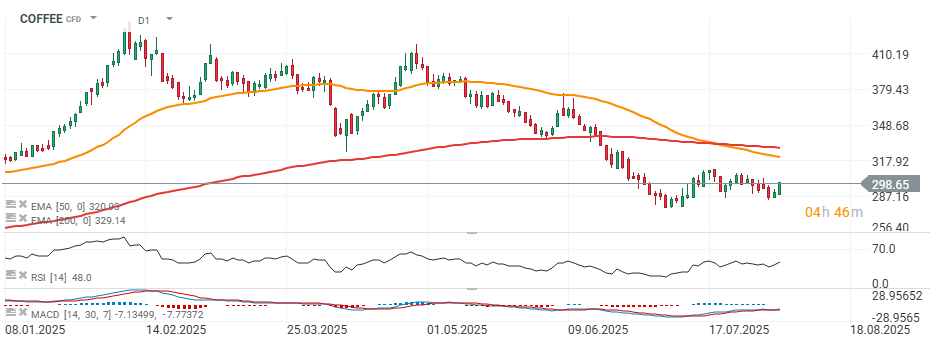
Source: xStation5



Three Markets to Watch Next Week: USDJPY, US500, OIL (01.05.2026)


Market Wrap – Data Confirms BoJ Intervention. Waiting for US ISM (05.01.2026)

Chart of the Day: Intervention on the Yen? Tokyo Challenges Speculators (01.05.2026)


Morning Wrap- Wall Street Records and Oil Stabilization (01.05.2026)
The material on this page does not constitute as financial advice and does not take into account your level of understanding, investment objectives, financial situation or any other particular needs.
All the information provided, including opinions, market research, mathematical results and technical analyses published on the website or transmitted to you by other means is provided for information purposes only and should in no event be interpreted as an offer of, or solicitation for, a transaction in any financial instrument, nor should the information provided be construed as advice of legal or fiscal nature.
Any investment decisions you make shall be based exclusively on your level of understanding, investment objectives, financial situation or any other particular needs. Any decision to act on information published on the website or transmitted to you by other means is entirely at your own risk. You are solely responsible for such decisions.
If you are in doubt or are not sure that you understand a particular product, instrument, service, or transaction, you should seek professional or legal advice before trading.
Investing in OTC Derivatives carries a high degree of risk, as they are leveraged based products and often small movements in the market could lead to much larger movements in the value of your investment and this could work against you or for you. Please ensure that you fully understand the risks involved, taking into account your investments objectives and level of experience, before trading, and if necessary, seek independent advice.
