



Brent crude futures (OIL) are sliding around 3%, diving below the psychological $90-per-barrel mark to the $87–$88 range. WTI crude (OIL.WTI) is also retreating, falling 3.4% to $82. A third consecutive session of losses was triggered by reports that the US is likely to rely on sanctions rather than further military action to pressure Iran.
US Announces Sanctions: What We Know So Far
The latest twist in the Middle East conflict was the end of a 60-day negotiation window, which concluded with Trump announcing plans for an "Economic D-Day" against Iran. In a social media post, the US President threatened any nation whose entities support Iran in any way, promising total isolation for the country. But how will this look in practice?
Key Announcements from the US Department of the Treasury:
-
Direct Sanctions on Entities and Vessels: US Treasury Secretary Scott Bessent announced direct sanctions against over 70 Iran-related entities, individuals, and vessels. The list includes 26 mainland China and Hong Kong-based entities and individuals, alongside measures targeting Iran's banking sector (including Bank Melli) and the wind-down of existing sanctions exemptions.
-
Targeting Five Core Sectors: The new sanctions package focuses on five key economic pillars for Tehran: shipping, aviation, digital assets, technology, and gold trading. Trump's directive mandates an immediate crackdown on oil smuggling, cash transfers, exchange houses, front companies, ship registries, and swap lines.
-
Secondary Sanctions: Washington warned foreign governments that permitting local companies, airports, or financial institutions to support Iran will trigger US retaliatory sanctions. Strict timelines have reportedly been set to sever ties, and Bessent additionally threatened to sanction a key financial institution by the end of the week over its relations with Iran.
Sanctions Discount Escalation Risk... and Matter Little for Now
On one hand, sanctions might seem like another phase of an endless war; however, for markets, they significantly discount the scale of geopolitical risk and Washington's overall strategy creates room for further downside in oil. Why?
First, Washington adopting a shift in tone lowers the probability of a further military escalation.
Second, China remains the primary buyer of Iranian oil, meaning that without a direct economic strike on Beijing, global crude flows should not face worse conditions than they currently do.
Third, the market views Washington’s new stance as more "talk than action." Without secondary sanctions on Iran's key partners, an economic D-Day is unlikely to disrupt the oil market significantly. Furthermore, the true scale of the sanctions will remain muted as the Trump administration leans on "quiet negotiations."
Fourth, the opposing side of the conflict is not sitting idly by. Iran threatened that the US and its allies should prepare for a counterattack rather than assume Iran will only defend itself. China raised a yellow flag, threatening to cut off access to pharmaceuticals and critical minerals/rare earths. Qatar called the sanctions unilateral. Pakistan is reportedly preparing another peace offer for the US, while American diplomats are said to be planning a return to the Middle East.
All of this lowers the pain threshold for the US, which is why the market sees the current situation as an opportunity for oil to pull back from its local highs.
Technical Analysis: OIL (D1)
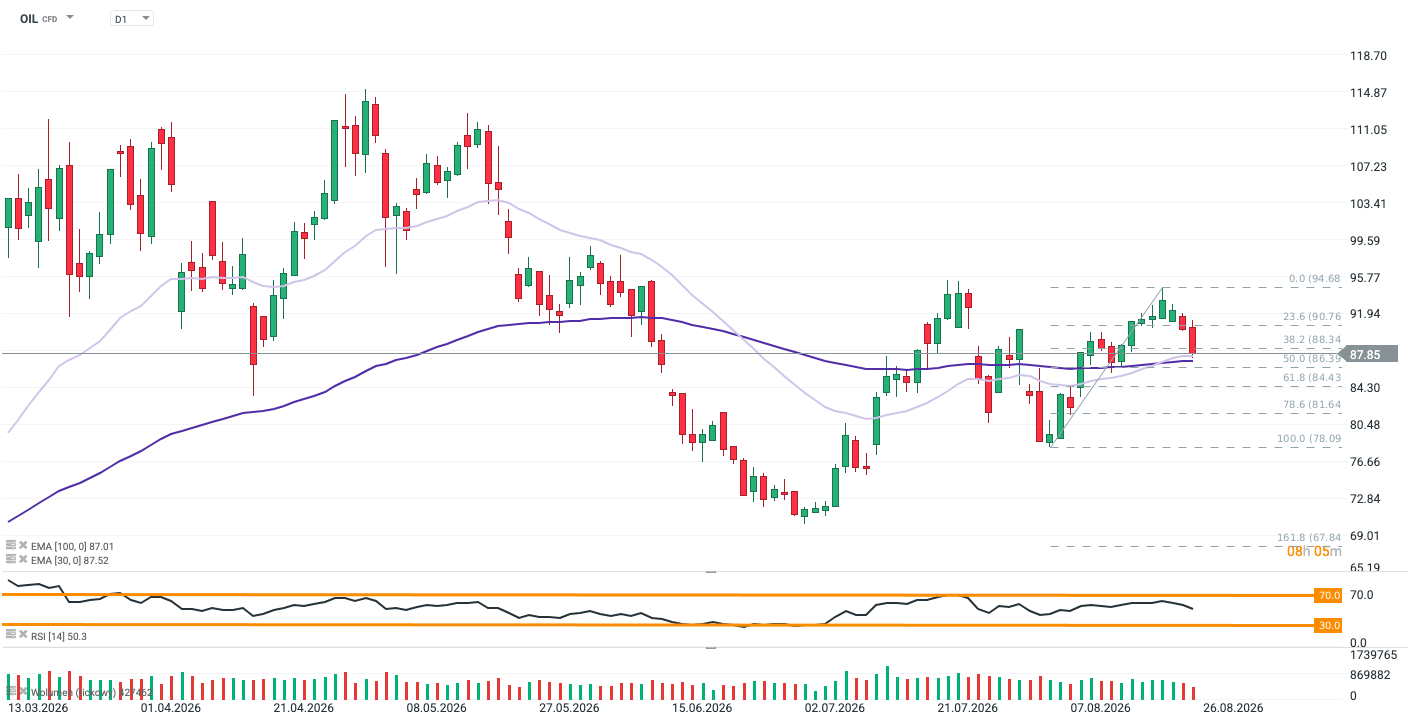
Brent crude futures (OIL) remain under clear selling pressure, currently testing a key support zone on the daily chart. Primary support for the price remains today's test of a confluence of two major exponential moving averages: the 30-day EMA ($87.52) and 100-day EMA ($87.01), reinforced near $86.40 by the 50% Fibonacci retracement level. Meanwhile, the 14-day RSI sits at a neutral 50.3 points. The absence of oversold signals leaves ample room for bears to operate, opening the door for a deeper slide. A breakdown below this support would pave the way for a drop toward the 61.8% Fibo level ($84.43).
Source: xStation5



Daily Summary: A Shallow Rebound Ahead of Earnings Season



Market Wrap: A 4% surge in oil prices weighs on indices (08.10.2026)


Market Wrap: Oil rises again, French fiscal concerns weigh on euro (07.10.2026)

Oil falls below $100🚨
The material on this page does not constitute as financial advice and does not take into account your level of understanding, investment objectives, financial situation or any other particular needs.
All the information provided, including opinions, market research, mathematical results and technical analyses published on the website or transmitted to you by other means is provided for information purposes only and should in no event be interpreted as an offer of, or solicitation for, a transaction in any financial instrument, nor should the information provided be construed as advice of legal or fiscal nature.
Any investment decisions you make shall be based exclusively on your level of understanding, investment objectives, financial situation or any other particular needs. Any decision to act on information published on the website or transmitted to you by other means is entirely at your own risk. You are solely responsible for such decisions.
If you are in doubt or are not sure that you understand a particular product, instrument, service, or transaction, you should seek professional or legal advice before trading.
Investing in OTC Derivatives carries a high degree of risk, as they are leveraged based products and often small movements in the market could lead to much larger movements in the value of your investment and this could work against you or for you. Please ensure that you fully understand the risks involved, taking into account your investments objectives and level of experience, before trading, and if necessary, seek independent advice.