


Crude oil prices have posted a strong two-day rally after a recent series of declines, driven by growing concerns over potential disruptions to Russian supply. WTI crude has risen by nearly 4% this week, recording some of its largest daily gains in weeks.
Escalating Threats to Russian Supply
The price increase is fueled by mounting threats to Russia's energy exports. Russia is reportedly considering another ban on diesel exports for certain companies following a series of Ukrainian drone attacks on Russian refineries. The latest overnight attacks on an oil pipeline caused a sharp increase in domestic gasoline and diesel prices on the Spimex commodity exchange. Interestingly, traders suggest that Russia's inability to process crude domestically could ultimately lead to an increase in its crude oil exports. However, some restrictions on crude production itself cannot be ruled out.
Key Importers of Russian Oil
Following Western sanctions, the geography of Russia's oil exports has dramatically shifted. The main importers of Russian crude are now:
-
China – 47%-50% of Russian exports (more than 2 million barrels per day)
-
India – 37%-38% of exports (approximately 1.9 million barrels per day)
-
Turkey – 6% of exports
-
European Union – 6-7% of exports (a significant drop from the 30% level before Russia’s invasion of Ukraine)
China became the largest importer of Russian oil in 2022, displacing Saudi Arabia from the top spot. India has significantly ramped up imports from a near-zero level at the beginning of 2022 and is now benefiting from preferential pricing, which allows it to act as a re-exporter of refined fuels. India exports these fuels to Europe and the United States, despite their Russian origin. India is the largest seaborne importer of Russian crude, currently accounting for approximately 60% of the market.
Russia remains a major player in the global oil market, producing over 10 million barrels per day and accounting for 10-11% of total global supply. At the same time, Russia exports approximately 5 million barrels of crude oil per day.
The Development of the "Shadow Fleet"
Russia has built an extensive "shadow fleet" consisting of hundreds of aging tankers to transport oil while circumventing Western sanctions. This fleet now constitutes around 17% of all oil tankers worldwide. The average age of these vessels is approximately 20 years, compared to 13 years for the overall global fleet.
The shadow fleet enables Russia to bypass the so-called "price cap" for its oil, which was previously set at $60 per barrel. However, since the beginning of September, a new, even more restrictive formula has been introduced, setting the price cap at the market price minus 15%. This means the current cap for Russian crude is approximately $48. In addition to price circumvention, the shadow fleet also helps conceal the oil's origin by transferring cargo between ships. The fleet frequently uses falsified insurance documents and GPS trackers as well.
Geopolitical Tensions and NATO's Response
Recent weeks have seen a significant increase in Russian military activity near NATO borders, including confirmed airspace violations involving drones and aircraft. In early September, over 20 drones breached Polish airspace, followed by a violation in Romania. Last week, three MiG-31 fighter jets flew over Estonia, while recent drone incidents have been noted over Norway and Denmark.
In response, NATO has launched Operation Eastern Sentry, which includes continuous fighter patrols, improved radar systems, and enhanced air defenses along its eastern borders.
President Trump has stated that NATO countries should "shoot down Russian planes that violate their airspace." He also reiterated calls for European allies to stop purchasing Russian energy, warning: "I can tell you, they have to stop all purchases of energy from Russia immediately. Otherwise, we're all wasting a lot of time." While Trump spoke favorably of Ukraine, there is no indication he would take the lead in implementing strong sanctions against Russia. Although the costs to Russia from export restrictions are already in the hundreds of billions of dollars, its earnings are much larger. This suggests that the current sanctions have not been fully effective against Russia. Nonetheless, if the United States were to take more aggressive action, it could ultimately lead to some limitations and force Russia to make concessions toward Ukraine.
Market Outlook
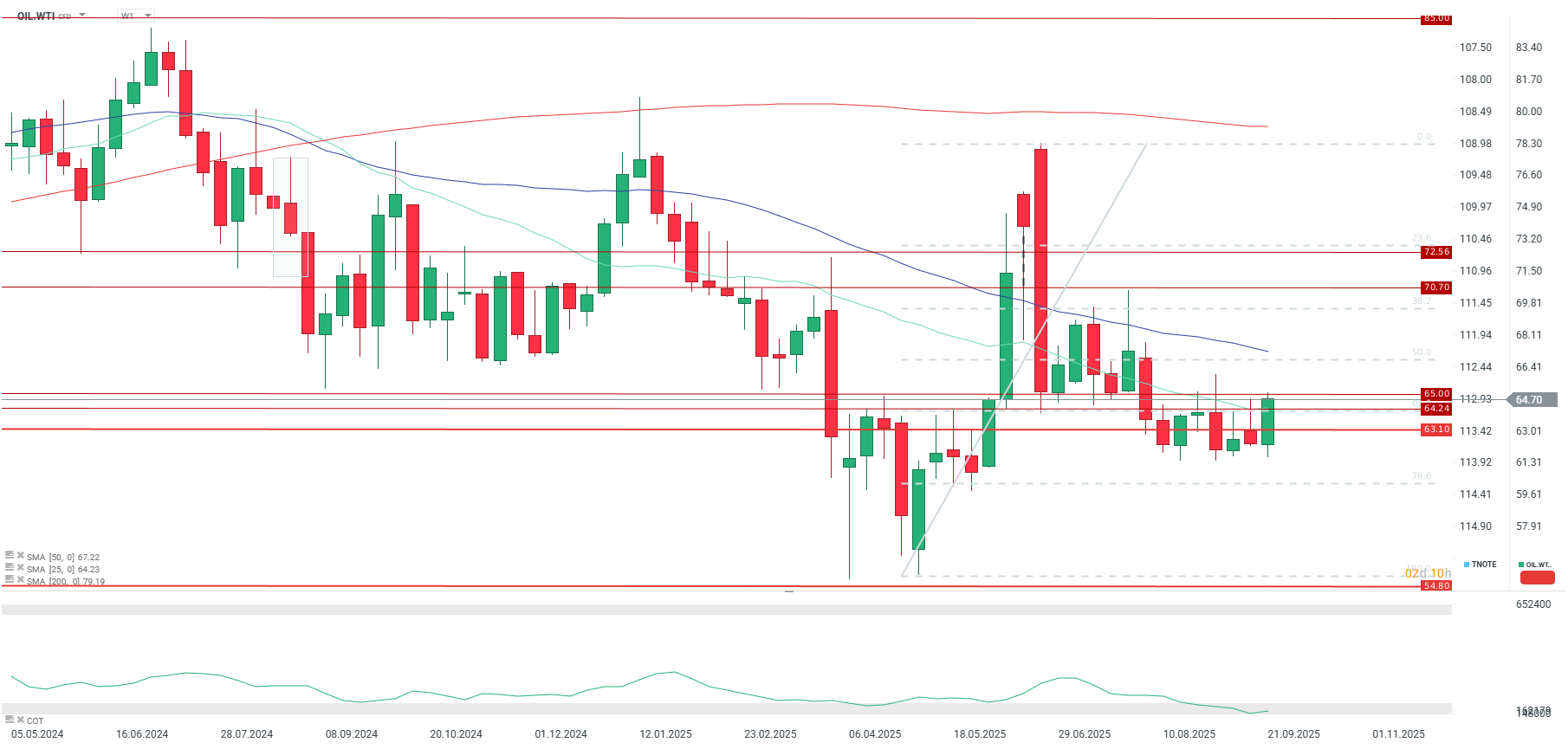
Crude oil is currently experiencing its largest price increase since the second week of June. The price of WTI crude has approached the $65 per barrel mark, its highest level since early September. While a supply threat from Russia does not seem realistic at this time, continued tensions could lead to further gains and a test of the $67 per barrel level. On the other hand, the fundamental situation points to a persistent supply overhang, which makes prices above $70-80 per barrel seem unjustified. However, were it not for the ongoing geopolitical risk, prices would likely have already fallen below $60 per barrel. The most probable scenario is for oil to remain in a sideways trend within the $61.50 to $66 per barrel range.


BREAKING: Eurozone economy slows down unexpectedly❗️EURUSD without direction 🇪🇺


Chart of the Day: Yen breaks beyond 160 as the market tests the limits of the “red line”



Morning Wrap: Record-breaking Big Tech results driven by AI, Fed delivers no surprises


Daily summary: Powell remains in Fed 🏦 Oil skyrockets 🛢️ 🚀
The material on this page does not constitute as financial advice and does not take into account your level of understanding, investment objectives, financial situation or any other particular needs.
All the information provided, including opinions, market research, mathematical results and technical analyses published on the website or transmitted to you by other means is provided for information purposes only and should in no event be interpreted as an offer of, or solicitation for, a transaction in any financial instrument, nor should the information provided be construed as advice of legal or fiscal nature.
Any investment decisions you make shall be based exclusively on your level of understanding, investment objectives, financial situation or any other particular needs. Any decision to act on information published on the website or transmitted to you by other means is entirely at your own risk. You are solely responsible for such decisions.
If you are in doubt or are not sure that you understand a particular product, instrument, service, or transaction, you should seek professional or legal advice before trading.
Investing in OTC Derivatives carries a high degree of risk, as they are leveraged based products and often small movements in the market could lead to much larger movements in the value of your investment and this could work against you or for you. Please ensure that you fully understand the risks involved, taking into account your investments objectives and level of experience, before trading, and if necessary, seek independent advice.
