



Following the July Fed meeting, which brought neither an interest rate hike nor greater clarity regarding the committee's future actions, market pricing for interest rate hikes has fallen significantly, leading to a decline in the dollar and gains in the stock market.
Investors seem increasingly doubtful that the new Fed chair's hawkish communications will be followed by concrete actions. Recall that almost exactly a year ago, Warsh openly sided with Trump, stating on FOX News that the President's frustration with Powell's monetary policy management was fully justified. He criticized the institution at the time for being too slow to cut interest rates and for being overly attached to backward-looking economic data.
As the Fed must ensure both price stability and maximum employment, signs of cooling in the US labour market could lead to a further dovish revision of the expected interest rate path in the US.
However, the NFP has tended to surprise to the upside in recent years – the headline reading (change in non-farm payrolls) has beaten expectations in 35 of the last 50 months.
So what to expect? Or rather...
...what do we already know about the US labour market?
Latest NFP reading
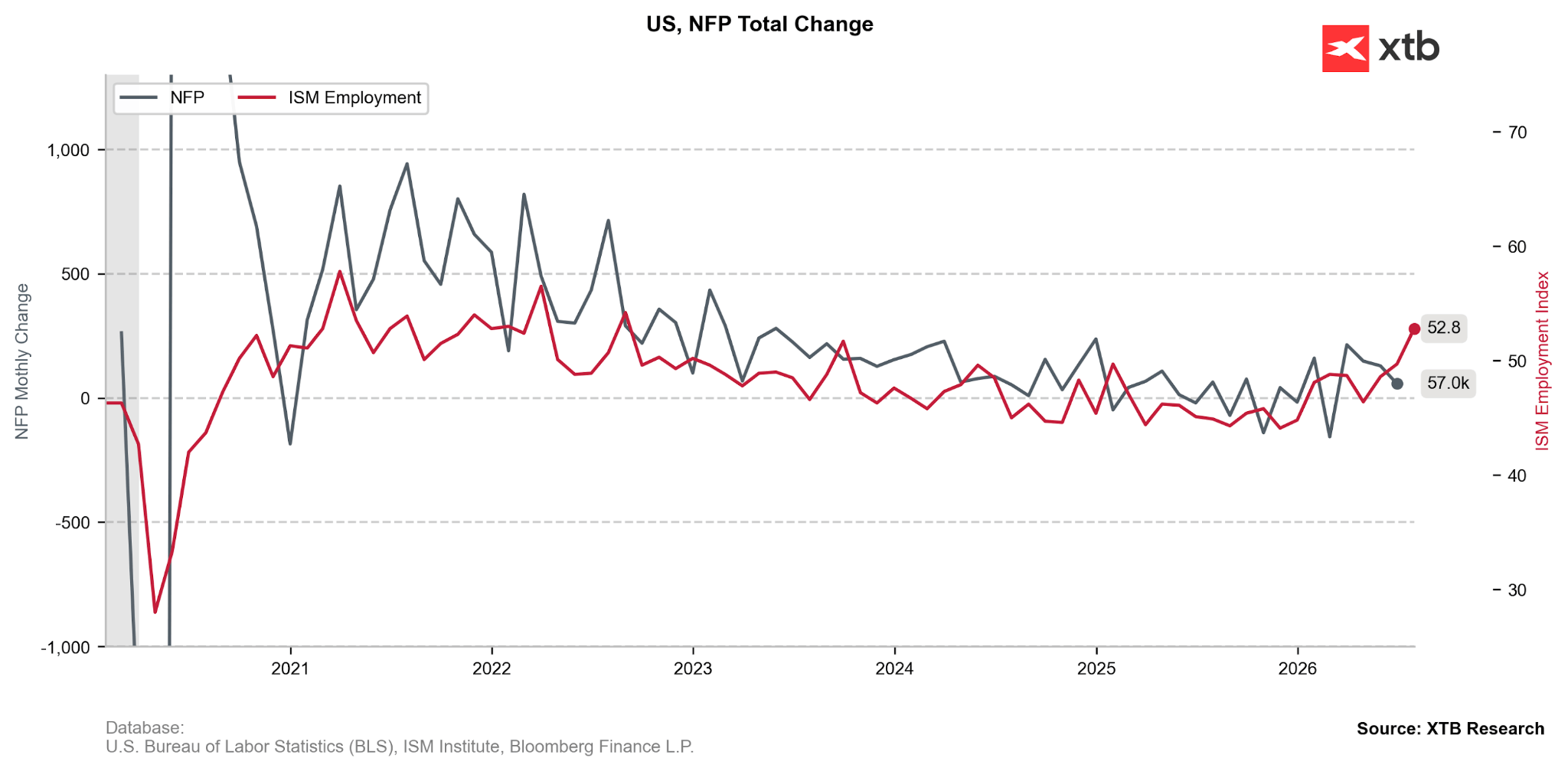
In June, the number of jobs in the US labour market increased by 49,000, significantly below the projected level (107,000). There was also a significant downward revision of the data for the last two months (-74,000).
However, the three-month average remained at a healthy level (+111,000) due to strong readings from April and May. In our opinion, the June decline does not necessarily signal a cooling of the US labour market.
Figure 1: NFP and ISM Employment PMI Component (2020-2026)
 Source: XTB Research, 07.08.2026
ADP
July data surprised to the downside once again. It showed the creation of just 44,000 new jobs, which, combined with the downward revision of the June reading (to 95,000), does not inspire excessive optimism.
- The divergence between the services sector (increase of 47,000 new jobs) and the industrial sector (decline of 3,000) is deepening.
- The education and healthcare sector remains a pillar of growth (+36,000), and finance (+10,000) and business services (+9,000) are also performing solidly.
- A clear slowdown is visible, however, in industries that previously drove employment. The leisure and hospitality industry cut 11,000 jobs (despite the World Cup co-hosted by the USA), and retail and logistics lost 8,000 jobs.
The situation regarding wages looks interesting.
- Wage growth for employees remaining in their current position has stabilized at 4.4% year-on-year.
- The highest raises in this group were enjoyed by those employed in finance (5.2%) and manufacturing (5.0%).
- We also see a significant gap depending on company size. Micro-enterprises (fewer than 20 people) are raising salaries by just 2.4%, while medium and large entities guarantee increases of around 4.7%.
- Wage dynamics for people changing jobs rose to 7.0%, the highest level since August 2025.
The pace of new job creation is slowing, but it is more consistent with the "soft landing" narrative. In many sectors, finding employment takes longer than before (average unemployment duration has extended to 26 weeks), but this is not a comprehensive picture. In key industries, employers still encounter problems finding suitable workers.
JOLTS
JOLTS data, it is worth noting at the start, are delayed by a month relative to other readings. They do not present an equally current picture of the situation currently prevailing in the US economy. Especially in a period of such dynamic geopolitical changes and volatility in the prices of key energy commodities.
However, the June data fits into the picture of low hiring and low firing that has been outlined for months.
- The layoff rate remained at a very low level of 1.1%.
- The number of voluntary quits was also low (2%).
Weekly unemployment claims
New benefit applications remained at a low level (199,000). Another low reading brought the 4-week moving average below the 200,000 level.
It is worth recalling that two weeks ago, new unemployment claims fell to their lowest level since 1969.
What will investors focus on today?
Beyond the headline reading, which will show the change in non-farm payrolls (consensus: 80,000), we will look towards:
- Revisions of data for the last two months.
- The unemployment rate (consensus: 4.2%).
- Wage growth, in both annual and monthly terms (consensus: 3.5%; 0.3%).
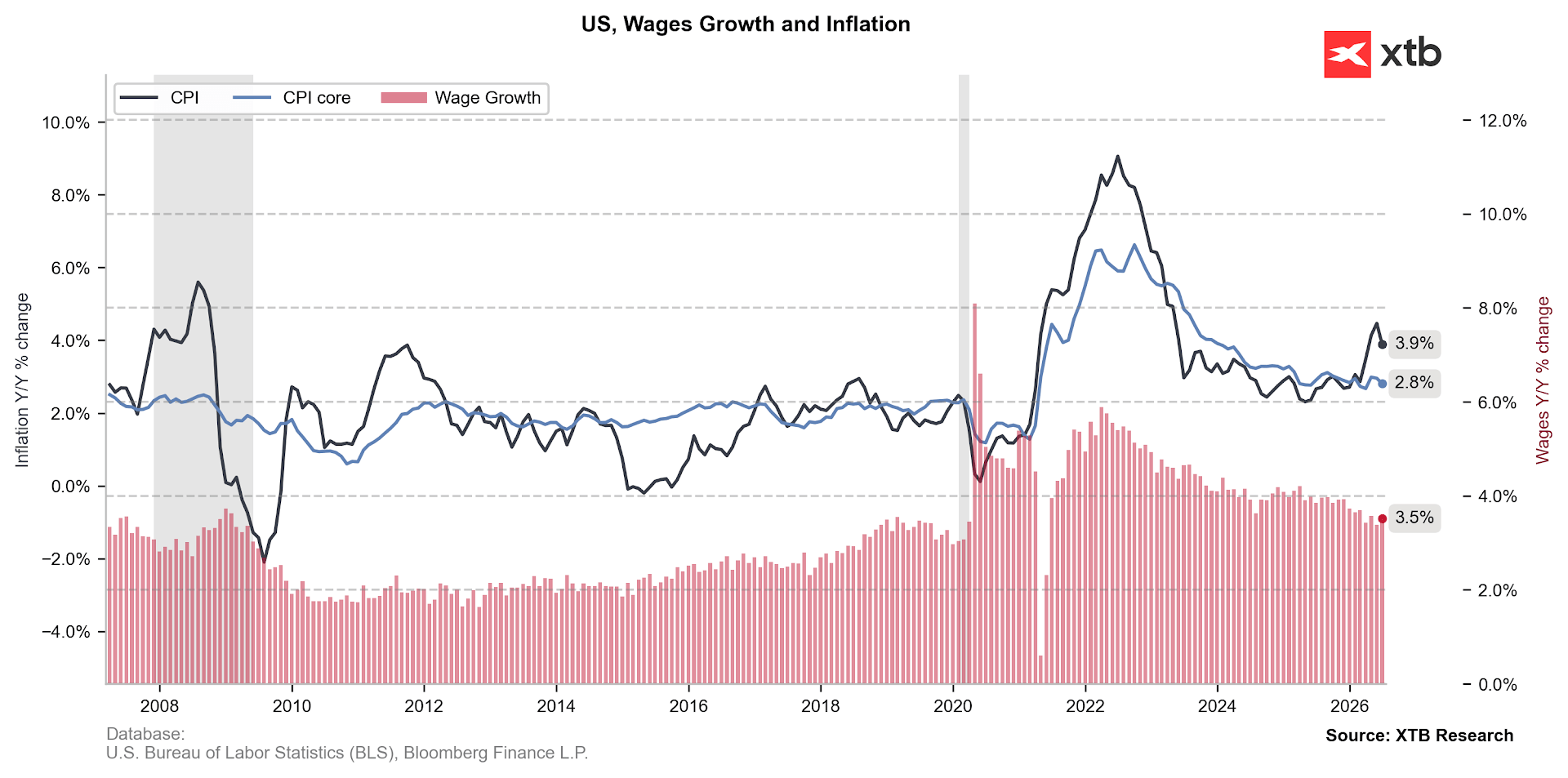
In the face of still-high inflation concerns (inflation at 3.5% and the core measure reaching 2.6%), wage growth may attract particular attention. The consensus assumes a reading of around 3.5%, which means no growth in earnings in real terms.
Figure 3: US CPI Inflation and Wage Growth (2007-2026)
 Source: XTB Research, 07.08.2026
Data lower than expected would increase concerns about the American consumer, which are already quite clearly outlined at this moment. Consumption is largely taking place at the expense of savings (the savings rate has fallen to just 3%), and its growth is very uneven. Consumption growth among the top quintile (20%) of earners in the US, after adjusting for inflation, reached 3.8% in Q1. In the rest of the population (80% of citizens), it was essentially flat (+0.6%).
On the other hand, strong employment growth could confirm the FOMC's hawkish axis in the belief about the necessity of interest rate hikes. Maintaining a "low fire-low hire" state should allow policymakers to fully focus their attention on inflationary pressure, which remains uncomfortably high.



Daily Summary: Bitcoin Excites Investors Despite the Fed's Hawkish Shift🏛️



What could halt the uptrend❓


Russia is taking over Nestlé's domestic assets 🍫 Shares are down nearly 3% 💥


BREAKING: US industrial production & manufacturing data lower than expected
The material on this page does not constitute as financial advice and does not take into account your level of understanding, investment objectives, financial situation or any other particular needs.
All the information provided, including opinions, market research, mathematical results and technical analyses published on the website or transmitted to you by other means is provided for information purposes only and should in no event be interpreted as an offer of, or solicitation for, a transaction in any financial instrument, nor should the information provided be construed as advice of legal or fiscal nature.
Any investment decisions you make shall be based exclusively on your level of understanding, investment objectives, financial situation or any other particular needs. Any decision to act on information published on the website or transmitted to you by other means is entirely at your own risk. You are solely responsible for such decisions.
If you are in doubt or are not sure that you understand a particular product, instrument, service, or transaction, you should seek professional or legal advice before trading.
Investing in OTC Derivatives carries a high degree of risk, as they are leveraged based products and often small movements in the market could lead to much larger movements in the value of your investment and this could work against you or for you. Please ensure that you fully understand the risks involved, taking into account your investments objectives and level of experience, before trading, and if necessary, seek independent advice.