


At 7:00 PM BST, the Federal Reserve will announce its interest rate decision, followed by a press conference with Fed Chair Jerome Powell at 7:30 PM. The key focus, however, will be on the updated macroeconomic projections released alongside the rate decision. Since there is a minimal chance of a rate change, markets will concentrate on analyzing the new forecasts, which are expected to show significant shifts.
What to Expect from Today’s FOMC Meeting:
-
The Fed is expected to keep interest rates unchanged for the fourth consecutive time (at 4.25–4.50%).
-
Despite recent softer inflation data, the "dot plot" and macroeconomic forecasts might send a hawkish signal, reflecting FOMC members' uncertainty about current price dynamics amidst tariff policies and political unpredictability.
-
Bloomberg Economics predicts that the new dot plot will indicate only one 25 bps rate cut before the end of 2025.
-
Powell is expected to maintain a moderate tone, emphasizing caution due to various risks and uncertainties. A key point will be whether the Fed feels it can afford to wait for clearer macro data without much cost.
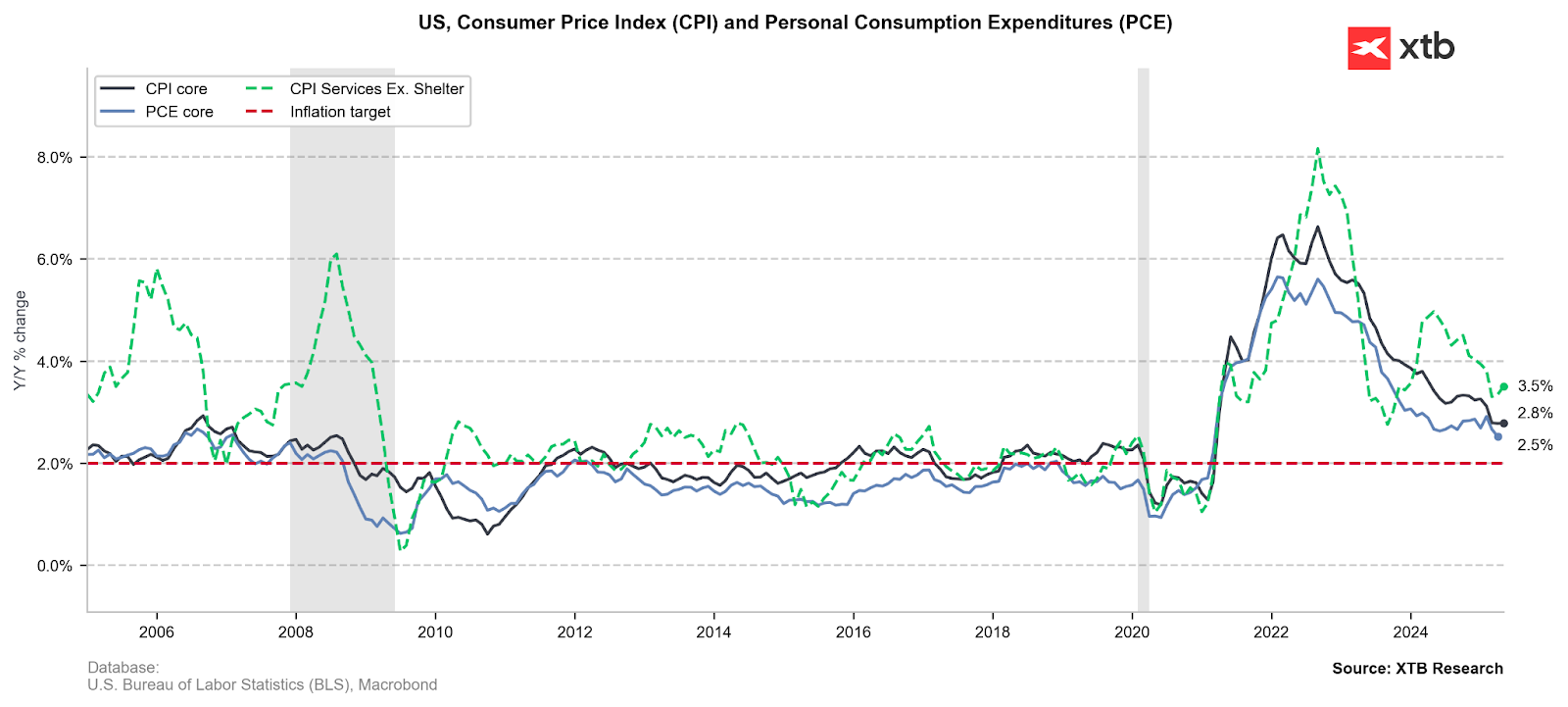
Core Inflation Still Above Fed’s 2% Target. Source: XTB Research
How High Will the Fed See Inflation?
The March projections already highlighted the Fed’s uncertainty about the future—even before major tariff hikes and the unprecedented US-China trade war. Although inflation has not significantly rebounded and economic data hasn't been weak, inflation risks have risen due to persistent tariffs (e.g., on cars, steel, aluminum, and many Chinese products), even if they’ve been somewhat reduced from extreme levels (145%).
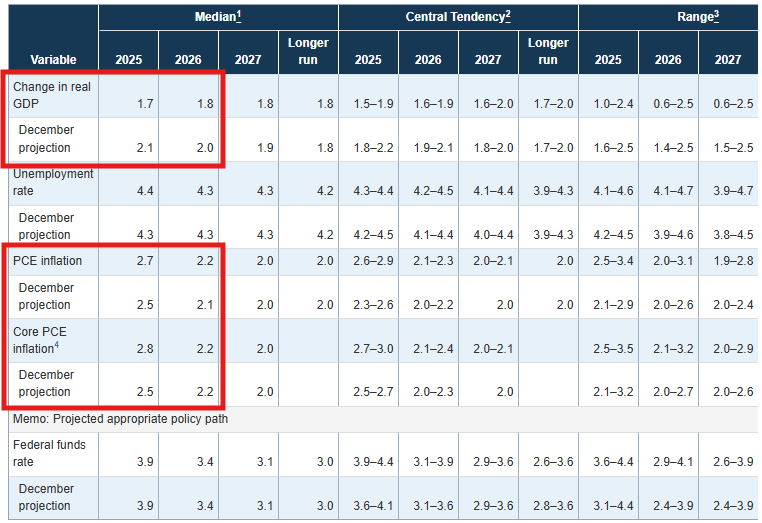
The new macro projections are expected to reflect a notable upward revision of inflation forecasts, potentially extending into next year. A critical issue will be whether the Fed still sees inflation reaching its 2% target by 2027.
Expected Projection Changes (According to Bloomberg Economics):
-
Core PCE inflation forecast for 2025 may rise to 3.5% from 2.8%. Currently, core PCE inflation is at 2.5%, and recent trends have been lower than expected. Thus, there is a possibility that the Fed might project a slightly lower rate of 3.3–3.4%.
-
Inflation forecast for 2026: 2.8% (up from 2.2%), and for 2027: 2.6% (vs 2.0%). This would imply that the Fed’s 2% target won’t be met even by 2027, and perhaps not until 2028.
-
GDP growth projections lowered:
-
2025: down to 1.3% (from 1.7%)
-
2026: 1.0% (from 1.8%)
-
2027: 1.0% (from 1.8%)
-
-
Unemployment rate projections expected to rise noticeably, which could offset the hawkish tone of higher inflation forecasts.
-
Given higher inflation, weaker growth, and higher unemployment, the Fed might reduce the number of expected rate cuts this year to just one (raising the median terminal rate from 3.9% to 4.1%).If the median stays at 3.9%, markets may interpret it as dovish.
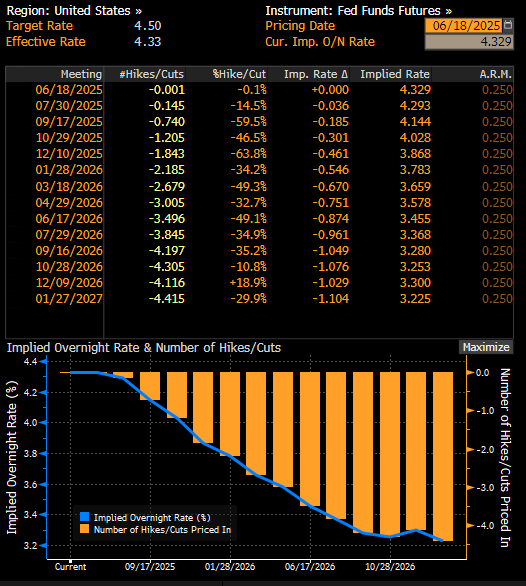
Markets still anticipate two rate cuts this year. Powell is likely among those who see room for two cuts, which could come in September and December if this outlook holds. Source: Bloomberg Finance LP
Will Powell Soften the Hawkish Tone?
At recent press conferences, Powell has remained neutral, citing significant uncertainty about the future. He will likely try to dilute the hawkish tone of the inflation projections today. The official statement may also include revisions to the labor market outlook.
Powell will probably stress that significant labor market changes could trigger a swift Fed response. He might also suggest the Fed is still on track for cuts but is waiting for more clarity on inflation trends. If so, any initial hawkish market reaction could quickly reverse during the press conference.
It’s important to remember that the Fed is not only assessing trade war risks, but also potential inflationary pressures from oil markets and energy prices, given ongoing tensions in the Middle East and rising gas prices.
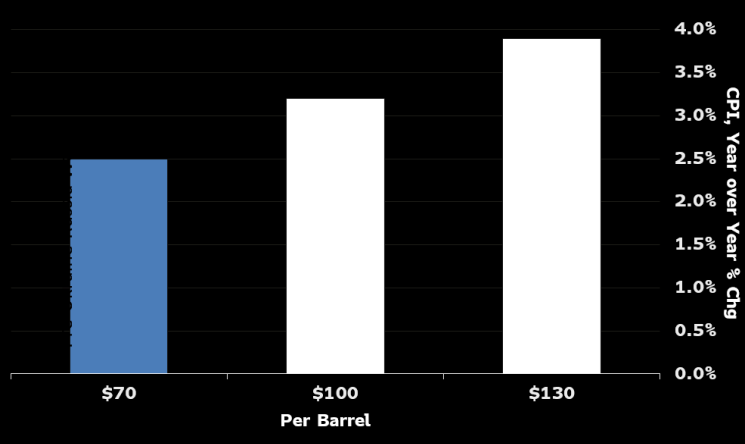
Bloomberg notes that CPI inflation could rise if the oil shock from the Middle East persists. Source: Bloomberg Economics
How WIll Dollar React?
Despite heightened geopolitical tensions, the dollar remains weak, with investors preferring safer assets like gold. A recent World Gold Council study shows that most central banks in the Global South plan to increase their gold reserves this year.
However, markets still expect two rate cuts. Recent US inflation data was weaker than expected. Inflation expectations have also dropped, and labor market data shows increasing signs of cooling. Retail sales and industrial production data were also weak, though possibly due to a one-off decline.
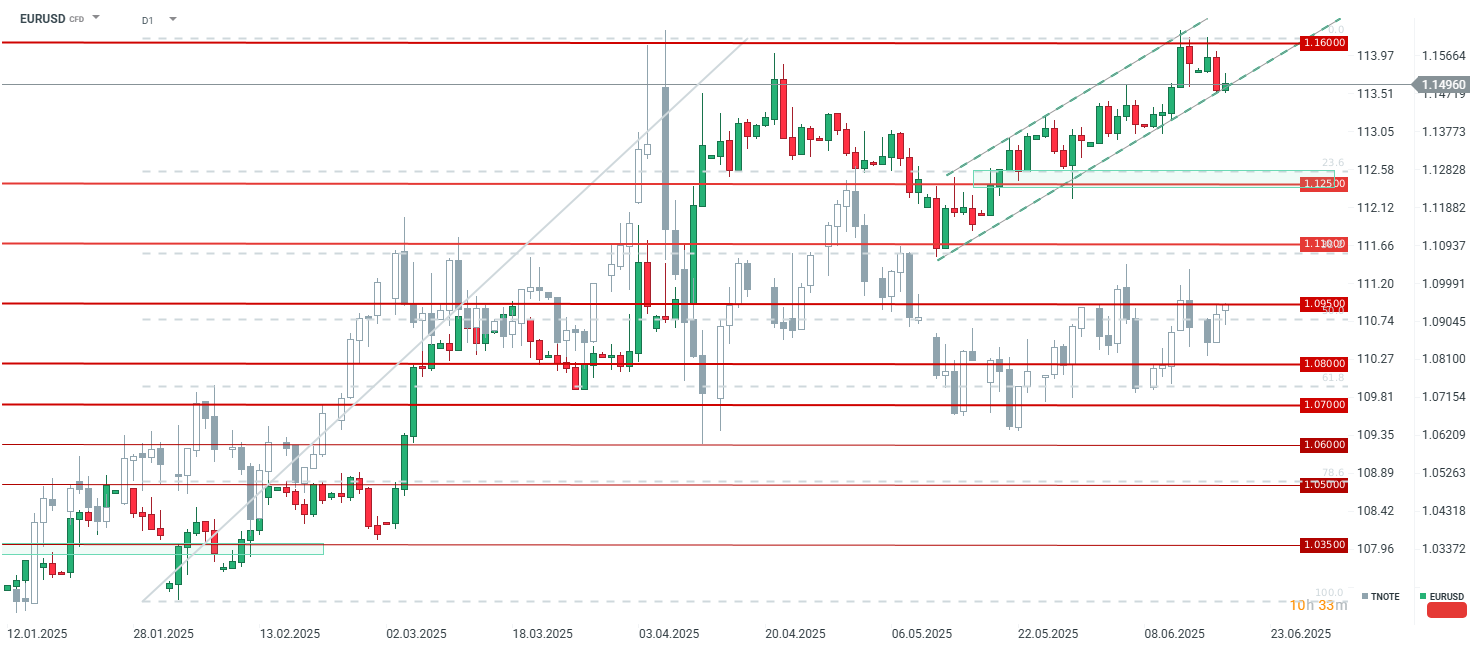
Given the possibility of hawkish projections, the USD could strengthen briefly right after the Fed’s release. But if Powell manages to soften the interpretation of the data, markets might price in a September cut more strongly, helping keep EURUSD above 1.1500. However, if inflation fears dominate, hawkish expectations could return, potentially pushing EURUSD toward the 1.1250–1.1300 support zone.
Source: xStation5



Daily Summary- Return of the Sell-off on Wall Street⬇️

🔴US100 drops nearly 4%


🟡⬇️Gold at its lowest since March


🛢️WTI Crude Below 90 USD Tests the 100-Session Average
The material on this page does not constitute as financial advice and does not take into account your level of understanding, investment objectives, financial situation or any other particular needs.
All the information provided, including opinions, market research, mathematical results and technical analyses published on the website or transmitted to you by other means is provided for information purposes only and should in no event be interpreted as an offer of, or solicitation for, a transaction in any financial instrument, nor should the information provided be construed as advice of legal or fiscal nature.
Any investment decisions you make shall be based exclusively on your level of understanding, investment objectives, financial situation or any other particular needs. Any decision to act on information published on the website or transmitted to you by other means is entirely at your own risk. You are solely responsible for such decisions.
If you are in doubt or are not sure that you understand a particular product, instrument, service, or transaction, you should seek professional or legal advice before trading.
Investing in OTC Derivatives carries a high degree of risk, as they are leveraged based products and often small movements in the market could lead to much larger movements in the value of your investment and this could work against you or for you. Please ensure that you fully understand the risks involved, taking into account your investments objectives and level of experience, before trading, and if necessary, seek independent advice.
