

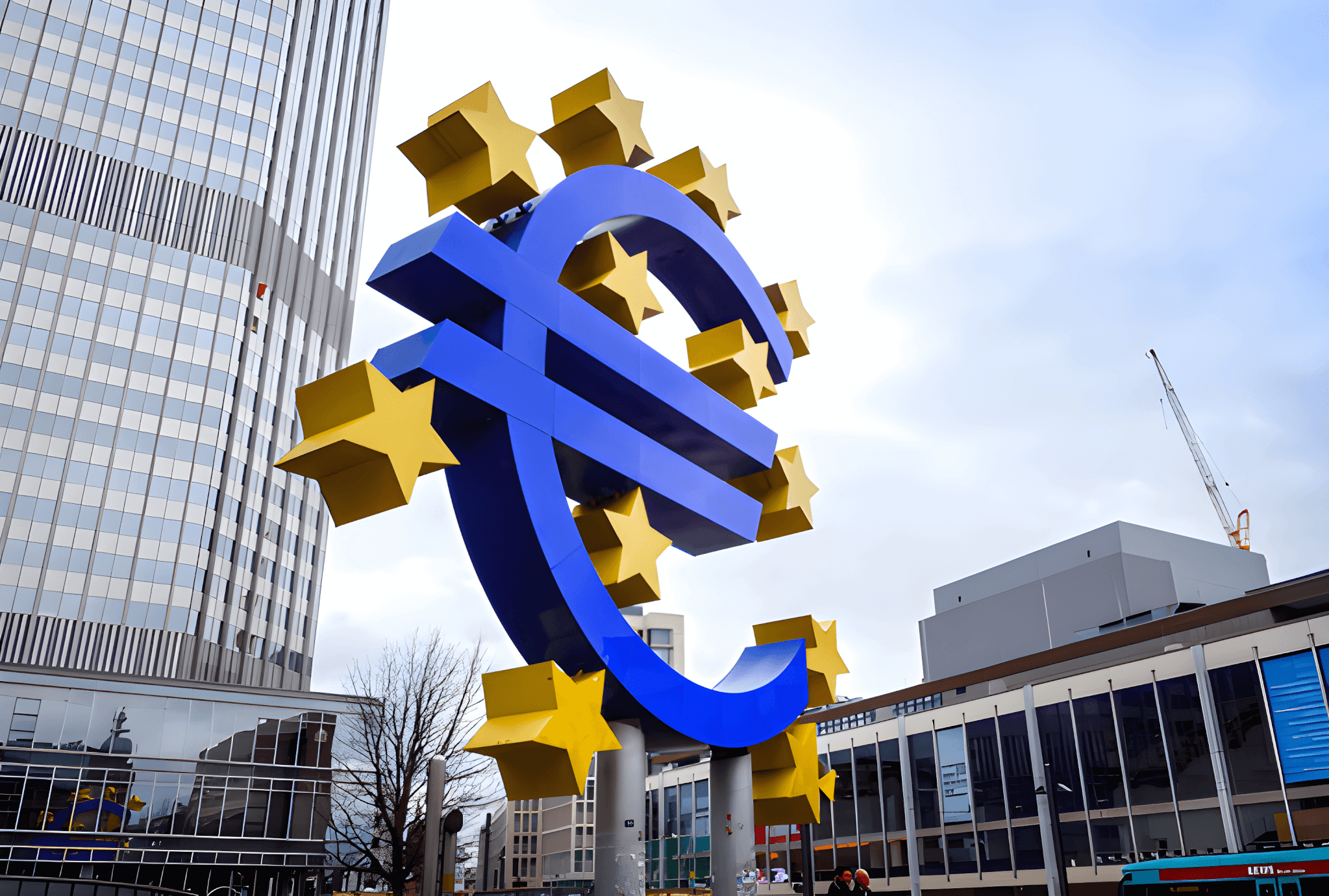
What to expect from today’s ECB decision?
-
ECB is expected to deliver 6th consecutive 25 bp rate cut, as the risk of economic stagnation has increased following the introduction of retaliatory tariffs by the U.S.
-
This scenario has already been almost fully priced in by swaps, at least for today’s decision.
-
The Governing Council may stress that rates are now close to neutral levels, though this does not rule out further cuts should trade policy developments warrant it.
-
The bond market is also signaling a decline in Eurozone rates below 2% by the end of 2025.
Energy price deflation paves the way for easing
The latest German PPI data points to a slowdown in one of the main inflationary drivers in the Eurozone: energy prices. In recent months, energy costs were frequently mentioned by ECB officials as the "but" when discussing progress on price stability, justifying their cautious approach to lowering interest rates. However, March data from Germany shows a record drop in energy commodity costs across the board, with energy sector deflation reaching -3.6% YoY and -2.8% MoM.

Eurozone inflation currently hovers slightly above 2%, but this reflects the natural slowdown in monetary policy transmission as the target nears. Source: XTB Research

The money market is pricing in almost three full rate cuts before the end of 2025. Source: Bloomberg Finance L.P.
Euro as a safe haven despite fragile growth
Yesterday’s remarks from Jerome Powell — that the Fed’s dual mandate faces risks from both sides — have effectively dashed hopes of rate cuts in the U.S., while adding more uncertainty to the 2025 economic outlook. Donald Trump’s trade policies have raised concerns about economic performance in both the U.S. and globally, as shown by a series of downward revisions to growth forecasts for major economies.
The Eurozone’s persistent stagnation will thus be tested, but there is growing motivation to actively support competitiveness in the region. Despite the lowered GDP outlook, expectations of fiscal expansion in Germany, continued monetary easing, and Europe’s institutional stability relative to the U.S. are boosting confidence in the euro — which could potentially emerge as a reserve currency alternative to the dollar amid record-high uncertainty.

Source: Bloomberg Economics

Yields on German 2-year bonds have fallen below the symbolic 2% mark, yet the euro is holding onto recent gains despite a hawkish Fed. The reason: a crisis of confidence in the dollar and rising uncertainty about the U.S. economic outlook. Source: XTB Research
EURUSD hits levels not seen since February 2022
The EURUSD pair has broken out to its highest levels since February 2022. Looking at the W1 chart and the RSI indicator, we can see that the recent rally pushed the pair above the 70-point zone — historically a level that often limits further strong upward moves.

Source: xStation5


Daily Summary: End of an Extremely Intense Week (19.06.2026)

Three markets to watch next week: EURUSD, OIL, NASDAQ (19.06.2026)


🚩 Gold loses 1.5% as Goldman Sachs cuts its 2026 bullion price target



Market wrap: Limited volatility and a strong dollar
The material on this page does not constitute as financial advice and does not take into account your level of understanding, investment objectives, financial situation or any other particular needs.
All the information provided, including opinions, market research, mathematical results and technical analyses published on the website or transmitted to you by other means is provided for information purposes only and should in no event be interpreted as an offer of, or solicitation for, a transaction in any financial instrument, nor should the information provided be construed as advice of legal or fiscal nature.
Any investment decisions you make shall be based exclusively on your level of understanding, investment objectives, financial situation or any other particular needs. Any decision to act on information published on the website or transmitted to you by other means is entirely at your own risk. You are solely responsible for such decisions.
If you are in doubt or are not sure that you understand a particular product, instrument, service, or transaction, you should seek professional or legal advice before trading.
Investing in OTC Derivatives carries a high degree of risk, as they are leveraged based products and often small movements in the market could lead to much larger movements in the value of your investment and this could work against you or for you. Please ensure that you fully understand the risks involved, taking into account your investments objectives and level of experience, before trading, and if necessary, seek independent advice.
