



French Prime Minister François Bayrou announced that on September 8 he will submit his government to a vote of confidence in the National Assembly, following his general policy declaration on budgetary orientations. Should the motion be rejected—a first under the Fifth Republic—the government would be forced to resign. Given the current parliamentary deadlock, a dissolution of the National Assembly would then appear inevitable, raising the risk of plunging the country back into the same political stalemate while further delaying the drafting of the 2026 budget.
Party Positions
On the left, La France Insoumise (radical left) and Europe Écologie-Les Verts (green left) are expected, unsurprisingly, to vote against confidence. The position of the Socialist Party, however, remains decisive. Although Boris Vallaud, president of the Socialist group in the Assembly, and Olivier Faure, first secretary of the PS, have both announced their opposition, negotiations with the government cannot be ruled out. A cabinet reshuffle including Socialist ministers and the withdrawal of the proposal to abolish two public holidays could potentially shift their stance.
On the right, the Rassemblement National finds itself in a delicate position. Until now, it had refrained from toppling the government by not supporting motions of no confidence. Yet the confidence vote carries a very different symbolic weight: backing the government would undermine its image as a defender of working- and middle-class voters. Politically untenable, such a move appears out of the question. The RN is therefore expected to vote against confidence.
Parliamentary Arithmetic
Out of 577 deputies, at least 264 are already certain to oppose the government, still short of the 289 votes required to strip it of confidence. Should the Socialist Party join the opposition, the total would rise to 330, making the fall of the executive inevitable. Even abstention by the Socialists would suffice to bring down the government, since the required majority would then drop to 256 votes. The PS therefore holds the key to the September 8 ballot.

Source: French National Assembly / Toute l'Europe
A Risk of Budget Paralysis
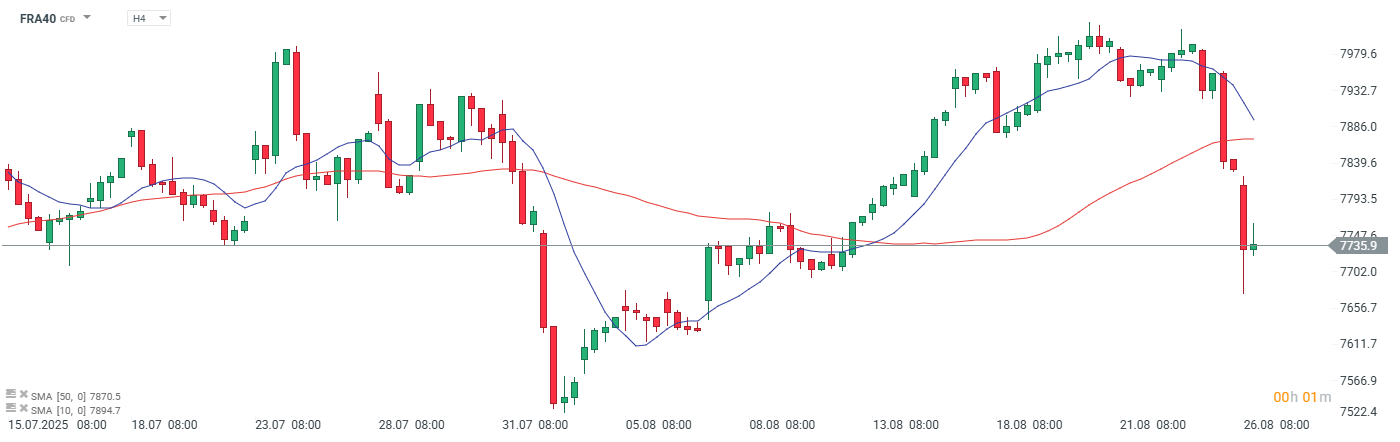
The scenario most widely anticipated by markets remains a rejection of confidence, triggering the government’s resignation, followed by the dissolution of the National Assembly and new elections. Yet such an outcome would usher in a prolonged period of uncertainty: nearly a month would be needed to convene a new Assembly, followed by several days to form a government. The budget process would then have to start almost from scratch, dangerously pushing back the 2026 budget timeline.
Such delays would heighten political and social tensions and increase the risk of a “blank year,” which would derail France’s debt-reduction trajectory. Already, the French 10-year OAT is approaching 3.6%, a technical resistance level, beyond which an uncontrolled surge in yields could ensue, at a time when debt servicing is expected to become the State’s largest budget item by 2027.
Market Reaction
Banks and insurers are among the hardest hit. Société Générale fell 8.20% and Crédit Agricole 6.01%, exposed both to interest-rate risk (as rising yields lower the value of sovereign bonds they hold) and credit risk (as concerns over the State’s repayment capacity grow). Construction and infrastructure companies, more dependent on the domestic economy, are also under pressure: Vinci, Bouygues and Saint-Gobain posted sharp declines.
By contrast, internationally oriented sectors such as luxury and healthcare remain resilient. LVMH, Hermès, L’Oréal, Sanofi and Kering held steady, confirming their role as safe havens in times of political and financial instability.
FRA40 (H4)
Source : xStation5
Matéis, Market Analyst – XTB



Daily Summary: Bitcoin Excites Investors Despite the Fed's Hawkish Shift🏛️



What could halt the uptrend❓


BREAKING: US industrial production & manufacturing data lower than expected



Market warp: Rate Forecasts and Semiconductors in the Spotlight
The material on this page does not constitute as financial advice and does not take into account your level of understanding, investment objectives, financial situation or any other particular needs.
All the information provided, including opinions, market research, mathematical results and technical analyses published on the website or transmitted to you by other means is provided for information purposes only and should in no event be interpreted as an offer of, or solicitation for, a transaction in any financial instrument, nor should the information provided be construed as advice of legal or fiscal nature.
Any investment decisions you make shall be based exclusively on your level of understanding, investment objectives, financial situation or any other particular needs. Any decision to act on information published on the website or transmitted to you by other means is entirely at your own risk. You are solely responsible for such decisions.
If you are in doubt or are not sure that you understand a particular product, instrument, service, or transaction, you should seek professional or legal advice before trading.
Investing in OTC Derivatives carries a high degree of risk, as they are leveraged based products and often small movements in the market could lead to much larger movements in the value of your investment and this could work against you or for you. Please ensure that you fully understand the risks involved, taking into account your investments objectives and level of experience, before trading, and if necessary, seek independent advice.