


Gold is down 2.5% today to $4,850 per ounce, pressured by a stronger U.S. dollar and rising hopes for a potential U.S.–Iran agreement after a second round of talks in Geneva, which is fueling expectations of de-escalation. Meanwhile, ANZ has raised its Q2 outlook. ANZ analysts lifted their second-quarter target to $5,800/oz from $5,400/oz, arguing that the latest pullback does not necessarily mark the end of the broader uptrend.
- ANZ believes the rally is not at an inflection point. The bank argues that despite elevated volatility, the move is not yet “mature enough” to warrant expectations of a sustained reversal in the near term.
- The correction from around $5,600 has reignited concerns about a deeper drawdown, but ANZ stresses that today’s macro backdrop differs materially from prior “cycle peaks” such as 1980 and 2011. In its view, current market conditions are not comparable to those historical episodes.
- The key support factor remains expected Fed rate cuts and falling real rates. ANZ assumes two 25bp cuts - one in March and another in June.
- Easing inflation is also pushing markets to price in the possibility of a third cut by December.
- Lower real yields typically support inflows into gold.
- Geopolitical and political risks remain an important pillar of support. ANZ points to persistent economic uncertainty and the risk of renewed trade-war escalation (tariffs) as factors that could sustain demand for hard assets.
- Gold is also benefiting from the relative loss of appeal in sovereign bonds. ANZ argues that rising global debt levels (not just in the U.S.) are undermining bonds’ role as the “safe anchor,” reinforcing gold’s value as a portfolio diversifier.
- ANZ also highlights a growing risk premium at the long end of the U.S. curve. According to the bank, investors are demanding higher compensation for holding long-dated Treasuries—visible in a widening gap between short- and long-term yields.
- Central-bank demand is expected to remain strong through 2026, but ANZ sees broader investment demand as the main driver in 2025. That implies a larger role for portfolio flows (funds, ETFs) in price formation.
- ETFs: ANZ expects continued inflows, with total gold ETF holdings potentially exceeding 4,800 tonnes in 2025. The bank assumes Western markets will remain an important base, while growth could accelerate in emerging markets—especially China and India (currently around 10% of global ETF holdings).
- Flow asymmetry remains supportive for gold. ANZ notes that gold ETF assets represent less than 3% of combined equity and bond holdings, meaning even small portfolio rotations could have a disproportionately positive impact on prices.
- Silver: constructive, but without a clear expectation of outperformance versus gold. ANZ remains bullish on silver, but argues that due to higher volatility and industrial demand sensitivity at elevated price levels, silver is unlikely to outperform gold this year.
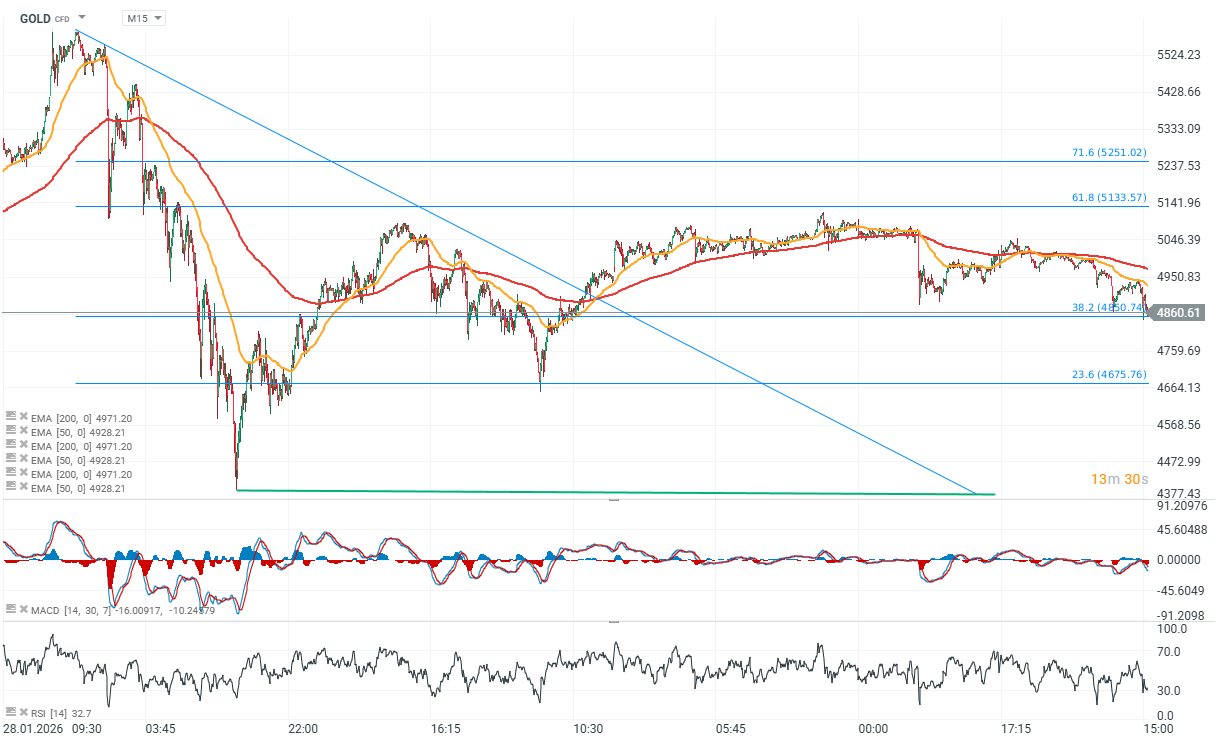
Source: xStation5



Daily summary: Wall Street climbs higher as oil falls 📈 SpaceX surges 28%


Oil slides 2.5% to $88 as Middle East tensions ease 📉 Is the uptrend over?



Wall Street Rebounds as Oil Prices Fall 📈 Adobe Shares Drop 8% After Earnings


BREAKING: USDIDX decline despite strong University of Michigan data
The material on this page does not constitute as financial advice and does not take into account your level of understanding, investment objectives, financial situation or any other particular needs.
All the information provided, including opinions, market research, mathematical results and technical analyses published on the website or transmitted to you by other means is provided for information purposes only and should in no event be interpreted as an offer of, or solicitation for, a transaction in any financial instrument, nor should the information provided be construed as advice of legal or fiscal nature.
Any investment decisions you make shall be based exclusively on your level of understanding, investment objectives, financial situation or any other particular needs. Any decision to act on information published on the website or transmitted to you by other means is entirely at your own risk. You are solely responsible for such decisions.
If you are in doubt or are not sure that you understand a particular product, instrument, service, or transaction, you should seek professional or legal advice before trading.
Investing in OTC Derivatives carries a high degree of risk, as they are leveraged based products and often small movements in the market could lead to much larger movements in the value of your investment and this could work against you or for you. Please ensure that you fully understand the risks involved, taking into account your investments objectives and level of experience, before trading, and if necessary, seek independent advice.
