


While natural gas isn't dominating headlines as it did in 2022, when European prices soared past €300 per megawatt-hour, current prices are several times lower, yet still significantly higher than the levels seen just a few years ago. However, Americans continue to enjoy the benefits of cheap gas. Consumer prices, while distinct from prices on commodity exchanges, are still a fraction of those in Europe. However, the US landscape is shifting. While the US president Donald Trump wants to pursue an "drill baby drill" approach to maximize oil and gas production, domestic demand is surging, and export ambitions are growing. Simultaneously, Europe's gas needs may be on the rise. Could this signal the end of cheap gas in the US, sacrificed for international expansion?
Declining Russian Supplies: A Real Shift?
Before the Ukraine war, Russia was Europe's undisputed leading natural gas supplier, primarily via pipelines. The conflict drastically altered this dynamic, virtually halting pipeline deliveries. Yet, Europe remains a significant buyer of Russian LNG. 2024 saw record-high Russian LNG imports, even as US deliveries declined. Russian gas, including its liquefied form, is simply cheaper, a fact exploited by major European economies. The EU aims to curtail this practice, potentially opening doors for other suppliers, notably the United States.
The US: An LNG Powerhouse
About one year ago, the US export capacity hovered around 12 billion cubic feet, but now frequently surpasses 15 billion. The US Energy Information Administration (EIA) forecasts North American LNG export capacity to double to 24.4 billion cubic feet by 2028. The US intends to leverage its potential, capitalizing on higher prices abroad.

EIA indicates that export capacity from North America could double. Source: EIA
Europe's gas needs remain, amidst green deal questions and depleted stockpiles. Donald Trump has urged Europe to increase LNG imports to address the substantial trade deficit. A timely opportunity arises as Europe, having depleted gas reserves earlier this winter, likely seeks to diversify away from Russian supplies.
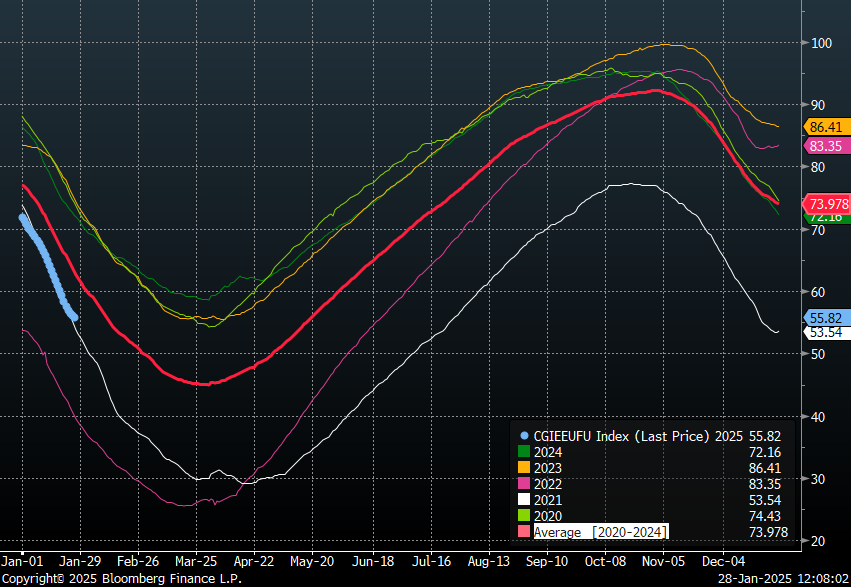
European storage levels currently stand at roughly 55%, below the 5-year average, echoing the situation in 2021 when Russia began reducing deliveries. Reaching the target 90% storage capacity by early November will necessitate increased US imports. Source: Bloomberg Finance LP, XTB
Weather's Influence
Cold spells at the turn of the year in both the US and Europe intensified heating demand. The preceding two years saw subdued gas consumption. Consequently, prices in both regions climbed. However, weather patterns are volatile, and indications suggest the worst of winter might be behind us. Europe, however, faces a different reality, still grappling with constrained supply and prices above €50/MWh. In contrast, US prices have already retreated almost 30% from their seasonal peak. Should last year's trend repeat, a 40-50% decline from the price zenith is plausible, potentially revisiting the $2.2-2.5/MMBTU, a range that was seen last autumn.
Price Outlook
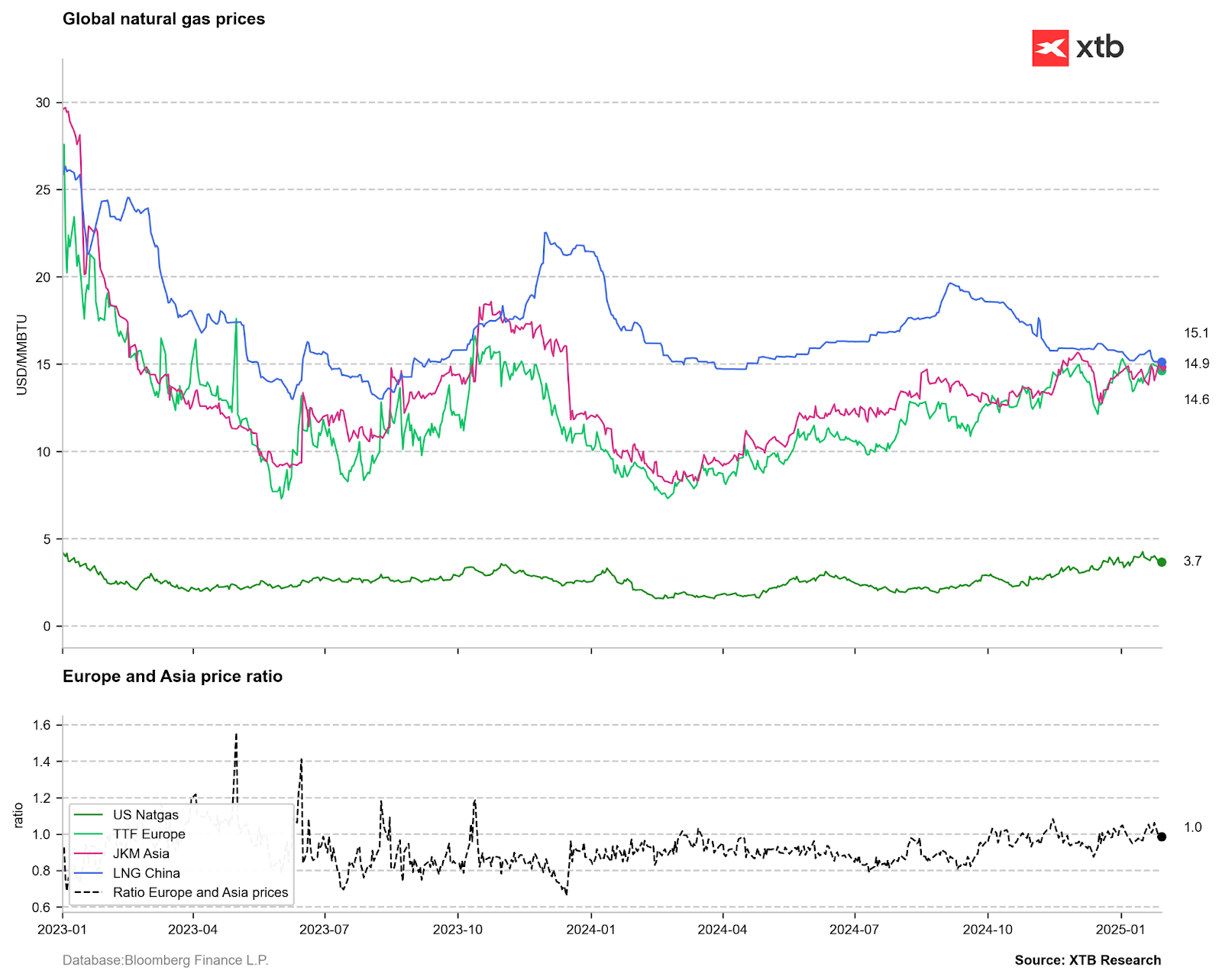
European and Asian prices remain multiples higher than those in the US. Factoring in transport and liquefaction costs, the gap between global benchmarks and US prices would narrow considerably. Yet, increased US export capacity will tighten domestic supply. While production growth potential exists, local demand is also poised to increase, driven by the rise of AI infrastructure. Donald Trump has suggested US energy needs could double in the coming years, with gas-fired plants accounting for over 40% of US electricity generation. This could lead to a squeeze on domestic supply amidst rising demand, inevitably driving prices upwards. This is partly reflected in the forward curve, projecting prices of $4.5-4.6 by next January, though these levels could be reached sooner. The upcoming summer is forecast to bring extreme temperatures, further straining US energy needs and potentially limiting stock replenishment ahead of the next heating season. The question then becomes: Is this the twilight of cheap American gas?


When will the rise in oil prices reach us?



Daily Summary: Equities Diverge as Tech Lags, Europe Rallies on Earnings & PMIs (24.07.2026)



Three markets to watch next week (24.07.2026)


Oil Slides Ahead of the Weekend!
The material on this page does not constitute as financial advice and does not take into account your level of understanding, investment objectives, financial situation or any other particular needs.
All the information provided, including opinions, market research, mathematical results and technical analyses published on the website or transmitted to you by other means is provided for information purposes only and should in no event be interpreted as an offer of, or solicitation for, a transaction in any financial instrument, nor should the information provided be construed as advice of legal or fiscal nature.
Any investment decisions you make shall be based exclusively on your level of understanding, investment objectives, financial situation or any other particular needs. Any decision to act on information published on the website or transmitted to you by other means is entirely at your own risk. You are solely responsible for such decisions.
If you are in doubt or are not sure that you understand a particular product, instrument, service, or transaction, you should seek professional or legal advice before trading.
Investing in OTC Derivatives carries a high degree of risk, as they are leveraged based products and often small movements in the market could lead to much larger movements in the value of your investment and this could work against you or for you. Please ensure that you fully understand the risks involved, taking into account your investments objectives and level of experience, before trading, and if necessary, seek independent advice.
