


Lululemon Athletica (NASDAQ: LULU) shares fell around 12% after the company released its fiscal first-quarter 2026 results. While revenue and earnings per share came in broadly in line with market expectations, investors were concerned by the retailer’s lowered full-year guidance and further signs of weakening demand in North America.
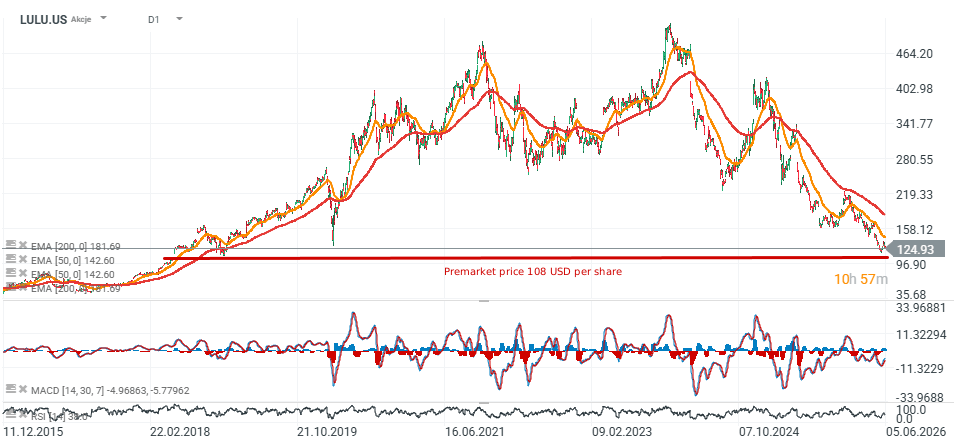
The market is increasingly questioning whether the company’s challenges — particularly its struggle to reignite growth in the U.S. market — are temporary in nature or reflect a deeper deterioration in the positioning of one of the world’s most recognizable premium athletic apparel brands. The stock has fallen to its lowest level since May 2018, and its weakness is weighing on sentiment across the broader athletic apparel sector, including rival Nike, whose shares are trading near their lowest levels in 15 years.
Key Takeaways
-
Revenue increased 4% year-over-year to $2.47 billion
-
Net income fell from $314.5 million to $195 million (-38% YoY)
-
EPS declined from $2.60 to $1.69
-
Gross margin contracted by 410 basis points to 54.2%
-
Operating margin declined by 730 basis points to 11.2%
-
Comparable sales increased 1%
-
Comparable sales in the Americas fell 5%
-
International comparable sales rose 13%
-
Revenue in Mainland China increased 30%
-
The company lowered its FY2026 EPS guidance to $10.95–$11.15 from $12.10–$12.30
-
Revenue guidance was cut to $11.0–$11.15 billion from $11.35–$11.50 billion
Results Met Expectations, but Profitability Continues to Deteriorate
From a top-line perspective, Lululemon delivered results that were broadly in line with Wall Street expectations. The company generated $2.47 billion in revenue versus analyst estimates of $2.44 billion, while earnings per share came in exactly at the consensus forecast of $1.69.
However, the underlying earnings picture was considerably weaker. Operating income declined 37% year-over-year, while net income dropped 38%. At the same time, gross margin narrowed to 54.2%, highlighting rising cost pressures and weakening pricing power.
This trend is particularly important for investors because Lululemon has historically commanded a premium valuation thanks to its ability to maintain industry-leading margins and strong brand equity.
China Remains a Growth Engine, but North America Continues to Weigh on Performance
The strongest aspect of the quarter remained the company’s international business. Revenue outside North America increased 22%, while international comparable sales rose 13%.
China stood out as the key growth driver. Revenue in Mainland China climbed 30%, while comparable sales advanced 20%, reinforcing the market’s importance within Lululemon’s long-term growth strategy.
In contrast, North America remains under pressure. Revenue in the region declined 3%, while comparable sales fell 5%. This segment continues to be the primary source of concern for investors and analysts alike.
Lowered Guidance Triggered the Sharp Sell-Off
The biggest disappointment came from management’s outlook for the coming quarters.
For the second quarter, Lululemon expects revenue between $2.45 billion and $2.47 billion and EPS of $1.76–$1.81, both below Wall Street expectations.
More importantly, the company significantly reduced its full-year guidance. Management now expects fiscal 2026 EPS of $10.95–$11.15, nearly 10% below its previous forecast.
The guidance cut suggests a more challenging consumer environment and a slower recovery trajectory than management had anticipated only a few months ago.
According to the company, macroeconomic uncertainty and cautious discretionary spending continue to pressure demand across key markets.
Analysts Cut Price Targets as the Chart Signals Persistent Weakness
Following the earnings release, several major brokerages lowered their price targets on Lululemon shares. Stifel reduced its target price from $176 to $134 while maintaining a Hold rating. The firm noted that the company’s core North American business deteriorated further during April and May and now expects comparable sales to remain negative through the first half of fiscal 2027.
Other analysts have expressed similar concerns. Wells Fargo cut its target price to $110, Jefferies lowered its target to $115, and BofA Securities reduced its valuation to $140.
The common theme across these revisions is weakening North American demand, ongoing margin pressure, and concerns about market share erosion. Some analysts are also beginning to question whether the company is facing a broader brand issue rather than merely a temporary product-cycle challenge.
From a technical perspective, the stock’s decline to eight-year lows reinforces the negative narrative surrounding the name. The breakdown reflects not only weaker earnings expectations but also growing uncertainty regarding the sustainability of Lululemon’s premium positioning.
Despite these challenges, the company continues to post strong international growth and has expanded its global store base to 816 locations. In addition, former Nike executive Heidi O’Neill is set to take over as CEO in the coming months, a leadership change that investors hope will help restore growth momentum. The next several quarters will likely determine whether Lululemon is experiencing a temporary operational slowdown or facing a more structural challenge to its brand and long-term growth story.
Source: xStation5



NFP: A turning point for the dollar and the start of a stock market correction?

US Open: Wall Street slides amid semiconductor stocks sell-off 📌Intel down 6%



Market Wrap: SAP bucks tech sell-off, SpaceX blocked from S&P 500 entry (05.06.2026)



Nvidia Bets on Everyone as the Entire HBM "Big Three" Secures Vera Rubin Certification
The material on this page does not constitute as financial advice and does not take into account your level of understanding, investment objectives, financial situation or any other particular needs.
All the information provided, including opinions, market research, mathematical results and technical analyses published on the website or transmitted to you by other means is provided for information purposes only and should in no event be interpreted as an offer of, or solicitation for, a transaction in any financial instrument, nor should the information provided be construed as advice of legal or fiscal nature.
Any investment decisions you make shall be based exclusively on your level of understanding, investment objectives, financial situation or any other particular needs. Any decision to act on information published on the website or transmitted to you by other means is entirely at your own risk. You are solely responsible for such decisions.
If you are in doubt or are not sure that you understand a particular product, instrument, service, or transaction, you should seek professional or legal advice before trading.
Investing in OTC Derivatives carries a high degree of risk, as they are leveraged based products and often small movements in the market could lead to much larger movements in the value of your investment and this could work against you or for you. Please ensure that you fully understand the risks involved, taking into account your investments objectives and level of experience, before trading, and if necessary, seek independent advice.
