


-
Asian equities under heavy pressure: The MSCI Asia Pacific Index fell as much as 2.8%, marking the largest two-day decline since April.
-
Sharp sell-off in South Korea: The KOSPI index dropped as much as 6.8% after markets reopened following a long weekend, despite having been one of the best-performing indices globally earlier this year.
-
Western futures signal further downside: Equity-index futures in the US and Europe declined by around 1%, pointing to a potential continuation of the correction.
-
Iran–US/Israel escalation pushes oil higher: Investors are focusing on supply risks, particularly after Iran threatened to close the Strait of Hormuz, a critical global oil transit route.
-
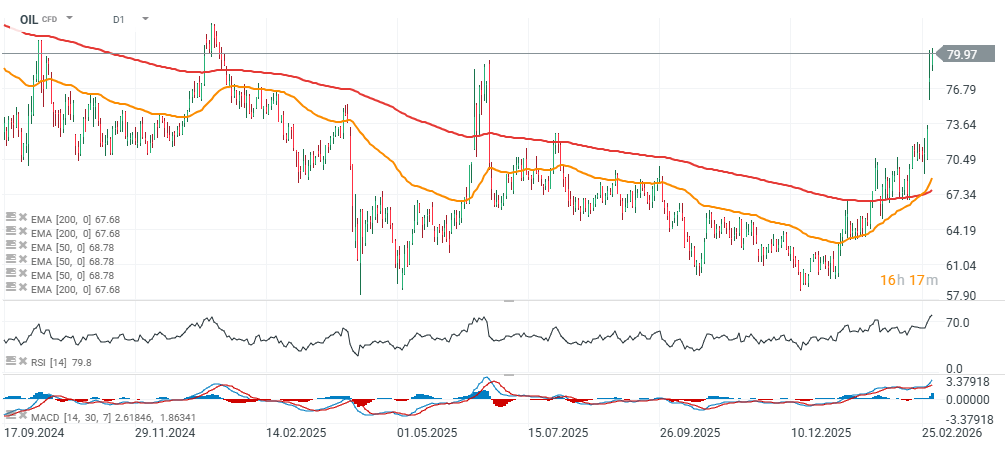
Brent back above $80 per barrel: Oil prices once again moved above $80, following a “moderate” surge of more than 7% on Monday.
-
US dollar strengthens: Rising risk aversion and geopolitical tensions are supporting gains in the US currency.
-
Bonds retreat despite safe-haven status: Higher oil prices are reviving inflation concerns, lifting rate expectations and weighing on global fixed-income markets.
-
Government debt sell-off from Sydney to Tokyo: Investors are offloading sovereign bonds amid fears that a prolonged Middle East conflict will sustain inflationary pressure.
-
Broad-based bond declines: Government bonds in the US, Japan, Australia, New Zealand, and South Korea are all posting losses this week.
-
Inflation back in focus: Markets are once again pricing in the risk that elevated energy costs could undermine the outlook for global bonds, which had previously recorded their strongest start to a year since the pandemic.
-
Trump comments on the Iran conflict: The former US president stated that the largest US strike may still be ahead, did not rule out a ground operation, and emphasized that with current military capabilities and industrial strength, the US could sustain a prolonged and ultimately victorious war.
-
TTF futures jumps: futures on European natural gas TTF surges more than 20% today after yesterday almost 50% jump driven by supply halt in Qatar.
OIL (D1 timeframe)
Looking at the Brent crude futures chart, we can see that the EMA200 and EMA50 have formed a technical “golden cross,” which may signal a more sustained bullish impulse, as the 50-period moving average has crossed above the 200-period average from below.
Source: xStation5


BREAKING: BoC Leaves No Surprises; Canadian Interest Rates Unchanged 🚨


BREAKING: US CPI data in line with expactations. Monthly CPI Slightly Elevated



Is Inflation Spinning Out of Control?



Market Wrap: Nervous wait for U.S. Inflation
The material on this page does not constitute as financial advice and does not take into account your level of understanding, investment objectives, financial situation or any other particular needs.
All the information provided, including opinions, market research, mathematical results and technical analyses published on the website or transmitted to you by other means is provided for information purposes only and should in no event be interpreted as an offer of, or solicitation for, a transaction in any financial instrument, nor should the information provided be construed as advice of legal or fiscal nature.
Any investment decisions you make shall be based exclusively on your level of understanding, investment objectives, financial situation or any other particular needs. Any decision to act on information published on the website or transmitted to you by other means is entirely at your own risk. You are solely responsible for such decisions.
If you are in doubt or are not sure that you understand a particular product, instrument, service, or transaction, you should seek professional or legal advice before trading.
Investing in OTC Derivatives carries a high degree of risk, as they are leveraged based products and often small movements in the market could lead to much larger movements in the value of your investment and this could work against you or for you. Please ensure that you fully understand the risks involved, taking into account your investments objectives and level of experience, before trading, and if necessary, seek independent advice.
