


We are starting a new week on the financial markets.
Today's session will be unique because, due to bank holidays in China, the US and Canada, there will be no session on the cash markets, which may significantly reduce the volatility observed in many markets.
Interestingly, the break in China will last until the end of the week, due to the Lunar New Year celebrations.
For this reason, volatility on Asian markets was very low today. At present, Japan's Nikkei is up 0.02%, while India's Nifty 50 is up 0.2%.
This week, the dollar will remain in the spotlight, and the market will play along with the narrative of "USD rebalancing", with Credit Agricole expecting consolidation rather than major movements, unless there is clearly weaker data or dovish signals from the Fed. Key publications will include: December core PCE, preliminary PMI for February, FOMC meeting minutes and the December TIC report, which will show whether foreign demand for US bonds and equities has begun to weaken. An additional, non-calendar source of volatility could be the potential US Supreme Court ruling on tariffs, scheduled for 20 February. All these factors mean that the end of the week could bring increased volatility for the USD and Treasury yields, especially if the data and decisions deviate from the consensus.
Today, however, the Australian dollar is performing best on the Forex market. Increased declines are being observed in the Japanese yen.
The yen weakened after the data was released, as GDP growth of only 0.2% annualised (0.1% month-on-month) clearly fell short of expectations, confirming the fragility of the recovery and the weakness of exports and investment. This combination – soft growth with still elevated inflation – on the one hand does not give the Bank of Japan the comfort to tighten aggressively, and on the other hand reinforces the narrative that policy will remain unchanged for longer, which the market interprets as negative for the yen. In addition, today's meeting between Prime Minister Takaichi and Governor Ueda raises concerns that the government will push for caution in normalisation, which also weighs on the currency.
The service sector in New Zealand continues to grow (PSI 50.9 – business sentiment index), but momentum is slowing, with employment and inventories contracting, indicating caution among companies and dampening optimism for the NZD. The 1.1% m/m decline in spending measured by payment card transactions in January, despite a slight y/y increase, confirms the seasonal weakness in consumption after the holidays, limiting expectations for interest rate cuts and supporting a slight stabilisation of the economy.
Both SILVER, which is down 1.2%, and GOLD, which is down 0.83%, are performing poorly on the metals market.
However, the biggest declines are seen in NATGAS, where investors are once again reacting to higher than average temperatures in the 8-14 day forecast. Prices for this commodity have already fallen by nearly 7%.
Bitcoin loses 1% and is trading close to £68,000.
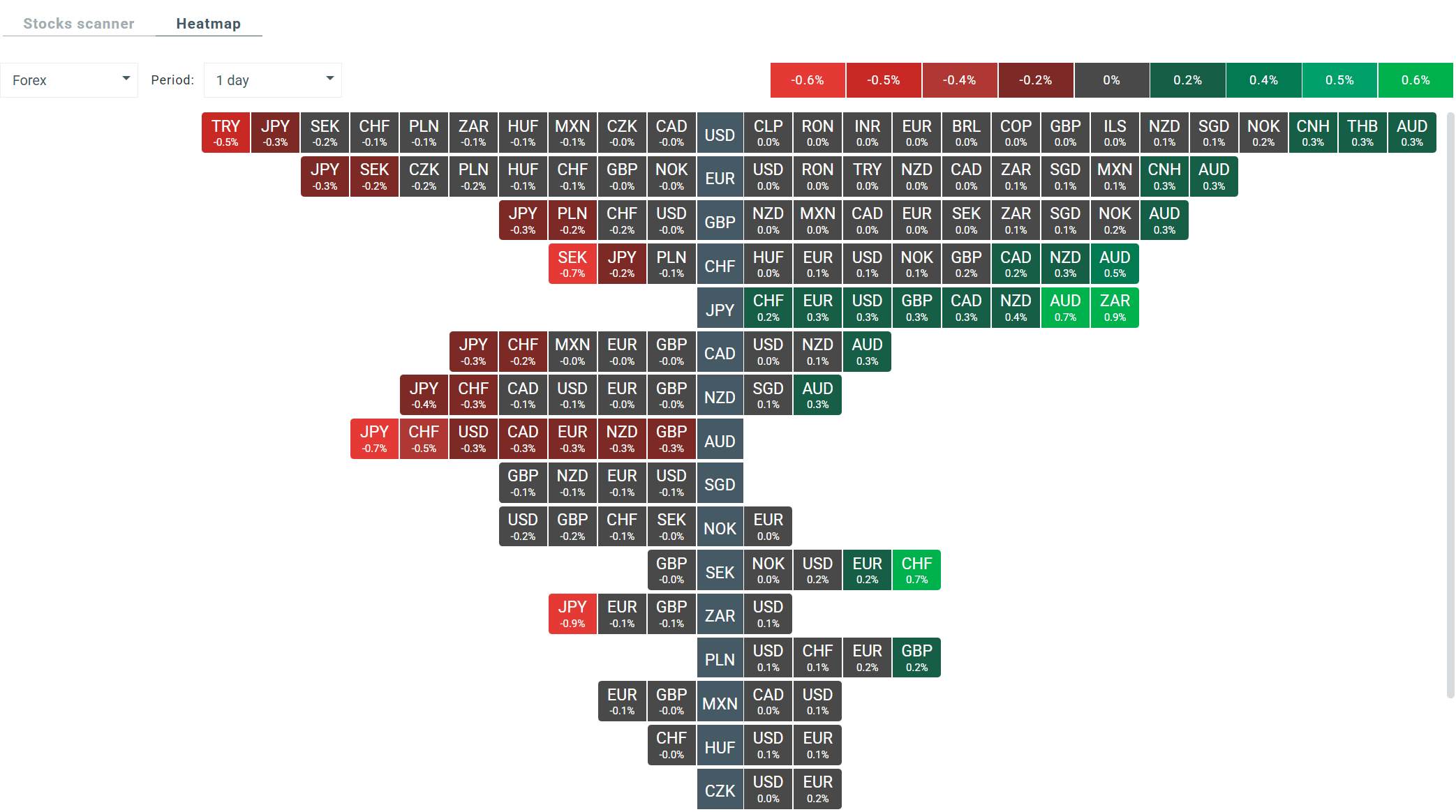
Heatmap of volatility on the FX market at present. Source: xStation


Chart of the Day: EU50 - European indices at new peaks (15.06.2026)



Economic Calendar: Will the Yen Find Support? (15.06.2026)


Morning Wrap: Strait of Hormuz Finally Set to Open (15.06.2026)



Daily summary: Wall Street climbs higher as oil falls 📈 SpaceX surges 28%
The material on this page does not constitute as financial advice and does not take into account your level of understanding, investment objectives, financial situation or any other particular needs.
All the information provided, including opinions, market research, mathematical results and technical analyses published on the website or transmitted to you by other means is provided for information purposes only and should in no event be interpreted as an offer of, or solicitation for, a transaction in any financial instrument, nor should the information provided be construed as advice of legal or fiscal nature.
Any investment decisions you make shall be based exclusively on your level of understanding, investment objectives, financial situation or any other particular needs. Any decision to act on information published on the website or transmitted to you by other means is entirely at your own risk. You are solely responsible for such decisions.
If you are in doubt or are not sure that you understand a particular product, instrument, service, or transaction, you should seek professional or legal advice before trading.
Investing in OTC Derivatives carries a high degree of risk, as they are leveraged based products and often small movements in the market could lead to much larger movements in the value of your investment and this could work against you or for you. Please ensure that you fully understand the risks involved, taking into account your investments objectives and level of experience, before trading, and if necessary, seek independent advice.
