



Tuesday brought significant gains to markets in the USA and Europe. The Nasdaq 100 index strengthened by 1.9%, and the pan-European Euro Stoxx 50 by 0.9%. This occurred amidst rising tensions between the USA and Iran, which drove Brent crude oil prices back above the level of 92 dollars per barrel.
📈 Equities
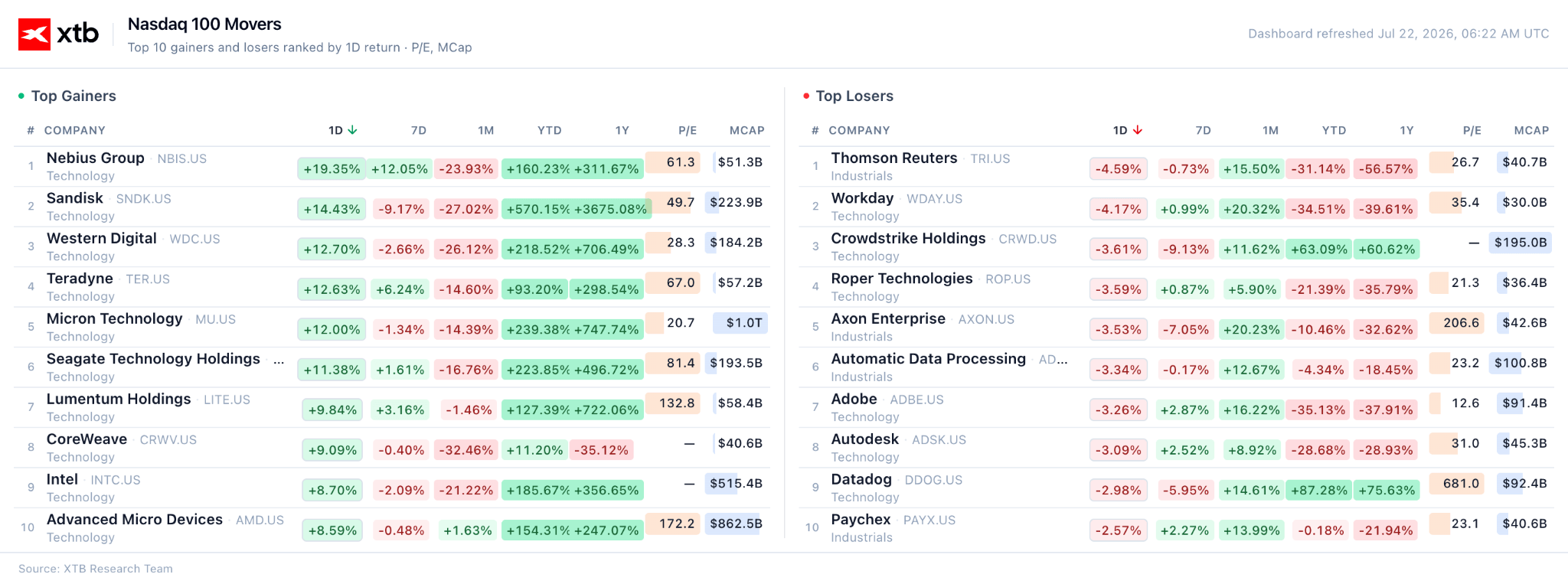
Companies in the broader AI sector seem to be returning to favour, having been the main driver behind yesterday's strengthening of key stock indices. Among Tuesday's biggest winners were Nebius, Sandisk, Micron, Teradyne, and Seagate - all of which gained over 10%.
Figure 1: Winners and Losers of the Day on Nasdaq 100 (21.07.2026)
 Source: XTB Research, 22.07.2026
The significant gains recorded today by the Korean KOSPI index, which is strengthening by 2% today, are therefore not surprising, supported by strong performance from Samsung (+2.8%) and SK Hynix (+2.4%).
The situation looks worse in other Asian markets, especially the Chinese Hang Seng (-1%), where we see losses for giants: Tencent (-6.2%), Geely (-4%), and Xiaomi (-3.5%).
The futures index for the S&P 500 is also showing red. However, the losses are minor (-0.2%), and attention is focused not only on geopolitical issues, which are weighing on the price of crude oil and LNG, but also on the results of the giants. Today, we are awaiting quarterly reports from companies including Tesla, Google, AT&T, IBM, and ServiceNow.
🌍 Geopolitics
Since the beginning of the week, US forces have continued night attacks on Iranian territory - this is the 11th night of bombing in a row. Targets include Iranian command centres, missile bases, aircraft hangars, and drone depots. The strikes have affected many cities, including Bushehr, Tabriz, and Bandar Abbas. Iranian authorities are not remaining passive and are responding with attacks on targets in Kuwait, Jordan, Syria, and Bahrain.
Tension rose drastically after the death of at least 3 American soldiers, who died as a result of Iranian attacks in Jordan and Iraq last weekend. President Donald Trump announced a firm retaliation and threatened to extend attacks to civilian and energy infrastructure if Iran does not come to an agreement.
Mediators (Qatar, Egypt, and Pakistan) were supposed to present both sides with a proposal for a 10-day ceasefire yesterday, which would, in a way, constitute a return to the situation after the signing of the 60-day memorandum. Despite the ongoing exchange of blows, both the authorities in Tehran and President Trump's administration have signalled a readiness to return to talks.
🛢️ Energy commodities
The continuation of shelling and the lack of clear premises indicating that both sides have reached an agreement is leading to further price increases for key energy commodities.
- We currently have to pay about 92 dollars per barrel of Brent and 85 dollars for WTI, which means an increase of 8% and 6%, respectively, compared to levels recorded exactly one week ago.
- Gas on the Dutch TTF exchange is also becoming more expensive, rising to 60 dollars per MWh (+11% over the week).
🧈 Precious metals
Despite the lack of first-class macroeconomic data and meetings of the largest central banks, yields on 10-year bonds are heading upwards in many developed economies (including Germany and Japan). At the same time, the prices of precious metals are rising, representing a direct alternative to bonds for some investors.
In our opinion, this growth signals a kind of risk-off sentiment among investors in the face of unabating geopolitical tension and a return of concerns about the situation in the energy market (while simultaneously showing what an important role the return of optimism regarding the AI sector played in yesterday's stock market gains).
- One has to pay about $4135 for a troy ounce of gold (+1.4%), and $59.8 for silver (+1.7%).
📈 Macroeconomic data and monetary policy
Hungary
- Our attention was focused yesterday, which might be quite non-obvious, on Hungary. The MNB, or the Hungarian National Bank, carried out its second interest rate cut since the outbreak of the war in Iran. This cut is a consequence of inflation falling (1.7%) below the bank's inflation target (3% ± 1pp.). Even despite the cuts, the reference rate in Hungary remains 2 pp. higher than in Poland. There is, therefore, significant room for further easing. If a still quite dynamic wage growth (7% in real terms, i.e., after taking inflation into account) does not stand in the way, we expect the continuation of cuts at upcoming meetings.
United Kingdom
- Today, the focus shifted towards the British Isles, from where we received June inflation data. The headline measure fell more than expected (to 2.6%), which was, of course, largely a consequence of lower fuel prices at petrol stations. However, for investors, the lack of change in the core measure, which remained at 2.6%, and the very small decline in inflation in the services sector (3.6%), which remains the main factor troubling the Bank of England, may be more important. Looking at market valuations, investors expect two interest rate hikes in the UK before the end of the year. The first may take place as early as September. It is hard to expect an upward move at the upcoming meeting (30 July).
💱 Currencies
In the face of rising global tensions and the return of Brent crude oil prices firmly above the level of 90 dollars per barrel, the dollar and commodity currencies are gaining. At the very top of the list, we find the Norwegian krone and the Australian dollar.
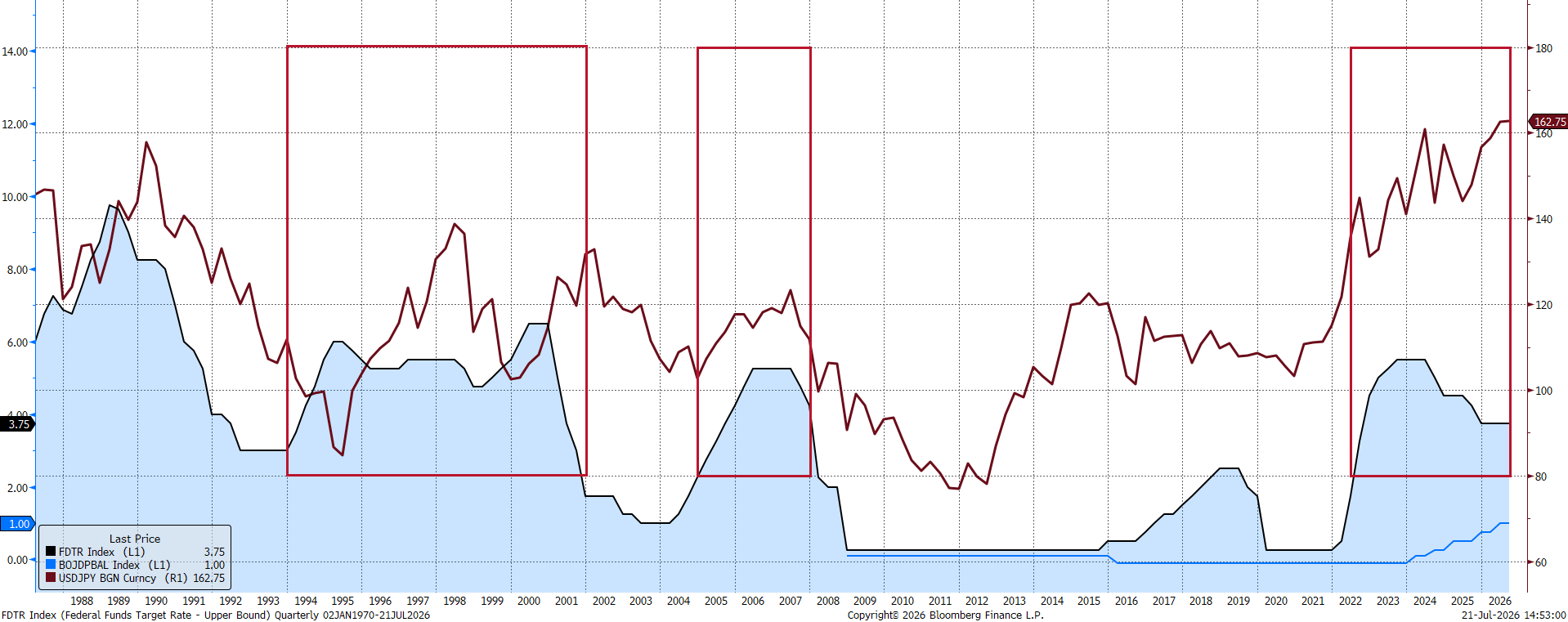
The yen, although it is in the middle of the pack, having weakened by about 0.4% against the dollar since the beginning of the week, reached a new, near 40-year low at the level of 163.2 yesterday.
In the longer term, this is, of course, largely a consequence of the return to favour of the carry trade strategy, which is based on borrowing a currency (in this case, the yen) at near-zero interest rates and immediately exchanging it for another (for example, the dollar) in order to make an investment in a market offering higher rates of return.
Figure 2: Interest Rates in the USA (Upper Bound) and Japan + USDJPY (1987 - 2026)
 Source: Bloomberg, 21.07.2026
In recent days, however, the dominant factor conditioning the weakening is the issue of the further escalation of tensions between the USA and Iran and the resulting increase in energy commodity prices.
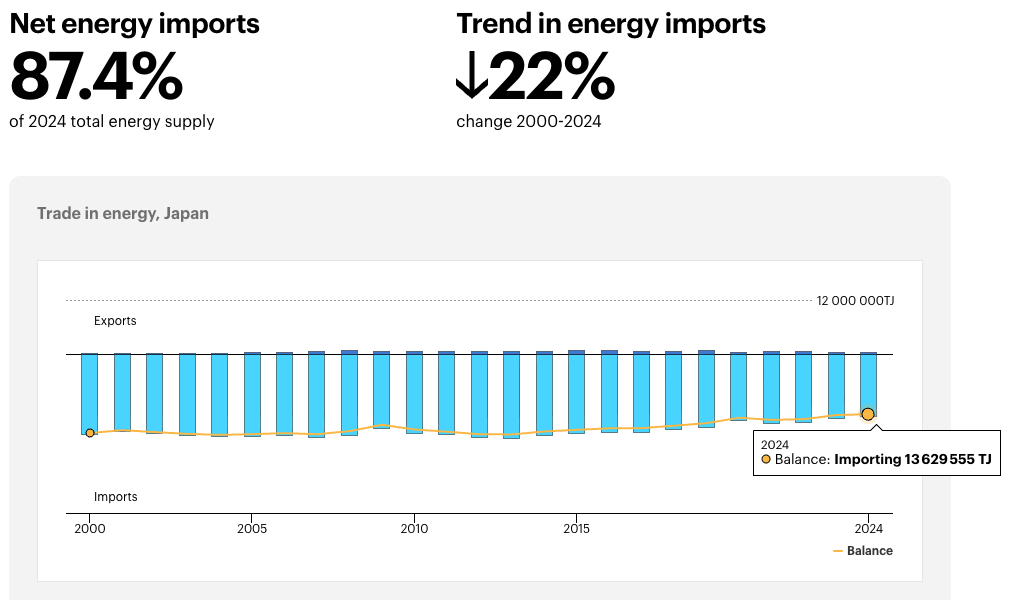
Nearly 90% of Japan's energy demand comes from imports, and under standard conditions, its main suppliers are countries in the Middle East.
Figure 3: Japan's Energy Trade Balance (1998 - 2026)
 Source: IEA, 21.07.2026
The long-term lack of de-escalation of the conflict between the United States and Iran may translate not only into a significant increase in inflationary pressure but also into problems with maintaining the continuity of supplies of key energy commodities.
₿ Cryptocurrencies
A worsening of sentiment is also visible in the cryptocurrency market, although the scale of the declines is currently small.
- Bitcoin is falling by 0.8% today, breaking the 66 thousand dollar barrier.
- Ethereum is recording a downward movement of 0.2%, which means a return to the level of 1920 dollars.
—
Michał Jóźwiak, Financial Markets Analyst at XTB



Daily Summary: A Shallow Rebound Ahead of Earnings Season


Market Wrap: A 4% surge in oil prices weighs on indices (08.10.2026)


Market Wrap: Oil rises again, French fiscal concerns weigh on euro (07.10.2026)

Oil falls below $100🚨
The material on this page does not constitute as financial advice and does not take into account your level of understanding, investment objectives, financial situation or any other particular needs.
All the information provided, including opinions, market research, mathematical results and technical analyses published on the website or transmitted to you by other means is provided for information purposes only and should in no event be interpreted as an offer of, or solicitation for, a transaction in any financial instrument, nor should the information provided be construed as advice of legal or fiscal nature.
Any investment decisions you make shall be based exclusively on your level of understanding, investment objectives, financial situation or any other particular needs. Any decision to act on information published on the website or transmitted to you by other means is entirely at your own risk. You are solely responsible for such decisions.
If you are in doubt or are not sure that you understand a particular product, instrument, service, or transaction, you should seek professional or legal advice before trading.
Investing in OTC Derivatives carries a high degree of risk, as they are leveraged based products and often small movements in the market could lead to much larger movements in the value of your investment and this could work against you or for you. Please ensure that you fully understand the risks involved, taking into account your investments objectives and level of experience, before trading, and if necessary, seek independent advice.