


Today's reshuffle in the equity market may appear somewhat surprising. Under normal conditions, an increase in interest rates should weigh on the stock market, primarily as a result of rising bond yields.
Yesterday's Fed Meeting
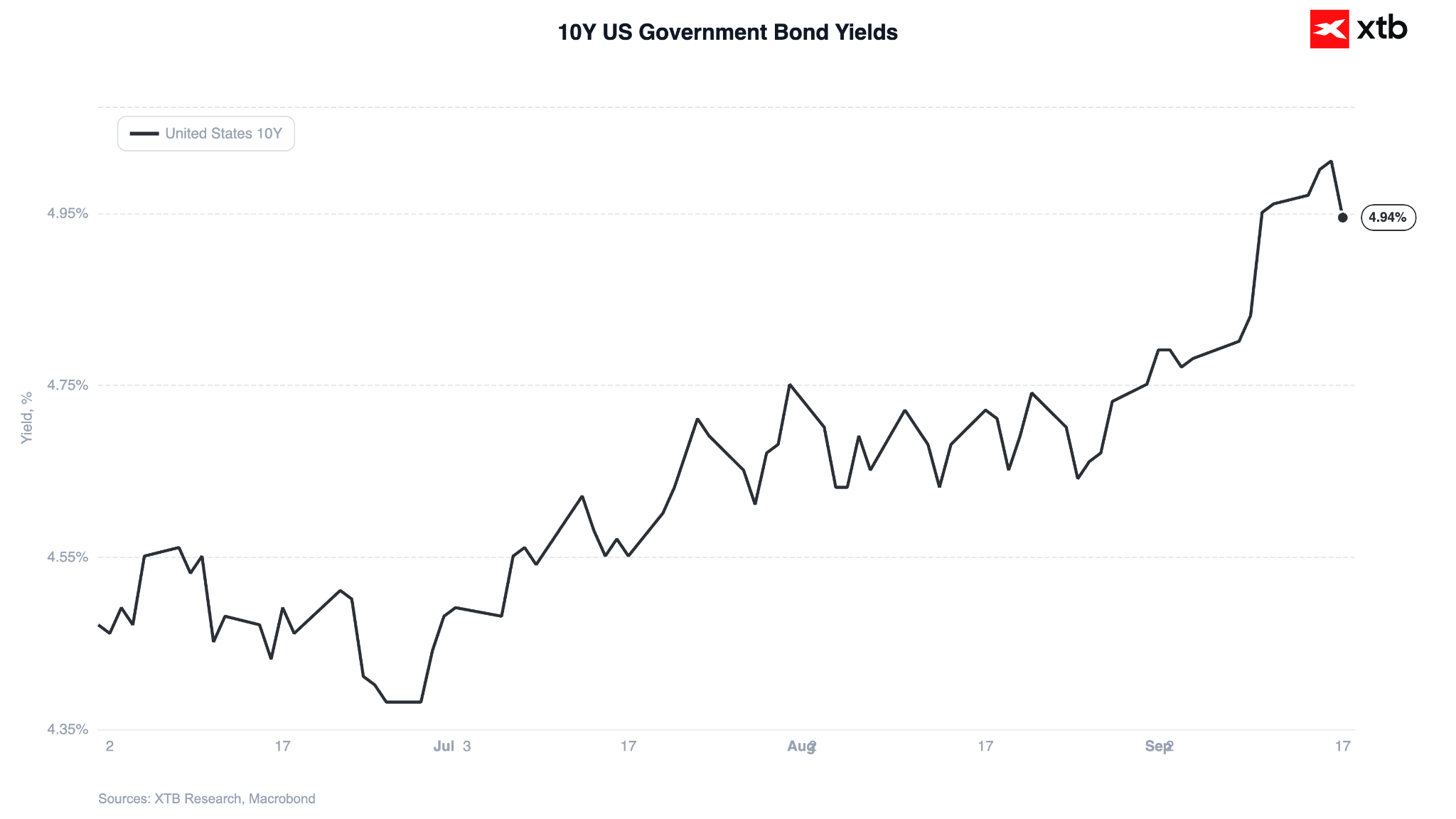
Yields on 10-year US Treasury bonds did indeed rise yesterday, climbing by nearly 1.5%. The primary driver of the move was not the rate hike itself, as the move had been almost fully priced in by the markets, meaning it should already have been reflected in asset prices.
Attention was focused on the Dot Plot, which projects the Fed's interest rate levels for coming years, as well as the rhetoric from Kevin Warsh. The tone of the new Fed Chair's statements was perceived as hawkish, suggesting further rate increases in this context.
Why Are Indices on the Rise Then?
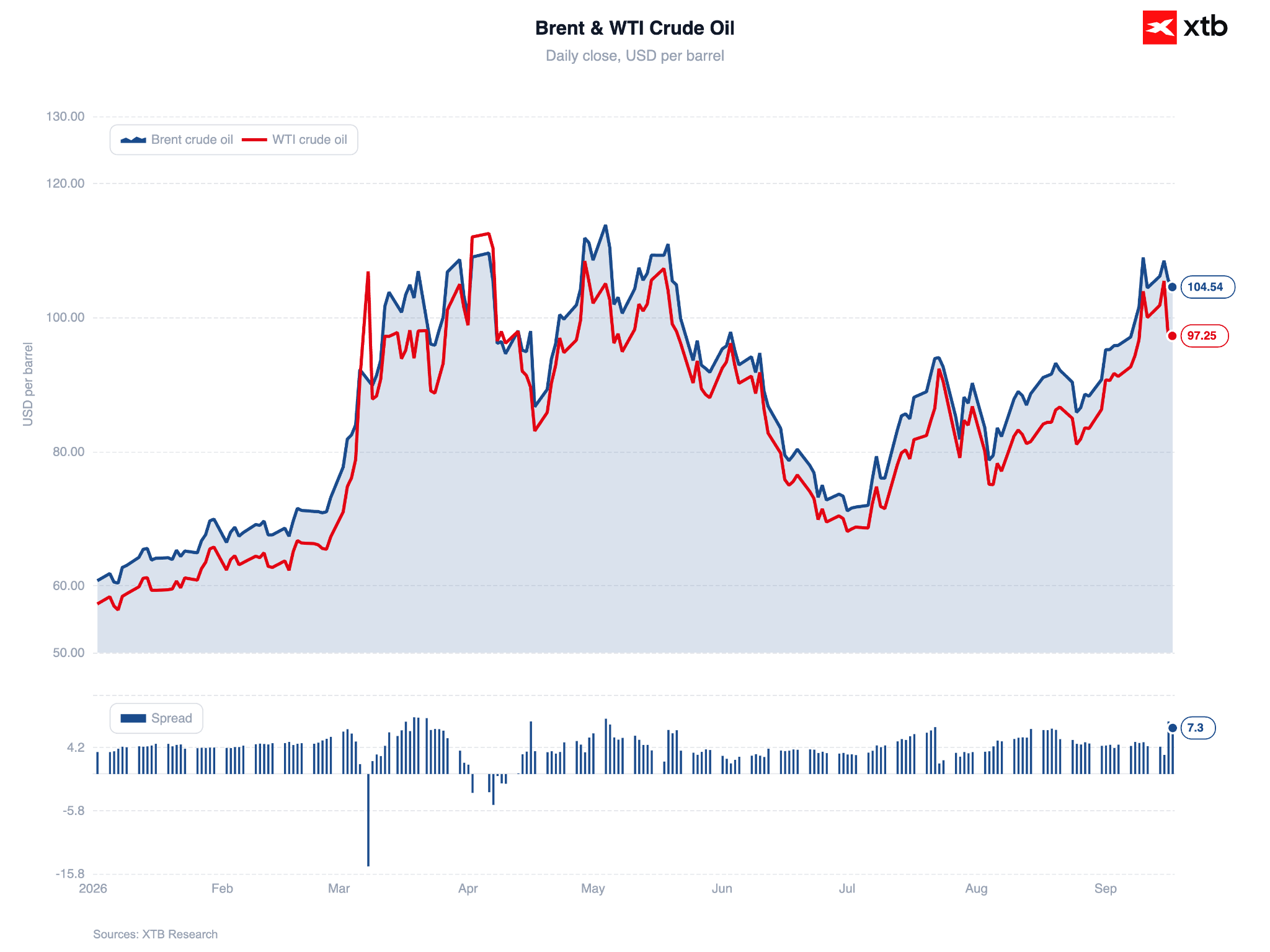
Today, yields on those bonds began to fall sharply, returning to pre-decision levels (around 1.95% for 10-year bonds). The primary catalyst for this move appears to be a sharp drop in crude oil prices. Around 2:00 PM, Brent crude was trading below $102 per barrel.
Figure 1: 10-Year US Government Bond Yields (06.2026 - 09.2026)
 Source: XTB Research, 17.09.2026
We are currently seeing a rebound to higher levels around $105. The correction in the bond market is noticeably weaker. It appears that just as important as the fall in energy commodity prices was the easing of market concerns over the Fed losing its independence, which would have unanchored inflation expectations (and required aggressive monetary tightening in the future). From this viewpoint, the interest rate hike may be seen by investors as the "lesser of two evils".
Figure 2: Brent and WTI Crude Oil (2026)
 Source: XTB Research, 17.09.2026
It is worth noting that despite his hawkish past (while serving on the FOMC between 2006 and 2011, he advocated higher interest rates despite the Great Financial Crisis), Warsh had often hinted at support for rate cuts before taking office. Just over a year ago, he openly backed the President, stating on FOX News that Trump's frustration with Powell's handling of monetary policy was fully justified. At the time, he criticised the institution for lowering rates too slowly and relying excessively on backward-looking economic data.
Yesterday's hike and accompanying rhetoric reduced the ranks of sceptics, giving Warsh a significant vote of confidence. This was something both the Fed and the market desperately needed.
Pressure from Trump
Donald Trump's reaction to the rate hike was surprisingly "calm", if one can call a caps-lock-laden post demanding interest rates be cut to 1% (or lower) calm.
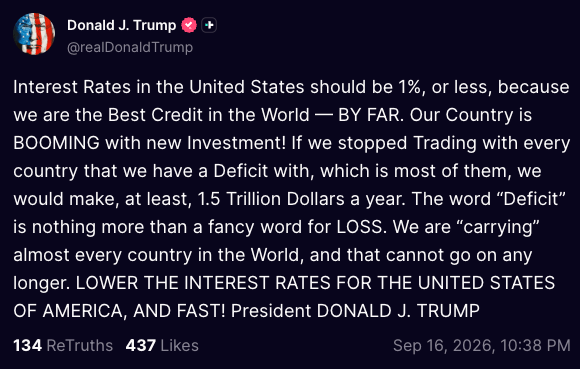 Source: Truth Social, 16.09.2026
Donald Trump's questioning of the Federal Reserve's independence remains, unfortunately, an ongoing issue. Markets remember well the pressure faced during the final months of his term by former Fed Chair Jerome Powell, who in Trump's view kept interest rates insufficiently low. The situation involving Lisa Cook cannot be overlooked either, having been "dismissed" by President Trump. The quotation marks are intentional here: the Supreme Court later overturned the decision, and Cook remains an FOMC member, set to participate in Wednesday's meeting.
Macroeconomic Outlook
Markets are currently pricing in a relatively dynamic rate-hiking cycle. The baseline scenario envisions three further upward moves before the end of the first half of next year.
Figure 3: Market-Implied Fed Interest Rate Path (2026 - 2027)
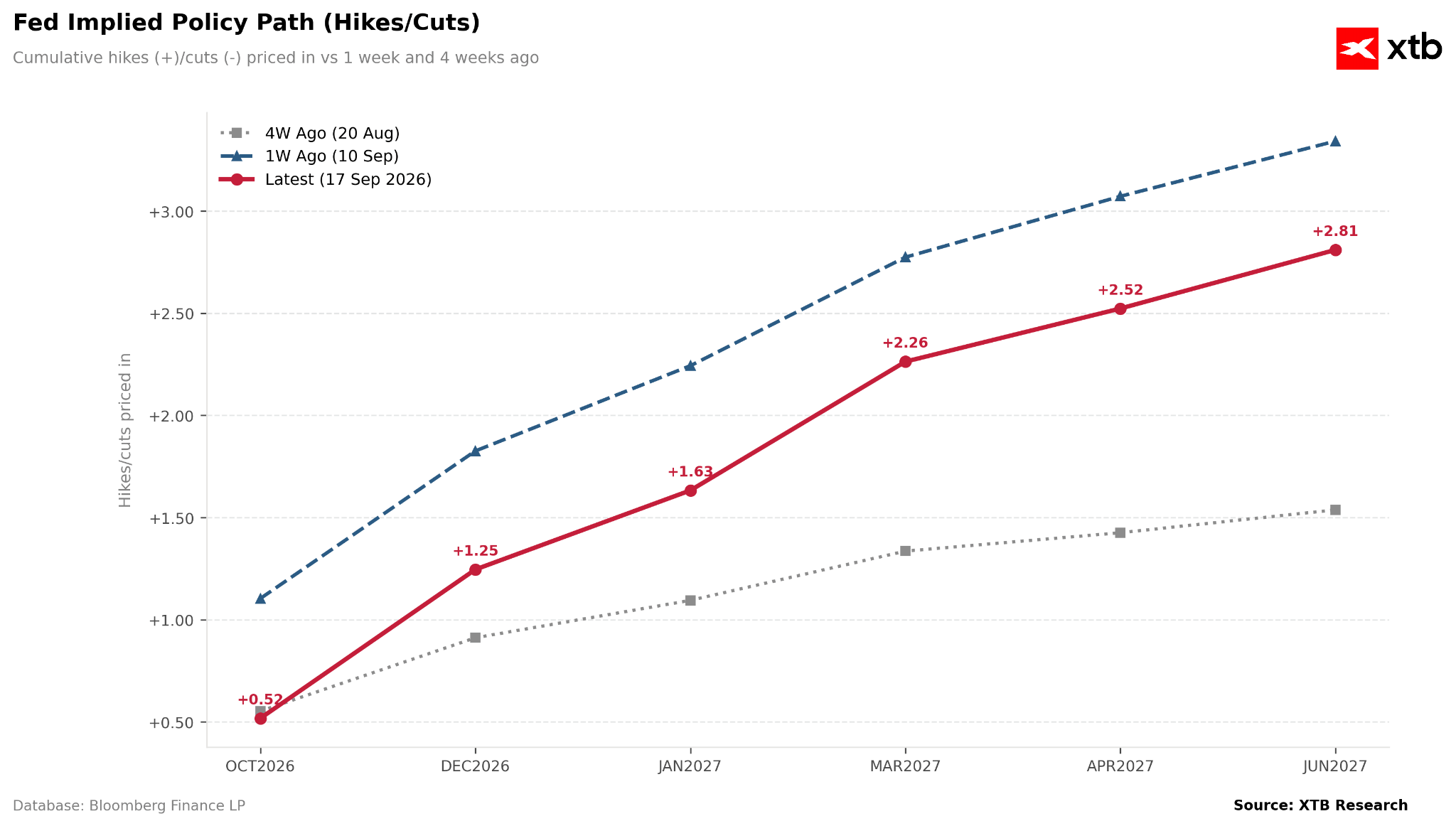 Source: XTB Research, 17.09.2026
*NOTE: The current path references a higher baseline level (i.e. the rate level following yesterday's hike)*
The FOMC enjoys a considerable comfort margin, as the economy remains surprisingly resilient and the labour market stays in a "low fire, low hire" state (low layoffs and low hiring). Therefore, a "soft landing" scenario appears likely, where modest monetary tightening cools buoyant consumption and rising inflation expectations without significantly sapping growth momentum.
Figure 4: US Initial Jobless Claims (2025 - 2027)
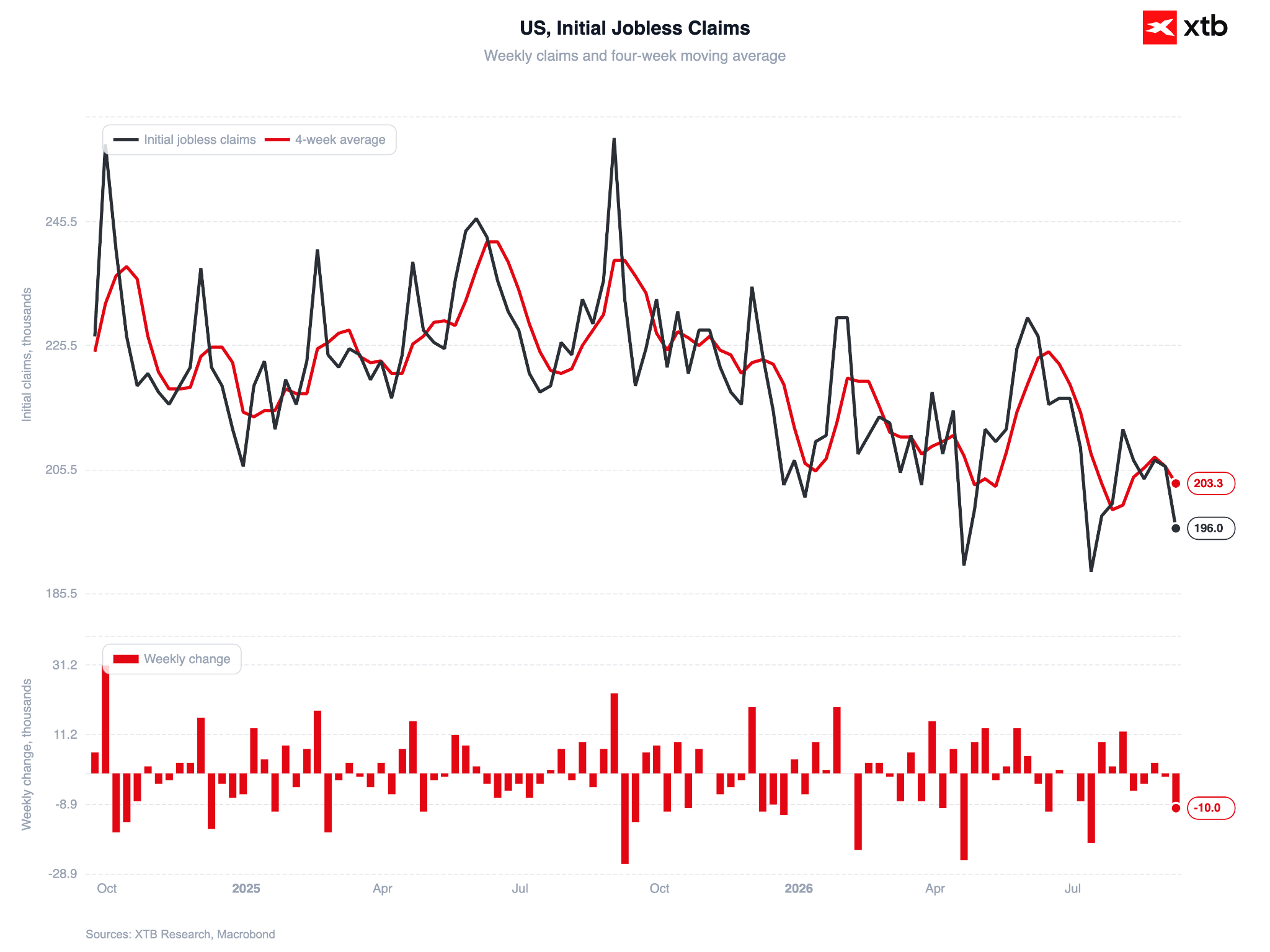 Source: XTB Research, 17.09.2026
Middle East Remains in Focus
A potential correction in energy commodity prices could, of course, trigger a sharp repricing (i.e. unwinding bets on further rate hikes), as observed at the turn of May and June. Attention is focused not only on crude oil and LNG supply (where the situation in the Strait of Hormuz and, increasingly, the Bab-el-Mandeb Strait remains critical), but also on refinery capacity.
The issue of the war in Iran will return to the spotlight in the coming weeks, given the rapid approach of the US midterm elections. From a political perspective, bringing down fuel prices at the pump is of paramount importance.
—
Michał Jóźwiak, Financial Markets Analyst at XTB


Yen loses ground after the BoJ decision
Hawkish remarks by BOJ Governor strengthen the yen – key takeaways

🏯Chart of the Day: Yen in a Trap. BoJ Hike That Weakened the Currency (18.09.2026)



Macro Calendar – Dovish BoJ Pivot and Key Data from Europe and the US
The material on this page does not constitute as financial advice and does not take into account your level of understanding, investment objectives, financial situation or any other particular needs.
All the information provided, including opinions, market research, mathematical results and technical analyses published on the website or transmitted to you by other means is provided for information purposes only and should in no event be interpreted as an offer of, or solicitation for, a transaction in any financial instrument, nor should the information provided be construed as advice of legal or fiscal nature.
Any investment decisions you make shall be based exclusively on your level of understanding, investment objectives, financial situation or any other particular needs. Any decision to act on information published on the website or transmitted to you by other means is entirely at your own risk. You are solely responsible for such decisions.
If you are in doubt or are not sure that you understand a particular product, instrument, service, or transaction, you should seek professional or legal advice before trading.
Investing in OTC Derivatives carries a high degree of risk, as they are leveraged based products and often small movements in the market could lead to much larger movements in the value of your investment and this could work against you or for you. Please ensure that you fully understand the risks involved, taking into account your investments objectives and level of experience, before trading, and if necessary, seek independent advice.