



Oil prices are moving higher during Thursday's session as investors once again focus on geopolitical risks affecting global crude supply. Market attention is centered on negotiations between Iran and Oman over the future of shipping through the Strait of Hormuz, alongside reports of new Houthi attacks on Saudi oil tankers. Additional support for prices comes from Ukrainian drone strikes targeting Russian refining infrastructure, adding to uncertainty over supply. Against this geopolitical backdrop, Saudi Arabia slightly lowered the official selling price of its flagship Arab Light crude for September deliveries to Asia. While the move points to continued competition for Asian demand, it has been largely overshadowed by geopolitical developments, which remain the primary driver of oil prices.
Key facts
- Brent crude rises toward $81 per barrel, while WTI trades close to $76 per barrel.
- Negotiations between Iran and Oman over the Strait of Hormuz remain the key market focus, although the outcome is still uncertain.
- Ukraine carried out drone strikes on two Russian refineries and vessels involved in transporting Russian crude, increasing supply disruption risks.
Iran-Oman talks remain the market's key focus
The biggest driver of oil prices is currently the ongoing negotiations between Iran and Oman over shipping arrangements through the Strait of Hormuz. According to Iran's Foreign Ministry, the parties have reached an agreement on the proposed shipping route, with a joint statement expected after consultations with the remaining participants conclude.
According to Reuters sources, the proposed deal could give Iran greater control over vessels entering the Persian Gulf. For the oil market, this could pave the way for a partial restoration of traffic through one of the world's most important energy chokepoints. However, investors remain cautious after previous attempts to reach a lasting agreement failed.
Strait of Hormuz remains critical for global oil supply
Before the conflict erupted in late February, roughly 20% of global daily oil and liquefied natural gas shipments passed through the Strait of Hormuz. As a result, any developments related to the security of the waterway or the potential resumption of normal shipping activity have an immediate impact on energy prices.
At the same time, shipping data indicate that crude oil and condensate exports from Gulf countries remain approximately 40% below pre-conflict levels, highlighting that physical supply has yet to fully recover.
Houthi attacks increase the geopolitical risk premium
Fresh reports of Houthi attacks targeting Saudi oil tankers operating in the Red Sea and the Gulf of Aden have added another layer of uncertainty to the market. Saudi Arabia has not officially confirmed the incidents, but the reports alone have contributed to a higher geopolitical risk premium in oil prices.
Analysts note that previous Houthi attacks have not significantly disrupted global oil or natural gas supplies. Nevertheless, investors remain concerned that a broader escalation could eventually translate into tangible export disruptions across the region.
Iran warns of potential attacks on regional energy infrastructure
According to Reuters, Iran has warned Gulf states that any new U.S. strike on Iranian territory would trigger retaliation against strategic energy infrastructure across the region. Such statements reinforce concerns over the security of Middle Eastern oil supplies and continue to support the geopolitical premium embedded in crude prices.
Ukraine targets Russian refineries
Developments in Russia are also influencing market sentiment. Ukraine announced drone strikes on the Bashneft-Novoil and Slavneft-Yanos refineries, as well as vessels used to transport Russian crude in the Black Sea.
Russian authorities said the refinery in Yaroslavl was hit during one of the largest drone attacks since the beginning of the war, causing a fire at the facility. Although the immediate impact on global oil supply appears limited, the market continues to view repeated attacks on Russian energy infrastructure as a factor that increases supply risks.
OIL technical outlook (D1 chart)
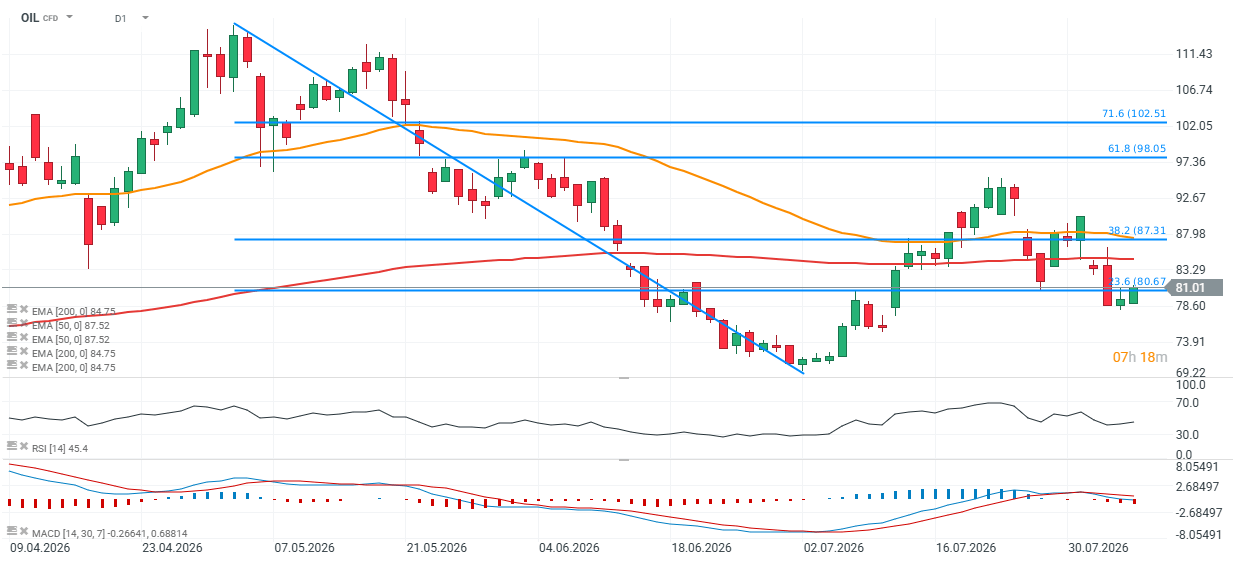
Oil prices have rebounded above the 23.6% Fibonacci retracement of the latest downward move, near $80.6 per barrel. For bulls, the next key resistance stands at $87.3, corresponding to the 38.2% Fibonacci retracement, a level reinforced by previous price reactions and the 50-day exponential moving average (EMA50, orange line). On the downside, the psychological $80 per barrel level remains the first important support, followed by the recent swing lows near $78.5 per barrel.
Source: xStation5



Three Markets to Watch Next Week (09.10.2026)



Daily Summary: A Shallow Rebound Ahead of Earnings Season


Strong rise in natural gas prices 📈🚨



US OPEN: Trump de-escalates, OpenAI supports Wall Street sentiment
The material on this page does not constitute as financial advice and does not take into account your level of understanding, investment objectives, financial situation or any other particular needs.
All the information provided, including opinions, market research, mathematical results and technical analyses published on the website or transmitted to you by other means is provided for information purposes only and should in no event be interpreted as an offer of, or solicitation for, a transaction in any financial instrument, nor should the information provided be construed as advice of legal or fiscal nature.
Any investment decisions you make shall be based exclusively on your level of understanding, investment objectives, financial situation or any other particular needs. Any decision to act on information published on the website or transmitted to you by other means is entirely at your own risk. You are solely responsible for such decisions.
If you are in doubt or are not sure that you understand a particular product, instrument, service, or transaction, you should seek professional or legal advice before trading.
Investing in OTC Derivatives carries a high degree of risk, as they are leveraged based products and often small movements in the market could lead to much larger movements in the value of your investment and this could work against you or for you. Please ensure that you fully understand the risks involved, taking into account your investments objectives and level of experience, before trading, and if necessary, seek independent advice.