


Brent crude futures continued to decline on Thursday, approaching the $70 per barrel level and erasing virtually all of the gains triggered by the conflict between the United States and Iran. Investors are increasingly pricing in a lower risk of prolonged supply disruptions, with attention shifting back to market fundamentals, including U.S.-Iran negotiations, the upcoming OPEC+ meeting, and the outlook for global oil demand. Another factor helping calm the market is the gradual normalization of tanker traffic through the Strait of Hormuz, one of the world's most critical energy shipping routes.
Market prices in de-escalation
Brent crude fell to around $70.7 per barrel, its lowest level since before the outbreak of the U.S.-Iran conflict. U.S. benchmark WTI crude also declined, slipping below $67 per barrel.
During the conflict, both benchmarks rallied sharply as geopolitical risk premiums surged. However, most of those gains have now been erased following the 60-day ceasefire and the start of indirect negotiations aimed at reaching a lasting agreement.
Strait of Hormuz helps ease supply concerns
One of the strongest drivers behind the recent decline in oil prices has been improving conditions in the Strait of Hormuz. Tanker traffic through the strategic waterway has continued to recover, reducing concerns about potential disruptions to global energy supplies.
Before the conflict, roughly one-fifth of the world's oil and petroleum exports passed through the Strait, making any change in regional tensions an important driver of oil prices.
U.S. inventories fail to support prices
Additional downside pressure followed the latest report from the U.S. Department of Energy.
Crude oil inventories declined by around 2 million barrels, but the drawdown was smaller than the market had anticipated.
The data reinforced the view that the global oil market remains relatively well supplied, limiting the case for another leg higher in crude prices.
OPEC+ may increase production again
The next major event for the oil market will be this weekend's OPEC+ meeting.
According to media reports, the producer group is expected to increase output quotas by approximately 188,000 barrels per day starting in August. If confirmed, it would mark the fifth consecutive monthly production increase, reflecting OPEC+'s strategy of gradually restoring supply as prices ease.
Meanwhile, OPEC recently lowered its 2026 global oil demand growth forecast for a second consecutive month, cutting its estimate from 1.17 million to 970,000 barrels per day. Despite the downgrade, the organization continues to expect the global economy to remain resilient despite geopolitical uncertainty.
Focus shifts back to macroeconomics as the oil chart turns increasingly bearish (OIL, D1)
With geopolitical tensions easing, investors are once again focusing on central bank policy and the inflation outlook. Lower oil prices reduce the risk of renewed inflationary pressures, potentially allowing central banks to maintain a less restrictive monetary stance.
The coming weeks will determine whether negotiations between Washington and Tehran can produce a lasting agreement. If de-escalation continues and OPEC+ delivers another production increase as expected, crude oil could remain under pressure through the second half of the summer.
From a technical perspective, the picture has also become increasingly challenging for oil bulls. The OIL contract is down around 0.6% today, while the Relative Strength Index (RSI) has fallen to 27, signaling deeply oversold conditions following the sharp decline from the $115–120 per barrel area.
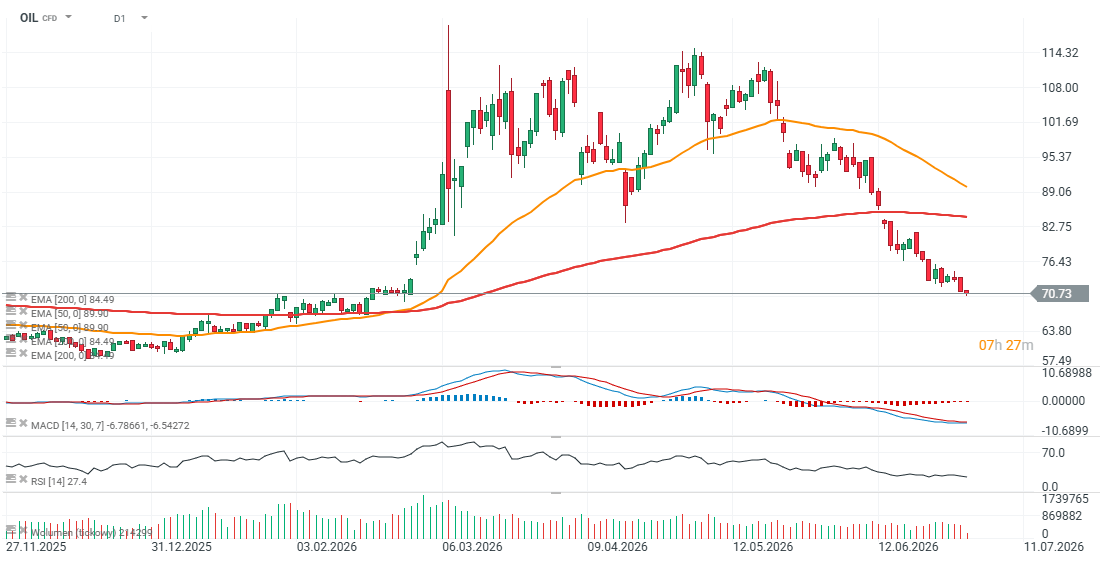
Source; xStation5



Daily Summary: Failure of negotiations in the gulf, oil and gas prices soar



US OPEN: Debt and the Strait of Hormuz fuel growing concerns.


⬆️TTF gas rises over 6% near 58 EUR



Economic Calendar: Markets Awaken After a Weekend of Geopolitical Deadlock🚢
The material on this page does not constitute as financial advice and does not take into account your level of understanding, investment objectives, financial situation or any other particular needs.
All the information provided, including opinions, market research, mathematical results and technical analyses published on the website or transmitted to you by other means is provided for information purposes only and should in no event be interpreted as an offer of, or solicitation for, a transaction in any financial instrument, nor should the information provided be construed as advice of legal or fiscal nature.
Any investment decisions you make shall be based exclusively on your level of understanding, investment objectives, financial situation or any other particular needs. Any decision to act on information published on the website or transmitted to you by other means is entirely at your own risk. You are solely responsible for such decisions.
If you are in doubt or are not sure that you understand a particular product, instrument, service, or transaction, you should seek professional or legal advice before trading.
Investing in OTC Derivatives carries a high degree of risk, as they are leveraged based products and often small movements in the market could lead to much larger movements in the value of your investment and this could work against you or for you. Please ensure that you fully understand the risks involved, taking into account your investments objectives and level of experience, before trading, and if necessary, seek independent advice.
