


The oil market is changing direction rapidly. Until recently, investors were worried about supply disruptions through the Strait of Hormuz and a potential supply shock. Today, that narrative is slowly reversing. Morgan Stanley has cut its oil price forecasts for the second time in around two weeks, arguing that flows through Hormuz are returning to normal faster than expected, while the market also faces strong U.S. production and weak demand from China. What does the bank see?
-
Morgan Stanley lowered its Brent crude forecast to an average of 75 USD per barrel for both Q3 and Q4 2026. This means previous forecasts were reduced by 15 USD and 5 USD per barrel, respectively.
-
The bank also cut its forecasts for all four quarters of 2027 and now expects Dated Brent to trade at around 70 USD per barrel by the end of 2027.
-
According to Morgan Stanley analysts, the main reason behind the revision is the faster-than-expected recovery in oil transport through the Strait of Hormuz following progress in talks between the U.S. and Iran.
-
At the same time, more oil is coming from the U.S., while demand from China remains disappointingly weak. This combination of rising supply and weaker consumption increases the risk of a global oil surplus.
-
Brent crude futures have fallen by around 30% this quarter, showing how quickly the market has moved from pricing geopolitical risk to worrying about excess supply.
-
The Strait of Hormuz remains one of the most important transport routes for the global oil market. Any improvement in the region reduces the geopolitical premium that had previously supported prices.
-
Morgan Stanley is not the only investment bank changing its view. Goldman Sachs has also lowered its oil market forecasts, suggesting that major financial institutions are becoming more cautious on the price outlook.
-
For investors, this marks a clear shift in narrative. The market is no longer focused only on conflict risk in the Middle East and is paying more attention to fundamentals — the balance between global supply and demand.
-
If production remains high and demand, especially from China, fails to accelerate, pressure on oil prices could continue in the coming quarters.
Morgan Stanley believes the biggest risk for the market is no longer a shortage of oil, but the possibility of a surplus. Such a scenario could keep Brent prices under pressure even if geopolitical tensions in the Middle East remain elevated.
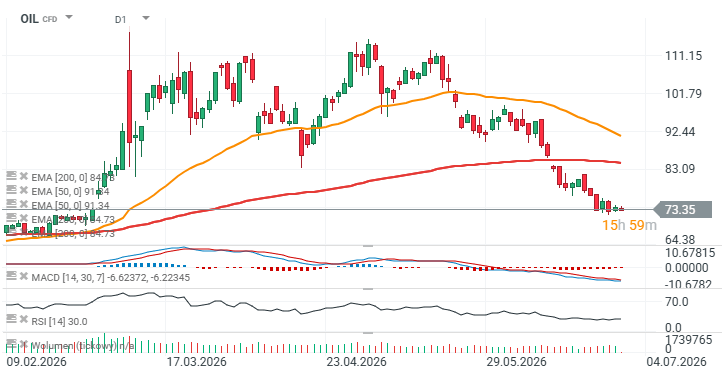
Brent crude futures chart (OIL), D1 interval
Oil has suffered a major decline and is now stabilizing in the 72–74 USD range — levels not seen since late February 2026. The RSI is close to the upper boundary of oversold territory, at around 30. The next important support level is the round 70 USD per barrel area, additionally supported by previous price reactions from February.
Source: xStation



Economic Calendar: RBA Holds Rates, Markets Await US Housing Data



Morning Wrap: Trump Sets Conditions for Iran. Oil Rises as Hopes for a Quick Reopening of the Strait of Hormuz Fade



Daily Summary: Failure of negotiations in the gulf, oil and gas prices soar


US OPEN: Debt and the Strait of Hormuz fuel growing concerns.
The material on this page does not constitute as financial advice and does not take into account your level of understanding, investment objectives, financial situation or any other particular needs.
All the information provided, including opinions, market research, mathematical results and technical analyses published on the website or transmitted to you by other means is provided for information purposes only and should in no event be interpreted as an offer of, or solicitation for, a transaction in any financial instrument, nor should the information provided be construed as advice of legal or fiscal nature.
Any investment decisions you make shall be based exclusively on your level of understanding, investment objectives, financial situation or any other particular needs. Any decision to act on information published on the website or transmitted to you by other means is entirely at your own risk. You are solely responsible for such decisions.
If you are in doubt or are not sure that you understand a particular product, instrument, service, or transaction, you should seek professional or legal advice before trading.
Investing in OTC Derivatives carries a high degree of risk, as they are leveraged based products and often small movements in the market could lead to much larger movements in the value of your investment and this could work against you or for you. Please ensure that you fully understand the risks involved, taking into account your investments objectives and level of experience, before trading, and if necessary, seek independent advice.
