


-
Oil drops on diplomacy: Iran's weekend threats to block Hormuz were quickly defused by talks with the US. Brent crude fell below $80 per barrel.
-
Massive "dark" shipping: While official traffic decreased, unofficially up to 2-3 million barrels a day are flowing through the strait with transponders turned off.
-
Higher fuel prices in Poland from July 1: The end of the CPN shield and a VAT jump (from 8% to 23%) will push gas station prices up right at the start of the summer holidays. Cheaper crude is the only cushion.

-
Oil drops on diplomacy: Iran's weekend threats to block Hormuz were quickly defused by talks with the US. Brent crude fell below $80 per barrel.
-
Massive "dark" shipping: While official traffic decreased, unofficially up to 2-3 million barrels a day are flowing through the strait with transponders turned off.
-
Higher fuel prices in Poland from July 1: The end of the CPN shield and a VAT jump (from 8% to 23%) will push gas station prices up right at the start of the summer holidays. Cheaper crude is the only cushion.
Weekend paralysis and a diplomatic twist
The past weekend brought a sharp rise in tensions in the Middle East, which initially threatened to cut off a key global oil transport hub that, before the war, accounted for 20% of the global supply of black gold and 20% of LNG trade. In response to Saturday's Israeli attacks in Lebanon, which killed over 30 people, Tehran announced the re-blocking of the strategic Strait of Hormuz, accusing the US of condoning the violation of previous agreements. It seemed that the agreement would be completely broken due to President Trump's harsh statements on social media, but this morning, ahead of the European session, shows a return to stabilization.
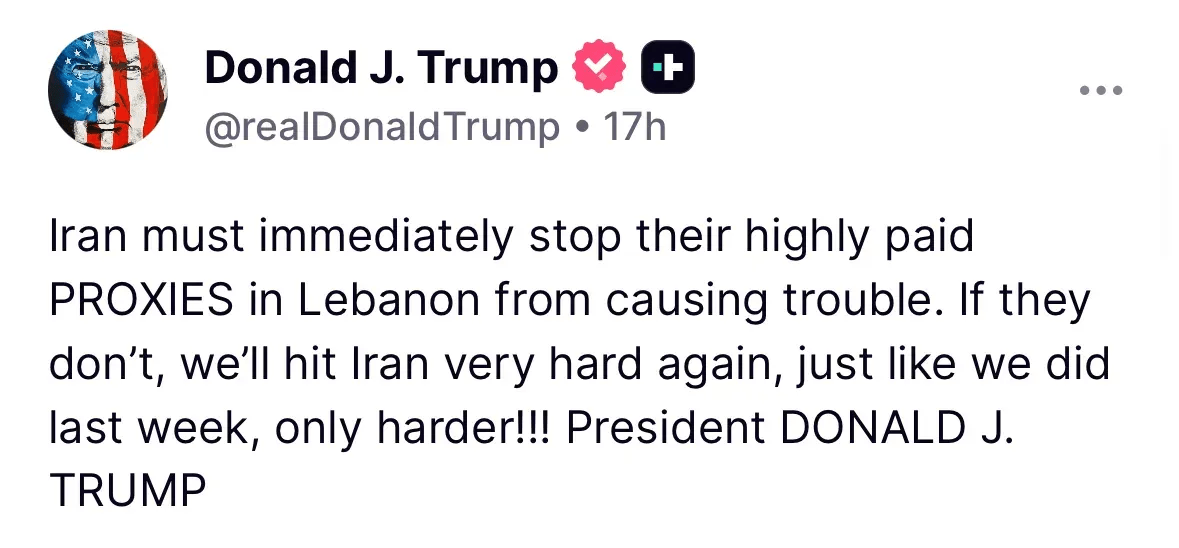 Source: Truth
Immediate mediation from Qatar and Pakistan led to another de-escalation. Talks in Bürgenstock, Switzerland, were resumed and concluded early Monday morning with the development of an official "roadmap" aimed at reaching a full peace agreement within 60 days. It is worth noting, however, that the Iranian side indicates that the initial negotiations focused primarily on Iran's frozen assets and sanctions, rather than issues concerning Lebanon. Nevertheless, the US and Iran have established a direct communication line to prevent incidents and guarantee the safe passage of commercial vessels through Hormuz, and have formed a group that is to work towards achieving lasting peace in Lebanon.
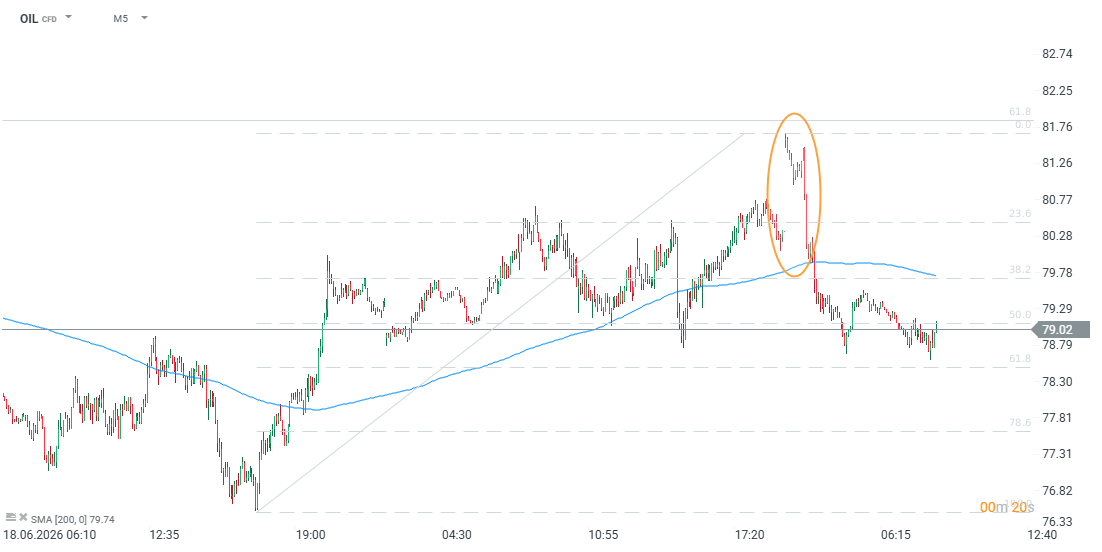
The start of today's trading, after a shortened session on Friday, was nervous. Brent oil started almost at the level of 82 USD per barrel, but prices very quickly returned to declines. Currently, Brent and WTI crude are losing about 1.5% in value, but they are still far from the local lows from last Thursday, when we were one day after the signing of the memorandum.
Two transport corridors: Traffic still heavily restricted
Despite Tehran's assurances about closing the route, millions of barrels of oil flowed continuously through the strait over the weekend, which supported the Pentagon's narrative of the ability to defend trade routes. Currently, two distinct corridors have emerged on the navigation map:
- Northern Corridor (Iranian): A route controlled by Tehran near Qeshm Island, which was used over the weekend by, among others, supertankers carrying Iraqi and Kuwaiti oil heading towards India.
- Southern Corridor (Oman): A route designated by the Joint Maritime Information Center (JMIC), running along the coast of Oman. Although navigation in this area does not require coordination with US forces, the JMIC advised ships to move with transponders (AIS system) turned on and full lighting both day and night.
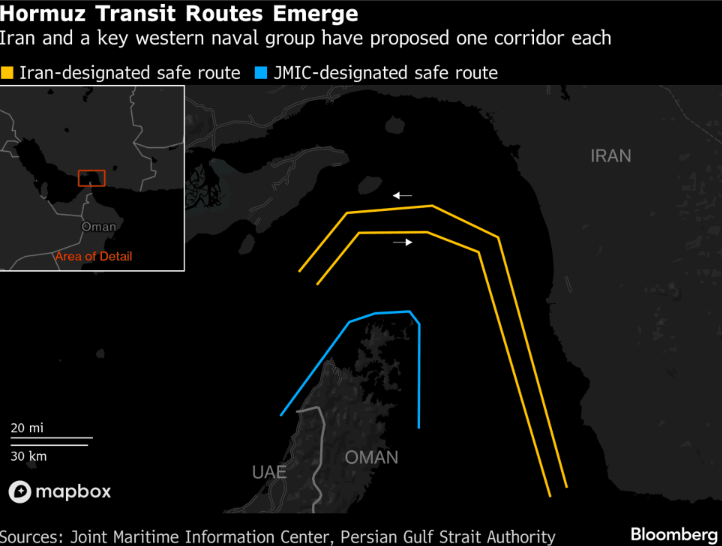 Source: Bloomberg Finance LP
Although transport was not physically completely blocked, the real volume of traffic on this key route dropped drastically, and on Sunday evening there was almost total paralysis in the strait. While in the previous days immediately after the conclusion of the preliminary agreement traffic was the highest since the beginning of the conflict, after the weekend communications from Iran, only a few smaller units decided on an open voyage with location turned on. Some producers from the region decided to send tankers "in the dark" (with transponders turned off) to perform transshipment on the high seas without attracting market attention. Such a procedure has been taking place for several weeks and reached nearly 2-3 million barrels per day. Officially, a small number of ships still pass through the Strait of Hormuz. Unofficially, it could be 2-3 times more. Source: Bloomberg Finance LP
What about LNG transport?
Data from ship tracking systems also bring information about the liquefied natural gas market. LNG carriers were observed during attempts to enter the Persian Gulf, however, the collected data indicates that these units managed to pass and leave key points of the route at the end of the day on Friday, which is before Iran's official announcements about restoring the blockade of the strait. It is worth emphasizing that an attack on a unit carrying oil, i.e., fuel, is not as dangerous as it is in the case of an attack on a gas carrier.


Yen loses ground after the BoJ decision

Hawkish remarks by BOJ Governor strengthen the yen – key takeaways

🏯Chart of the Day: Yen in a Trap. BoJ Hike That Weakened the Currency (18.09.2026)



Macro Calendar – Dovish BoJ Pivot and Key Data from Europe and the US
The material on this page does not constitute as financial advice and does not take into account your level of understanding, investment objectives, financial situation or any other particular needs.
All the information provided, including opinions, market research, mathematical results and technical analyses published on the website or transmitted to you by other means is provided for information purposes only and should in no event be interpreted as an offer of, or solicitation for, a transaction in any financial instrument, nor should the information provided be construed as advice of legal or fiscal nature.
Any investment decisions you make shall be based exclusively on your level of understanding, investment objectives, financial situation or any other particular needs. Any decision to act on information published on the website or transmitted to you by other means is entirely at your own risk. You are solely responsible for such decisions.
If you are in doubt or are not sure that you understand a particular product, instrument, service, or transaction, you should seek professional or legal advice before trading.
Investing in OTC Derivatives carries a high degree of risk, as they are leveraged based products and often small movements in the market could lead to much larger movements in the value of your investment and this could work against you or for you. Please ensure that you fully understand the risks involved, taking into account your investments objectives and level of experience, before trading, and if necessary, seek independent advice.