


- Software stocks fall ahead of the U.S. market open
- IBM warns that enterprise customers are cutting software spending
- Investors fear the entire industry could enter a slowdown in new orders

- Software stocks fall ahead of the U.S. market open
- IBM warns that enterprise customers are cutting software spending
- Investors fear the entire industry could enter a slowdown in new orders
Software and consulting stocks are selling off sharply after IBM released preliminary second-quarter results that missed expectations on both revenue and earnings. More importantly, IBM highlighted a noticeable shift in enterprise customer behavior, which investors interpreted as a potential warning sign for the broader enterprise software market.
The biggest decliners include:
- IBM: more than -20%
- Accenture: around -8%
- Cognizant: around -7%
- ServiceNow: around -7%
- Salesforce: around -5%
- Workday: around -5%
- Adobe, HubSpot, Datadog, and Microsoft: more than -3%
Companies are shifting spending from software to AI infrastructure
Beyond the disappointing financial results, the market focused primarily on comments from IBM CEO Arvind Krishna regarding customer behavior toward the end of June. According to IBM, many enterprise customers have begun redirecting IT budgets away from software, traditional IT services, and digital transformation projects toward servers, storage systems, and memory chips in an effort to secure critical hardware before prices rise even further.
The main driver behind this trend is the ongoing global shortage of HBM and DRAM memory. Massive demand from hyperscalers and AI infrastructure investments continues to push up prices for key data center components. As a result, enterprises are allocating a growing share of their IT budgets to hardware purchases, leaving less capital available for software licenses, SaaS subscriptions, consulting services, and new software deployments.
The market fears a broader slowdown across enterprise software
For investors, the key concern is that this issue may extend well beyond IBM. If enterprises continue reallocating capital from software toward AI infrastructure, software and consulting companies could face slower revenue growth over the coming quarters.
These concerns have found fertile ground because investors were already worried that AI could eventually reduce demand for traditional enterprise software and consulting services, creating longer-term headwinds for many companies in the sector. IBM also pointed to rapidly increasing cybersecurity threats, which further diverted customers' attention from executing some IT projects during the final weeks of the quarter.
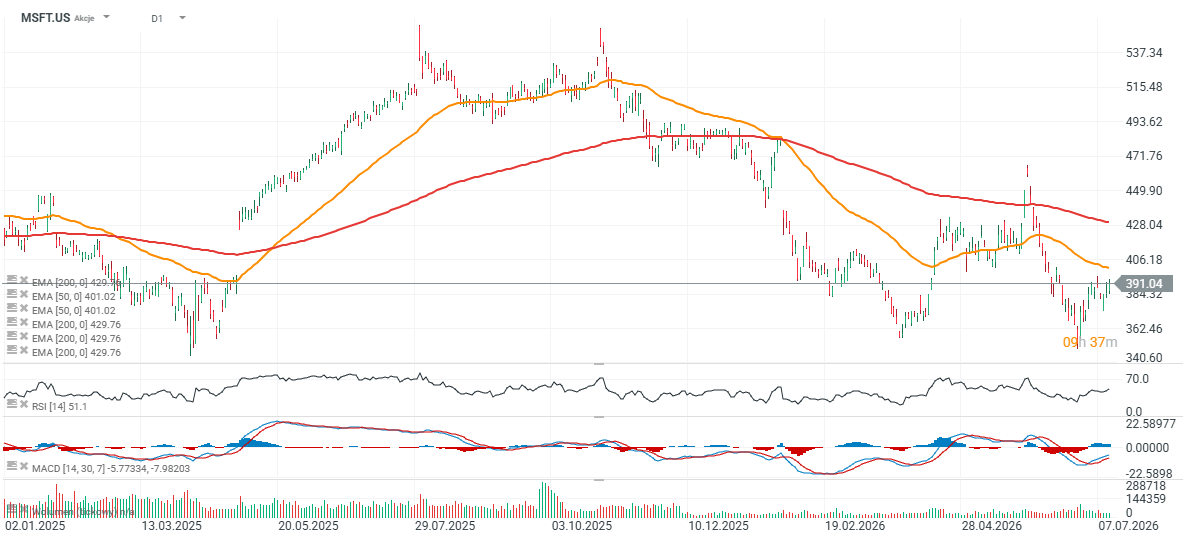
Microsoft shares (D1 timeframe)
Microsoft shares have fallen roughly 7% below their 200-day EMA (red line) and are now down nearly 30% from their all-time highs. The company has endured a challenging start to the year. After rebounding by around 10%, the RSI has recovered to 51, indicating a neutral technical position from which the stock could theoretically experience either a strong bullish or bearish move.
Source: xStation5
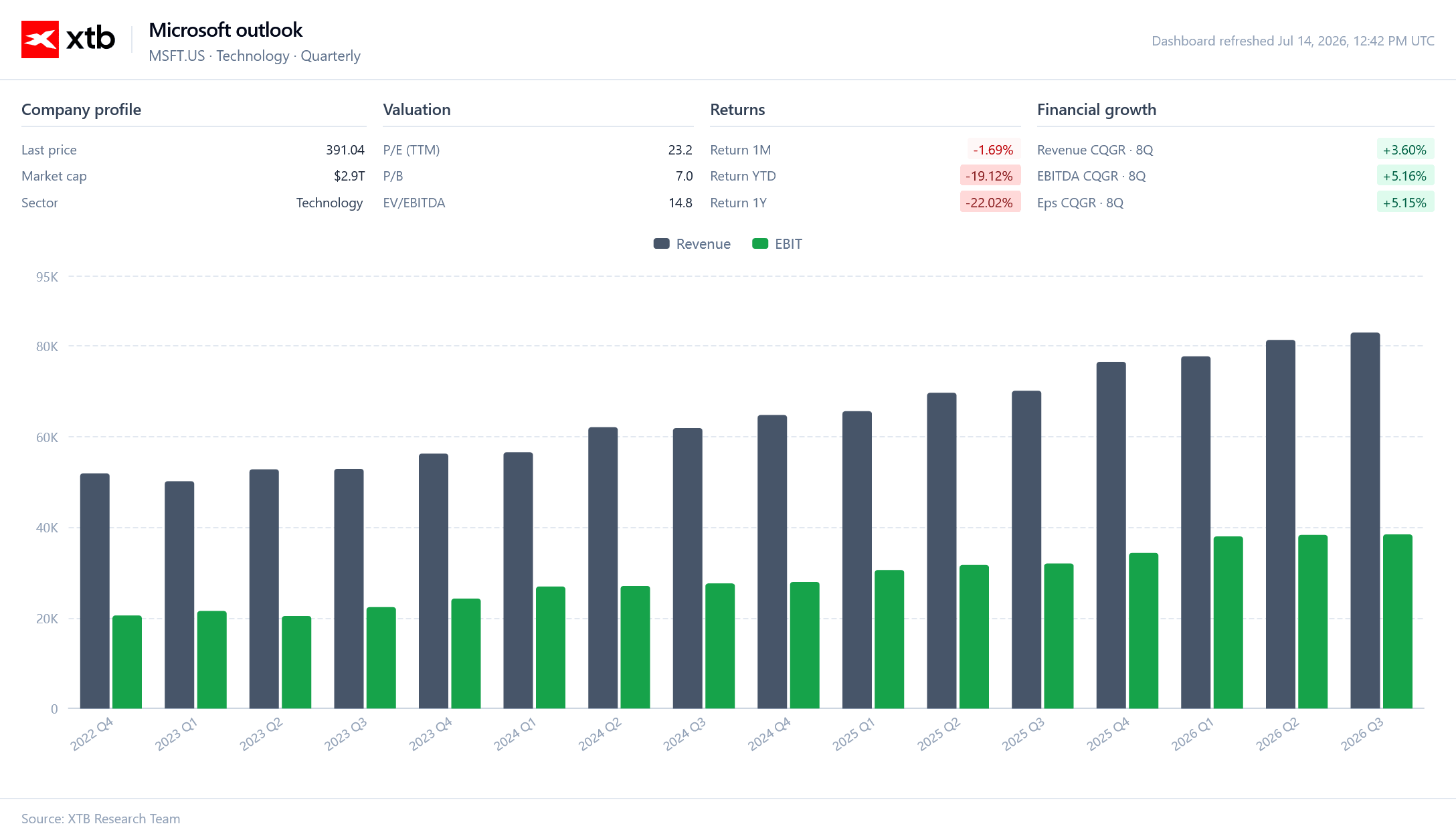
Microsoft shares are now down approximately 20% year-to-date, making the company one of the weakest performers among Wall Street's mega-cap technology stocks despite a significant year-over-year improvement in its financial results. With a P/E ratio of around 23, the valuation is not particularly demanding relative to the Nasdaq average. However, investors remain concerned about the company's massive AI-related capital expenditures, its exposure to a potentially slowing enterprise software cycle, and its substantial investment in OpenAI, which competes directly with other leading AI developers, including Anthropic.
Source: xStation5


Russia is taking over Nestlé's domestic assets 🍫 Shares are down nearly 3% 💥



Market warp: Rate Forecasts and Semiconductors in the Spotlight


Daily Summary: Hawkish Fed fails to scare the markets (17.09.2026)


Nasdaq 100 Up 1.7%
The material on this page does not constitute as financial advice and does not take into account your level of understanding, investment objectives, financial situation or any other particular needs.
All the information provided, including opinions, market research, mathematical results and technical analyses published on the website or transmitted to you by other means is provided for information purposes only and should in no event be interpreted as an offer of, or solicitation for, a transaction in any financial instrument, nor should the information provided be construed as advice of legal or fiscal nature.
Any investment decisions you make shall be based exclusively on your level of understanding, investment objectives, financial situation or any other particular needs. Any decision to act on information published on the website or transmitted to you by other means is entirely at your own risk. You are solely responsible for such decisions.
If you are in doubt or are not sure that you understand a particular product, instrument, service, or transaction, you should seek professional or legal advice before trading.
Investing in OTC Derivatives carries a high degree of risk, as they are leveraged based products and often small movements in the market could lead to much larger movements in the value of your investment and this could work against you or for you. Please ensure that you fully understand the risks involved, taking into account your investments objectives and level of experience, before trading, and if necessary, seek independent advice.