



The Korean conglomerate is one of the most important players in the global market. The brand becomes particularly significant in the context of the red-hot semiconductor market.
Massive investments by American technology companies are spilling over into successive sectors and niches, which are swelling by hundreds of percent almost week by week, driven by bottlenecks and by seemingly inexhaustible streams of money flowing from the leaders of the AI race.
One of the key components of this race is the memory segment, including DRAM, NAND, and HBM. Samsung holds around 30% of this entire market, which has grown severalfold over just the past few quarters.
From this perspective, a major shock to valuations, and to a market whose stability has all but disappeared, is the news of a strike that has erupted at Samsung Electronics. Around 48–50 thousand employees of the Korean giant are set to begin the strike as early as tomorrow, and it is expected to last 18 days.
The main axis of the conflict between employees and management is bonuses. The company recorded a 750% year-on-year increase in operating profit in Q1 2026. According to trade union representatives, they are demanding a reform of the bonus policy, including the removal of the cap that limits bonuses to 50% of annual salary, and they want the company to commit to allocating 15% of profit to bonuses.
The company’s management categorically rejected the unions’ demands, arguing that they are inconsistent with the “principles of corporate management.” Employees, union members, and strike supporters point out that Samsung’s competitor in this segment, SK Hynix - pays bonuses three times higher than those paid by Samsung.
Is this a problem for a company as large as Samsung? Yes.
About 40% of employees involved in electronics manufacturing at the company are expected to take part in the strike. Samsung declined to comment on potential production-capacity losses; however, losing even half of Samsung’s current capacity could reduce market supply by more than a dozen percent.
SMSN.UK (D1)
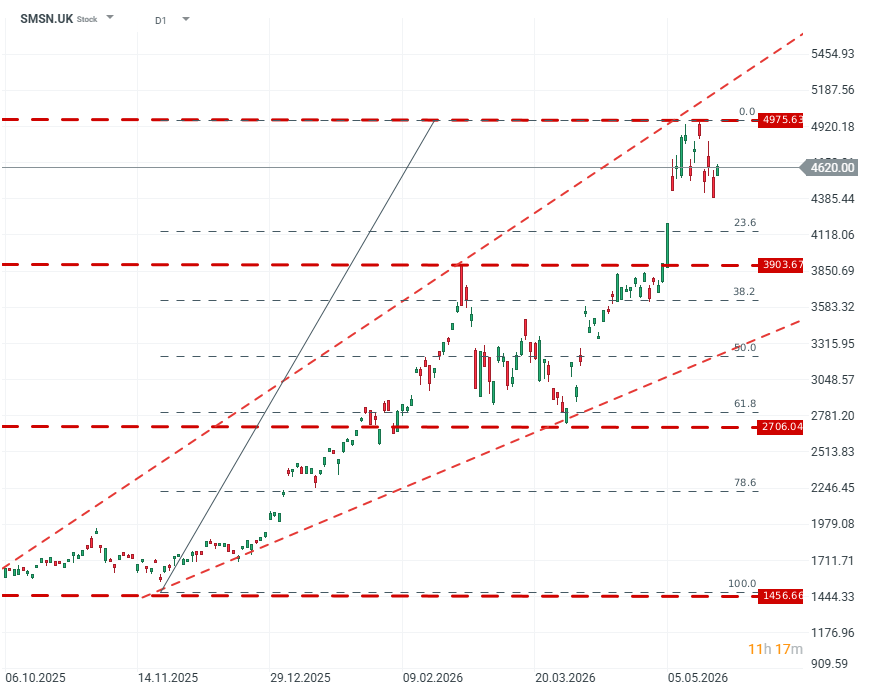
The company has gained over 150% in valuation since the beginning of the year. With expectations changing or negative surprises, there's plenty of room for correction. Source: xStation5



Daily Summary: Hawkish Fed fails to scare the markets (17.09.2026)


Nasdaq 100 Up 1.7%

US Open: Nasdaq, gold and silver surge following... an interest rate hike (17.09.2026)

US OPEN: Wall Street seeks rebound ahead of Fed decision
The material on this page does not constitute as financial advice and does not take into account your level of understanding, investment objectives, financial situation or any other particular needs.
All the information provided, including opinions, market research, mathematical results and technical analyses published on the website or transmitted to you by other means is provided for information purposes only and should in no event be interpreted as an offer of, or solicitation for, a transaction in any financial instrument, nor should the information provided be construed as advice of legal or fiscal nature.
Any investment decisions you make shall be based exclusively on your level of understanding, investment objectives, financial situation or any other particular needs. Any decision to act on information published on the website or transmitted to you by other means is entirely at your own risk. You are solely responsible for such decisions.
If you are in doubt or are not sure that you understand a particular product, instrument, service, or transaction, you should seek professional or legal advice before trading.
Investing in OTC Derivatives carries a high degree of risk, as they are leveraged based products and often small movements in the market could lead to much larger movements in the value of your investment and this could work against you or for you. Please ensure that you fully understand the risks involved, taking into account your investments objectives and level of experience, before trading, and if necessary, seek independent advice.