


Taiwan Semiconductor Manufacturing Co. has officially started mass production of 2‑nanometer chips, becoming the first company in the world to achieve a high-volume manufacturing process with Gate-All-Around transistors. This milestone marks a significant step for the semiconductor industry, introducing a structural shift comparable to the previous generations of 7‑nanometer and 5‑nanometer processes. The 2‑nanometer chips deliver higher performance at the same power consumption, or a significant reduction in energy use while maintaining current speeds, with transistor density increasing by more than 15 percent. Production is taking place at Fab 22 in Kaohsiung and Fab 20 in Hsinchu, with full capacity expected to reach 100,000 wafers per month by the end of 2026.
The company’s largest clients have already secured strategic production capacity. Apple has guaranteed more than half of the initial capacity for A20 and M6 chips, highlighting the giant’s strong reliance on the Taiwanese foundry. Nvidia and AMD have also reserved a significant portion of wafers for AI accelerators and server processors. The price per wafer is around 30,000 USD, representing a 10–20 percent premium over 3‑nanometer wafers and indicating high margins for the company.
Competition is trying to catch up, but TSMC maintains a clear advantage. Samsung started mass production of 2‑nanometer chips in November 2025, but lower yields limit its ability to attract new clients. TSMC is already working on an improved 1.6‑nanometer process with a new power delivery system, which is expected to further increase performance and reduce energy consumption, strengthening the company’s position in the next generation of chips.
For the market, the launch of the 2‑nanometer node has several important implications. TSMC is solidifying its position as a key supplier for companies in artificial intelligence and high-performance computing, where demand exceeds available production capacity. More than half of the production has already been allocated to major clients, while competitors face limited ability to expand, allowing TSMC to maintain high margins. Analysts estimate that TSMC’s revenue could grow by 20–25 percent in 2026, underscoring the strategic importance of the new node for the semiconductor market.
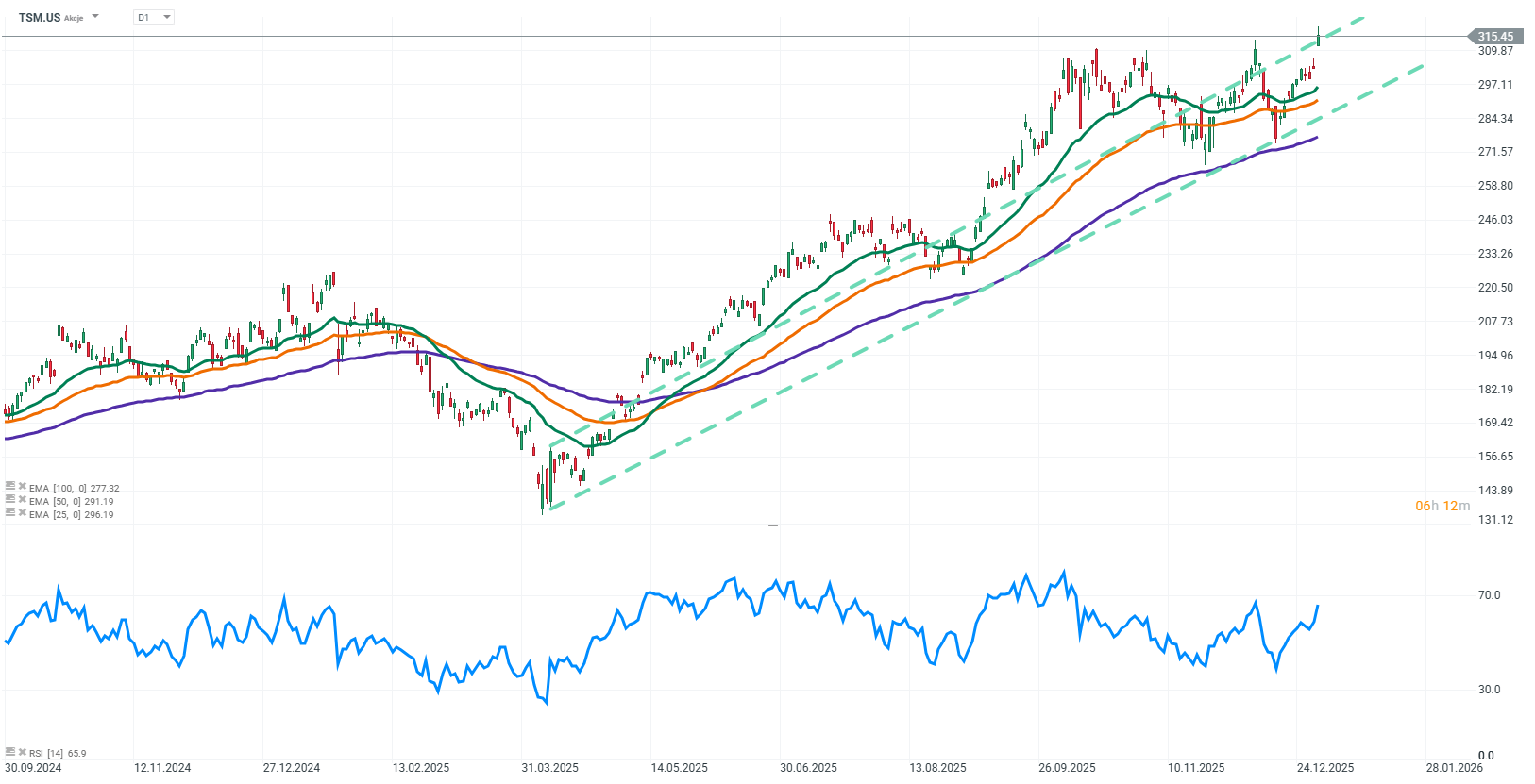
Source: xStation5



Market Wrap: Indices try to recover on US-Iran negotiations hopes 🇪🇺 SAP surges 6% after earnings 📈


Intel: AI drives results, and CPUs may be the next stage of the revolution



Defence sector earnings: Saab, Safran, Lockheed Martin


ServiceNow plunges 13% after earnings 📉Software sell-off kick-off again?
The material on this page does not constitute as financial advice and does not take into account your level of understanding, investment objectives, financial situation or any other particular needs.
All the information provided, including opinions, market research, mathematical results and technical analyses published on the website or transmitted to you by other means is provided for information purposes only and should in no event be interpreted as an offer of, or solicitation for, a transaction in any financial instrument, nor should the information provided be construed as advice of legal or fiscal nature.
Any investment decisions you make shall be based exclusively on your level of understanding, investment objectives, financial situation or any other particular needs. Any decision to act on information published on the website or transmitted to you by other means is entirely at your own risk. You are solely responsible for such decisions.
If you are in doubt or are not sure that you understand a particular product, instrument, service, or transaction, you should seek professional or legal advice before trading.
Investing in OTC Derivatives carries a high degree of risk, as they are leveraged based products and often small movements in the market could lead to much larger movements in the value of your investment and this could work against you or for you. Please ensure that you fully understand the risks involved, taking into account your investments objectives and level of experience, before trading, and if necessary, seek independent advice.
