


The publication by Google on its TurboQuant algorithm has become one of the most important catalysts for the semiconductor market in recent days, clearly ցույցing how strongly tech valuations are now tied to advances in artificial intelligence. The new solution developed by Google Research enables a dramatic reduction in memory requirements during the operation of large language models, while maintaining output quality and significantly accelerating computation on hardware such as the Nvidia H100.
The market reaction was immediate and notably jittery. Companies tied to memory and storage production, including Micron Technology, Western Digital, SanDisk, and Seagate Technology, came under selling pressure even as the broader Nasdaq 100 continued to advance. Investors initially concluded that if AI models can operate with significantly lower memory usage, long-term demand for key infrastructure components could weaken.
However, this interpretation is an oversimplification that overlooks the broader context of AI development. In reality, TurboQuant represents another step in a deeper trend where improvements in model efficiency go hand in hand with better information utilization. This is closely aligned with the idea behind the Hutter Prize, a competition that rewards advances in text compression. Its core premise is that effective compression requires understanding the structure of data, making it, in practice, a proxy for intelligence. In other words, the better a model is at predicting and structuring information, the more efficiently it can compress it.
From this perspective, TurboQuant is neither an anomaly nor a threat to the hardware market, but rather a natural manifestation of progress in AI. Language models such as Gemma and Mistral are becoming more efficient precisely because they better understand the data they process. This reduces per-task hardware requirements while simultaneously enabling a much broader range of applications.
This dynamic is often underestimated by markets in the short term. Lower deployment costs for AI can significantly expand the number of companies and industries adopting these technologies. As a result, total demand for compute, memory, and infrastructure may increase, even if individual use cases become less resource-intensive. The history of technological progress repeatedly shows that efficiency gains tend not to reduce demand, but to expand it by increasing accessibility.
It is also important to note that the discussed innovation primarily affects the inference phase, meaning the deployment of already trained models, rather than their training. The most resource-intensive stages of AI development still require substantial hardware investment. Consequently, the long-term impact of TurboQuant on demand for memory and semiconductors may be far more limited than the initial market reaction suggests.
From this perspective, the current situation fits a familiar market pattern, where a technological breakthrough triggers a short-term correction in segments perceived as potential “losers,” even though it may ultimately benefit the broader ecosystem. If AI continues along a path where better models also mean better compression and efficiency, solutions like TurboQuant may prove to be less of a threat and more of a catalyst for the next wave of AI adoption.
From this standpoint, the sell-off in memory stocks appears more like a reaction to headlines than a reflection of a fundamental shift. The longer-term outlook remains more balanced, and ongoing technological progress suggests that rather than a shrinking market, we may be witnessing its continued and dynamic expansion.
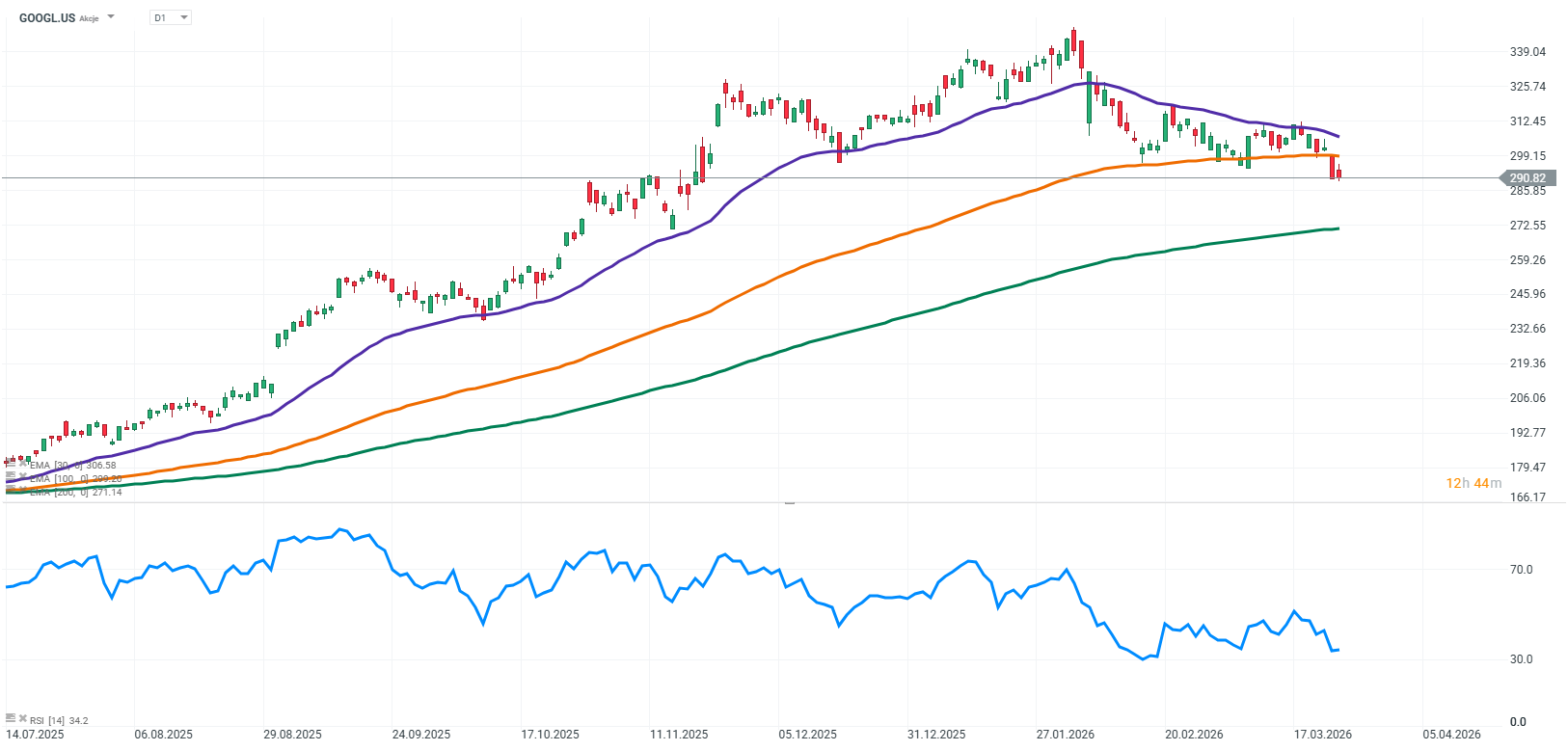
Source: xStation5



Rallies in European airline valuations



US OPEN: The Strait of Hormuz is fully open 💥Euphoria in the markets 🚀



Market wrap: Peace rumours and disapointing earnings



Morning Wrap: Trump Announces Ceasefire Between Israel and Lebanon
The material on this page does not constitute as financial advice and does not take into account your level of understanding, investment objectives, financial situation or any other particular needs.
All the information provided, including opinions, market research, mathematical results and technical analyses published on the website or transmitted to you by other means is provided for information purposes only and should in no event be interpreted as an offer of, or solicitation for, a transaction in any financial instrument, nor should the information provided be construed as advice of legal or fiscal nature.
Any investment decisions you make shall be based exclusively on your level of understanding, investment objectives, financial situation or any other particular needs. Any decision to act on information published on the website or transmitted to you by other means is entirely at your own risk. You are solely responsible for such decisions.
If you are in doubt or are not sure that you understand a particular product, instrument, service, or transaction, you should seek professional or legal advice before trading.
Investing in OTC Derivatives carries a high degree of risk, as they are leveraged based products and often small movements in the market could lead to much larger movements in the value of your investment and this could work against you or for you. Please ensure that you fully understand the risks involved, taking into account your investments objectives and level of experience, before trading, and if necessary, seek independent advice.
