

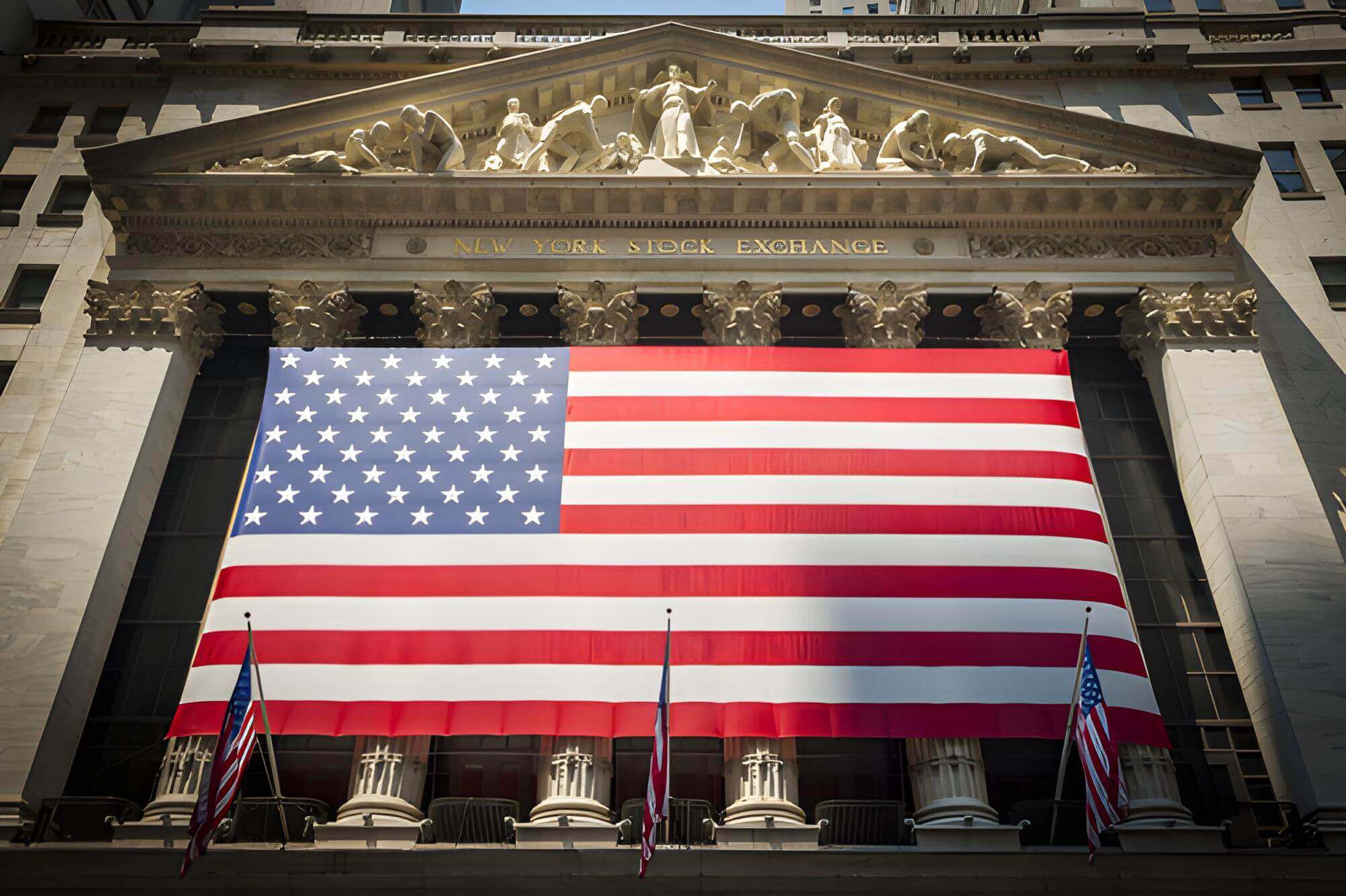
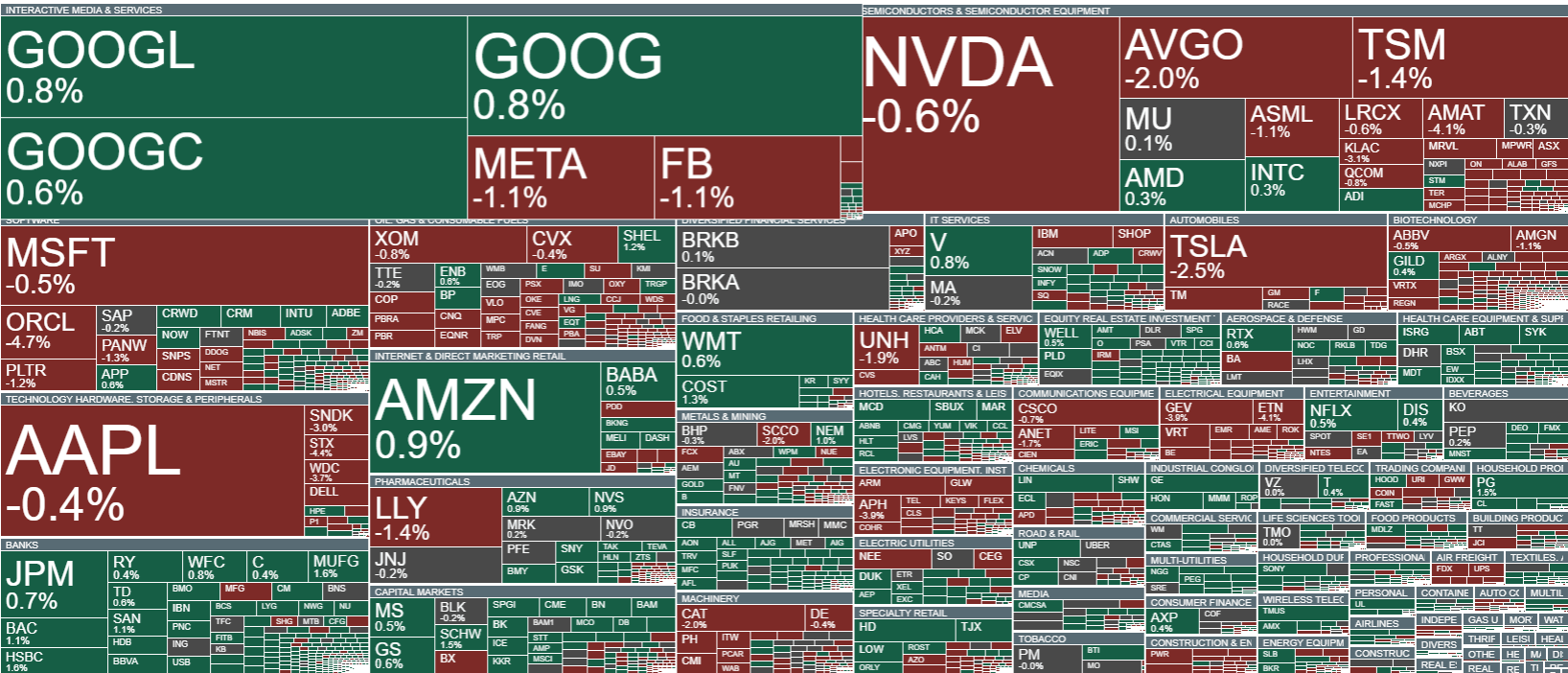
Major U.S. equity indices opened the session with mixed sentiment, while overall market direction remains limited and lacking a clear dominant trend. The Dow Jones Industrial Average is posting slight declines, similar to the S&P 500, while the Nasdaq Composite is hovering around the flat line, indicating the absence of a unified market catalyst across broader equities.
Index moves are relatively small, suggesting a cautious approach from investors and a wait-and-see attitude ahead of fresh signals. Sentiment on Wall Street remains broadly stable despite ongoing macroeconomic and geopolitical uncertainty in the background. The market appears to be operating in a low-visibility environment, where short-term data and capital flows drive intraday volatility but do not materially alter the broader market picture.
Investors have largely already priced in developments following the U.S.–China meeting in Beijing. The summit did not produce any breakthrough agreements that could meaningfully reshape trade or technology relations. Communications from both sides were limited to general statements about continuing dialogue and cautious signals of partial reopening of selected cooperation channels. In practice, the market interpreted this more as the absence of a negative surprise rather than any real progress, which in the current environment is also viewed as a form of stabilization.
Meanwhile, geopolitical tensions related to Iran remain present in the background and continue to reappear in market narratives as a potential source of volatility. Media reports and speculation around possible escalation in U.S. rhetoric periodically weigh on oil prices and broader risk assets. However, at this stage, this is not a factor that consistently drives equity valuations, but rather one that maintains an elevated level of investor caution.
The key pillar supporting market sentiment remains the technology sector, particularly semiconductors. This segment continues to act as the main driver of equity indices, offsetting weaker sentiment in other areas of the market and sustaining the overall bullish narrative. In effect, technology still sets the tone for broader market direction, while other sectors largely adjust to its momentum.
Investors are now focused on NVIDIA, which is set to report quarterly earnings this Wednesday. Expectations remain very high, with the market pricing in not only a clear earnings beat but also continued confirmation of the strength of the artificial intelligence investment cycle and rising demand for computing power. In this context, NVIDIA has effectively become a barometer for the broader AI narrative, which has been one of the key drivers of the technology rally in recent months.
Any disappointment in earnings or guidance could therefore trigger a reaction extending beyond a single stock. In such a scenario, the market could shift into a more defensive mode, with profit-taking spreading across a wider basket of technology names that have recently benefited from strong momentum. Elevated expectations leave limited room for error, meaning even a modest miss could be interpreted as a catalyst for a broader correction.
Source: xStation5
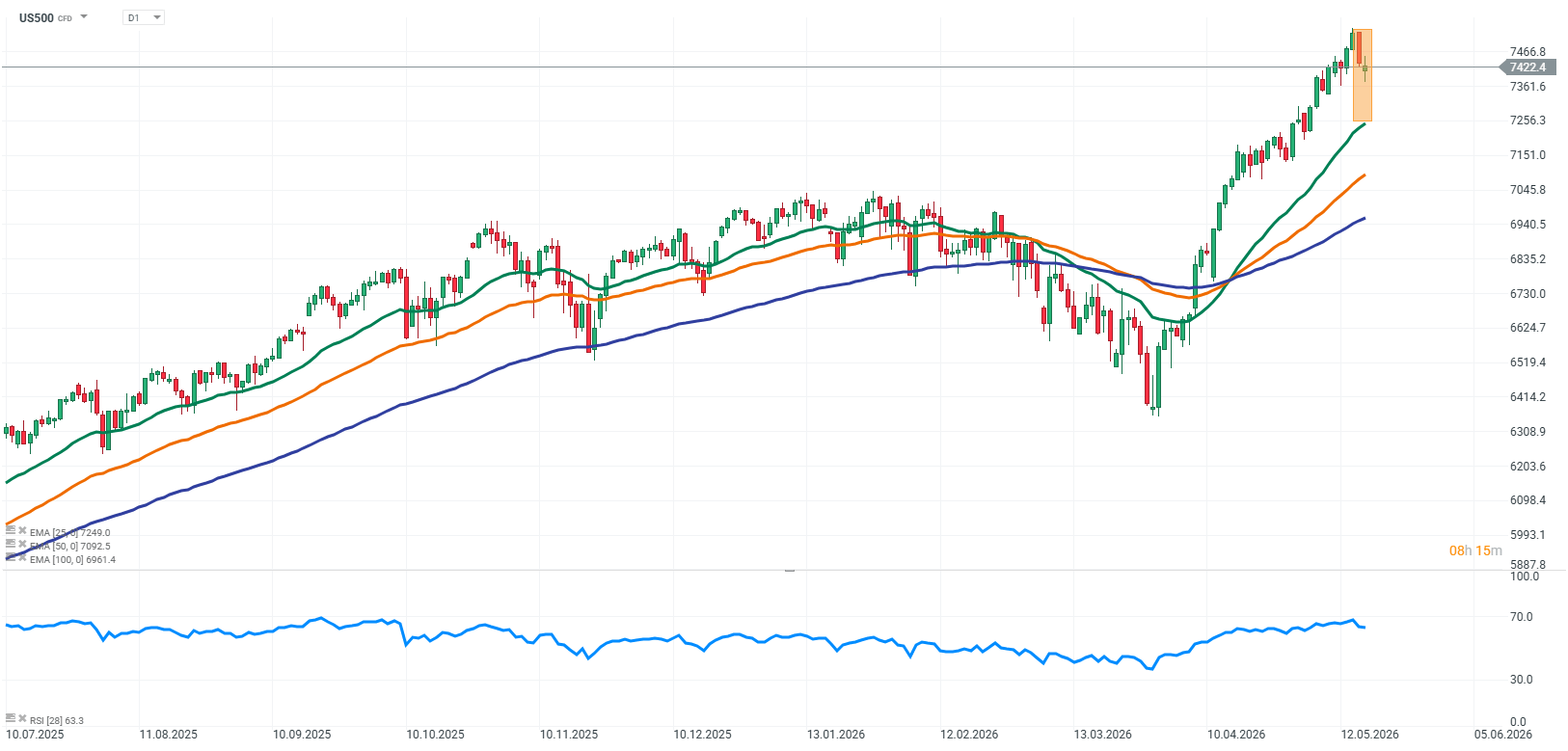
U.S. stock index futures (US500) are trading around the flat line, reflecting clear market caution and a lack of directional conviction at the start of the session. Sentiment remains subdued amid the absence of meaningful progress in U.S.–Iran relations and rising war rhetoric, which continues to increase uncertainty and encourages investors to reduce risk exposure.
Source: xStation5
Company news
Citi has raised price targets for Intel (INTC.US) and AMD (AMD.US), citing a more positive outlook for the CPU market than previously expected. Analysts anticipate stronger demand growth driven by artificial intelligence development and continued expansion of data centers, supporting a constructive view on both companies. At the same time, Intel came into focus after Donald Trump commented that, in earlier discussions regarding U.S. government involvement in the company, he “should have asked for more.”
Arm Holdings (ARM.US) is edging higher at the start of the session despite an ongoing U.S. antitrust investigation. Regulators are examining whether the company is leveraging its dominant position in semiconductor licensing to restrict competition, including limiting access to key licenses or worsening licensing terms. The investigation also considers potential conflicts of interest related to Arm’s expansion into its own chip design activities.
Ryanair (RYAAY.US) reported better-than-expected results, posting a roughly 40% increase in net profit to €2.26 billion and an 11% rise in revenue to €15.5 billion, supported by higher ticket prices and strong travel demand. Passenger numbers increased by 4%, while cost discipline further supported profitability. Despite strong results, the company highlighted ongoing uncertainty related to fuel prices and geopolitical risks.


NZD the strongest currency after a hawkish surprise from the RBNZ 📄

Economic Calendar: Richmond Fed Index and interesting companies' results ahead 🔎



Morning wrap (27.05.2026)


ملخص اليوم: قطاع أشباه الموصلات يدعم معنويات ناسداك رغم ارتفاع أسعار النفط؛ ومؤشر داو جونز الصناعي يتخلف عن الركب
The material on this page does not constitute as financial advice and does not take into account your level of understanding, investment objectives, financial situation or any other particular needs.
All the information provided, including opinions, market research, mathematical results and technical analyses published on the website or transmitted to you by other means is provided for information purposes only and should in no event be interpreted as an offer of, or solicitation for, a transaction in any financial instrument, nor should the information provided be construed as advice of legal or fiscal nature.
Any investment decisions you make shall be based exclusively on your level of understanding, investment objectives, financial situation or any other particular needs. Any decision to act on information published on the website or transmitted to you by other means is entirely at your own risk. You are solely responsible for such decisions.
If you are in doubt or are not sure that you understand a particular product, instrument, service, or transaction, you should seek professional or legal advice before trading.
Investing in OTC Derivatives carries a high degree of risk, as they are leveraged based products and often small movements in the market could lead to much larger movements in the value of your investment and this could work against you or for you. Please ensure that you fully understand the risks involved, taking into account your investments objectives and level of experience, before trading, and if necessary, seek independent advice.
