

- US strikes on Kharg Island—Iran’s main oil export terminal—combined with Tehran’s retaliation against Saudi petrochemical facilities in Jubail indicate that the conflict is expanding into the oil and gas sector, suggesting a negotiation deadlock.
- Iran is signaling a shift toward a more aggressive posture. The Revolutionary Guard has declared that “restraint is over” and warned of strikes beyond the region, raising the risk of broader international escalation.
- There are growing indications of direct threats to US and allied infrastructure. Iranian statements suggest potential targeting of military bases, energy assets, and even carrier strike groups.
- The Gulf region is increasingly affected by the conflict. The UAE has activated air defense systems in response to missile threats, pointing to a widening geographical scope.
- Internal logistics in Iran are coming under pressure. Attacks on railway infrastructure and disruptions to train services indicate strain on domestic transport systems and mobility.
- The Strait of Hormuz remains the central flashpoint. Maritime incidents and disruption risks are driving oil prices higher and fueling concerns over global energy supply.
- Markets are reacting immediately to the escalation. Brent and WTI crude prices are rising, while US equity futures are declining, reflecting a shift toward risk-off sentiment.
- Diplomatic channels remain limited and ineffective. Iran has rejected a temporary ceasefire proposal, maintaining hardline conditions, while mediation efforts continue without tangible progress.
- Global economies are preparing for potential energy shocks. The EU is convening coordination meetings, while Japan is securing oil supplies, highlighting rising concerns about prolonged disruptions.
- Crucially, Iran has responded to the US 15-point plan with its own 10-point proposal, which appears largely unacceptable to Washington. It includes demands such as lifting all sanctions, long-term security guarantees, Israeli withdrawal from Lebanon, and a $2 million transit fee per vessel passing through the Strait of Hormuz under Iranian coordination—effectively implying control over the strait.
US500 (D1 timeframe)
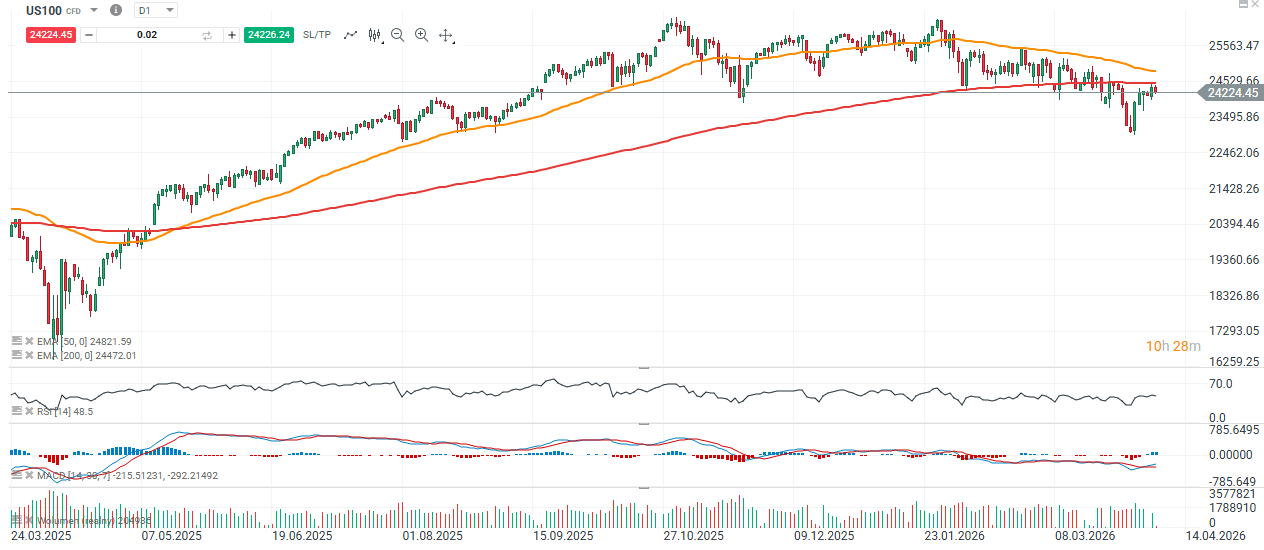
Source: xStation5



US OPEN: Further records on Wall Street at risk


Market wrap: ASML and Infineon support sentiments in Europe


Oil extends losses and tests local lows 🚩 Piper Sandler bets on a rebound


NZD the strongest currency after a hawkish surprise from the RBNZ 📄
The material on this page does not constitute as financial advice and does not take into account your level of understanding, investment objectives, financial situation or any other particular needs.
All the information provided, including opinions, market research, mathematical results and technical analyses published on the website or transmitted to you by other means is provided for information purposes only and should in no event be interpreted as an offer of, or solicitation for, a transaction in any financial instrument, nor should the information provided be construed as advice of legal or fiscal nature.
Any investment decisions you make shall be based exclusively on your level of understanding, investment objectives, financial situation or any other particular needs. Any decision to act on information published on the website or transmitted to you by other means is entirely at your own risk. You are solely responsible for such decisions.
If you are in doubt or are not sure that you understand a particular product, instrument, service, or transaction, you should seek professional or legal advice before trading.
Investing in OTC Derivatives carries a high degree of risk, as they are leveraged based products and often small movements in the market could lead to much larger movements in the value of your investment and this could work against you or for you. Please ensure that you fully understand the risks involved, taking into account your investments objectives and level of experience, before trading, and if necessary, seek independent advice.
