


Wells Fargo started 2026 with a quarter that, at first glance, appears solid at the earnings level, but in reality presents a clearly negative picture in terms of earnings quality. Despite a marginal beat on earnings per share, the bank disappointed in two key areas, namely revenue and net interest income, which directly undermines the foundations of its business model.
The report highlights a clear weakness in core retail banking activity and continued pressure on net interest margins, which remain the most important source of the bank’s revenue. At the same time, positive elements such as growth in markets activity and corporate and investment banking are not sufficient to offset the deterioration in overall earnings quality.
Despite year-over-year profit growth, the market reaction has been negative, confirming that investors are focusing on disappointments in key headline lines and the lack of convincing momentum in the core business.
Key financial results
-
Revenue: USD 21.45 billion, about USD 340 million below expectations
-
Net income: approximately USD 5.3 billion, year-over-year growth
-
Earnings per share (EPS): USD 1.60, beating forecasts by USD 0.02
-
Net interest income (NII): approximately USD 12.1 billion, below expectations
-
Credit loss provisions: approximately USD 1.1 billion, year-over-year increase
-
Corporate and investment banking: year-over-year growth
-
Private credit exposure: USD 36.2 billion
-
Return on equity (ROE): approximately 12.2%
Financial performance and profitability
At the earnings level, the report may appear stable, but its structure indicates a clear deterioration in earnings quality. EPS of USD 1.60 beat expectations only marginally, which is not sufficient to convince investors given the weakness in revenues.
Revenue of USD 21.45 billion disappointed the market and confirms that Wells Fargo is struggling to generate growth in its core business model. For a bank with strong retail banking exposure, this is a particularly negative signal.
A key issue remains the fact that earnings improvement is not driven by operating strength, but largely by cost control and more volatile income sources.
Net interest income (NII) as the key structural issue
Net interest income was the biggest disappointment in the report and remains a core issue in the bank’s investment narrative.
The result of approximately USD 12.1 billion fell short of expectations, highlighting increasing pressure on margins. The main drivers include rising deposit beta, a reduced ability to further reprice loans, and a changing interest rate environment.
For a bank like Wells Fargo, where net interest income accounts for more than half of total revenue, this is a clearly negative signal. In addition, the bank reaffirmed its full-year 2026 NII guidance of around USD 50 billion, but the weak first quarter undermines the credibility of this outlook.
Corporate and investment banking as insufficient support
The corporate and investment banking segment delivered solid double-digit year-over-year growth, benefiting from improved capital markets activity.
However, this does not change the overall picture of the report. The scale of this segment remains too small to offset the weakness in the core retail business. Compared to more diversified peers such as Goldman Sachs or JPMorgan Chase, Wells Fargo remains more dependent on net interest income.
Loans, balance sheet and exposure
The loan portfolio remains stable, and the bank continues moderate asset growth. However, this is not translating into proportional growth in net interest income, which further highlights margin pressure.
A notable element of the report is the USD 36.2 billion exposure to private credit. While not an immediate concern in the short term, it increases the bank’s sensitivity to a potential deterioration in the credit cycle.
Costs and risk
Credit loss provisions increased to approximately USD 1.1 billion, reflecting a more conservative approach to risk and potential deterioration in asset quality in upcoming quarters.
The combination of rising provisions and pressure on net interest income creates an unfavorable outlook for future profitability, particularly in the consumer lending segment.
Business structure and earnings quality
The most important conclusion from the report is the deterioration in earnings quality. The bank is generating higher profits, but not through stronger fundamentals, rather through short-term supportive factors.
The simultaneous disappointment in both revenue and net interest income, combined with their recurring weakness in recent quarters, points to structural issues in the core business. This is the factor driving the negative market reaction.
Key risks
The main risk remains continued pressure on net interest income in an environment of falling interest rates and increasing competition for deposits.
In addition, rising credit provisions, private credit exposure, and limited revenue diversification may increase the bank’s sensitivity to a downturn in the economic cycle.
Opportunities and positive factors
The positive element remains growth in corporate banking and capital markets activity, which could improve revenue diversification over the longer term.
There is also potential in private credit, although its contribution will take time to materialize and does not address the current issues in net interest income.
Outlook
In the near term, the outlook remains weak. A recovery in net interest income will be critical in upcoming quarters, as without it, the full-year guidance is increasingly at risk.
If margin pressure persists, achieving return on equity above 12 percent may prove challenging, and the bank is likely to continue losing ground to sector leaders.
Key takeaways
The first quarter of 2026 for Wells Fargo should be viewed negatively. Despite a marginal earnings per share beat, simultaneous disappointment in revenue and net interest income points to deteriorating earnings quality and pressure on the core business model.
Weakness in retail banking, rising sensitivity of deposit costs to interest rate changes, and insufficient revenue diversification all indicate that the bank is entering a more challenging phase of the cycle.
Without a clear improvement in net interest income in the coming quarters, it will be difficult to rebuild market confidence and maintain competitiveness against the largest players in the sector.
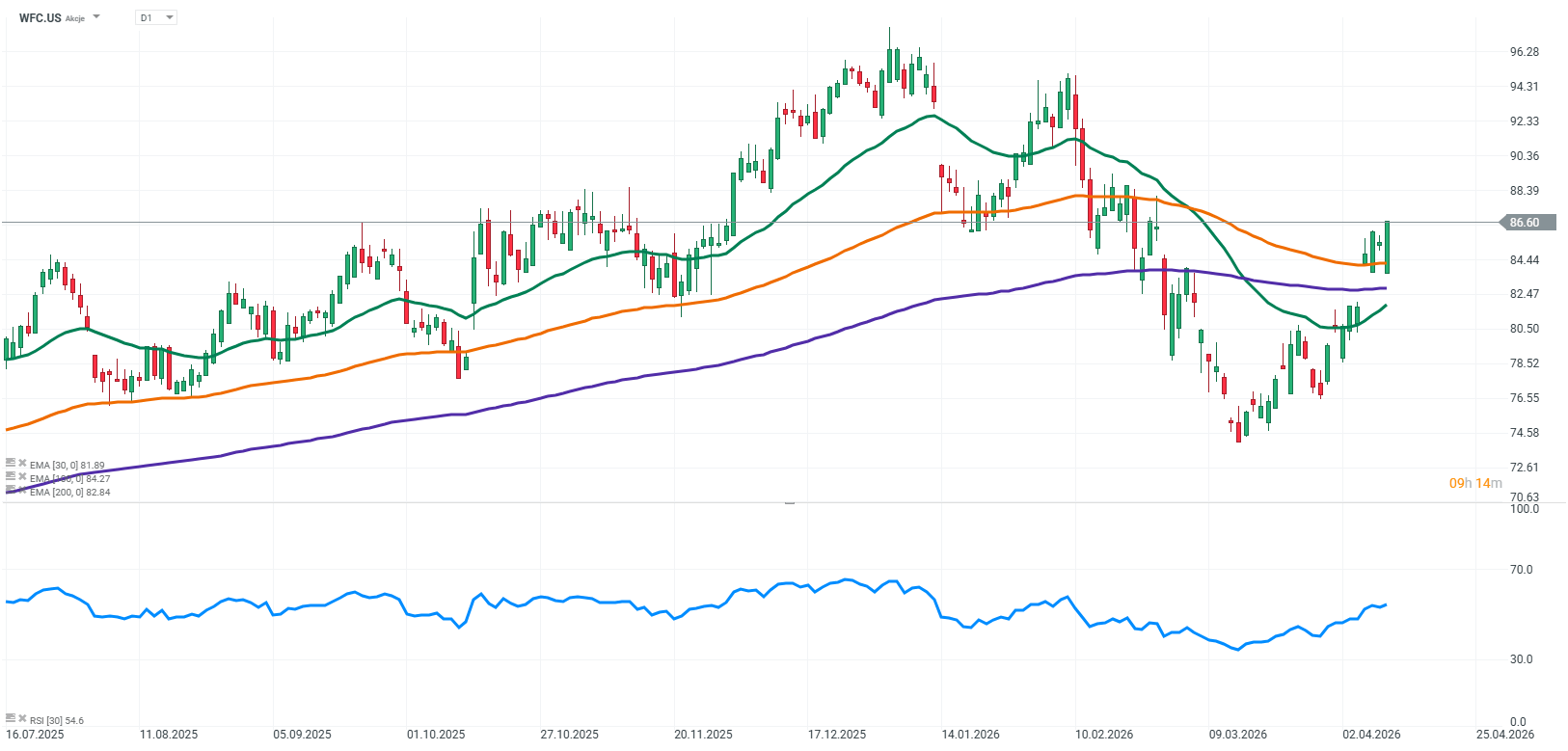
Source: xStation5



AI needs power and that’s where the profits are. Oracle and Bloom set the path.



US OPEN: Wall Street Rallies on Soft PPI Data


Novo Nordisk announces a strategic partnership with OpenAI🧬🤖


JP Morgan earnings: Good, but it could have been better
The material on this page does not constitute as financial advice and does not take into account your level of understanding, investment objectives, financial situation or any other particular needs.
All the information provided, including opinions, market research, mathematical results and technical analyses published on the website or transmitted to you by other means is provided for information purposes only and should in no event be interpreted as an offer of, or solicitation for, a transaction in any financial instrument, nor should the information provided be construed as advice of legal or fiscal nature.
Any investment decisions you make shall be based exclusively on your level of understanding, investment objectives, financial situation or any other particular needs. Any decision to act on information published on the website or transmitted to you by other means is entirely at your own risk. You are solely responsible for such decisions.
If you are in doubt or are not sure that you understand a particular product, instrument, service, or transaction, you should seek professional or legal advice before trading.
Investing in OTC Derivatives carries a high degree of risk, as they are leveraged based products and often small movements in the market could lead to much larger movements in the value of your investment and this could work against you or for you. Please ensure that you fully understand the risks involved, taking into account your investments objectives and level of experience, before trading, and if necessary, seek independent advice.
