


- Analysts estimate that the change in hiring will be +238,000 along with a 0.3% month-on-month increase in wages and the unemployment rate held at 3.8%
- However, leading indicators reported earlier indicate that the data may turn out to be higher than the above expectations
- The situation is similar if we look at the historical correlation over the past few months, when actual data turned out to be higher than expectations
The end of the week in the international markets promises to be really interesting, due to the fact that at 1:30 pm BST we will learn key NFP data from the US economy. The Fed's recent decision has further cemented for investors that the incoming macro data will determine whether interest rates in the US will be cut in Q3 2024, but whether we will have to wait until the end of the year for the first such moves. This, of course, has a huge impact on the sentiment observed in the stock markets, so we can expect today's report to cause a big jump in volatility on popular instruments. Here are the key details you need to know ahead of today's report:
What is the market expecting?
US NFP report for April.
- Change in non-farm payroll Expected: 245,000. Previously: 303 thousand.
- Change in private sector payroll. Expected: 180 thousand. Previously: 232 thousand.
- Average hourly wages on an annualized basis. Expected: 4%. Previously: 4.1%.
- Average wages per hour on a monthly basis. Expected: 0.3%. Previously: 0.3%.
- Unemployment rate. Expected: 3.8% y/y. Previously: 3.8% y/y.
What do other macro readings indicate?
- The ISM Manufacturing PMI employment sub-index rose to 48.6 from 47.4 last month.
- The ECI (employment cost index) clearly beat expectations for Q1, coming in at 1.2% versus an expected 1% increase
- ADP's employment report showed 192,000 net new jobs, above the expected 175,000
- Challenger's report indicated a sharp decline in planned layoffs relative to the March reading (66.79 thousand vs. 90.31 thousand)
- On the other hand, the 4-week moving average of unemployment claims fell slightly to 210,000 from 214,000 last month, remaining at a historic low.
Conclusion:
Given the data and historical correlation, indicators point to a slightly higher-than-expected reading in today's NFP report (combined with higher price/wage pressures) in the economy. At 3 pm BST, investors will also learn the ISM data for the US service sector, which could also be an important factor creating volatility in the markets.
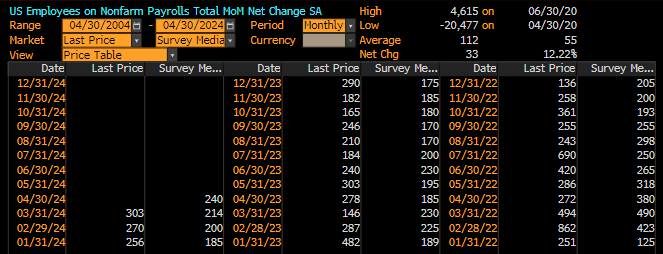
Historical correlation shows us that since December 2023, each time the NFP data has turned out to be higher than analysts' estimates. Of course, past readings are not necessarily an indication of the future, so the data should only be analyzed as a snapshot. Source: Bloomberg Financial LP
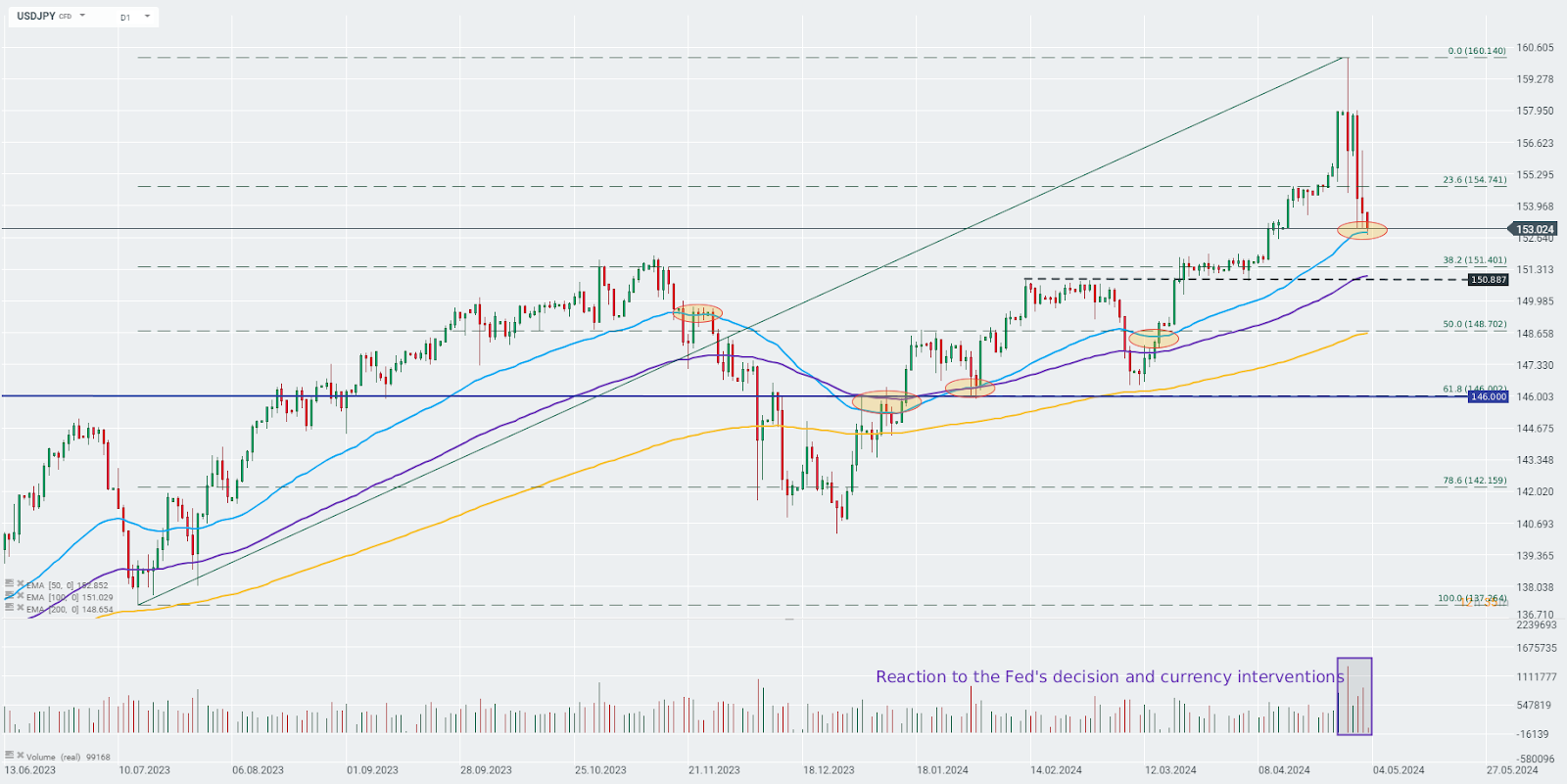
USDJPY chart (D1 interval)
The impact of today's data may be particularly well seen on the USDJPY pair, where, in addition to data from the US, internal changes in Japan's monetary policy are of great importance. We are talking about the currency interventions made this week on the pair with the yen. At the moment, the pair is trading near the 153.00 barrier, which is connected to the 50-day exponential moving average visible on the chart (blue curve). For the moment, it is this zone that may serve as a key barrier to the long-term uptrend on the pair.
Source: xStation


📈 EURUSD gains 0.5%



Market Wrap: UK100 skyrockets after BoE 🇬🇧 🚀 Euphoric gain as ECB Lagarde speaks 🇪🇺 📈

🔵 ECB Conference (LIVE)
BREAKING: ECB keep rates unchanged 📌 EURUSD back below 1,1700 📉 🇪🇺
The material on this page does not constitute as financial advice and does not take into account your level of understanding, investment objectives, financial situation or any other particular needs.
All the information provided, including opinions, market research, mathematical results and technical analyses published on the website or transmitted to you by other means is provided for information purposes only and should in no event be interpreted as an offer of, or solicitation for, a transaction in any financial instrument, nor should the information provided be construed as advice of legal or fiscal nature.
Any investment decisions you make shall be based exclusively on your level of understanding, investment objectives, financial situation or any other particular needs. Any decision to act on information published on the website or transmitted to you by other means is entirely at your own risk. You are solely responsible for such decisions.
If you are in doubt or are not sure that you understand a particular product, instrument, service, or transaction, you should seek professional or legal advice before trading.
Investing in OTC Derivatives carries a high degree of risk, as they are leveraged based products and often small movements in the market could lead to much larger movements in the value of your investment and this could work against you or for you. Please ensure that you fully understand the risks involved, taking into account your investments objectives and level of experience, before trading, and if necessary, seek independent advice.
