


-
Intervention at 160: Breaking the psychological USDJPY barrier forced Tokyo to act, pushing the rate down to 155 amid low liquidity during Golden Week.
-
Buying Time: Market interventions provide only temporary relief; a long-term trend reversal requires BoJ rate hikes and a shift in U.S. dollar strength.
-
Path to 1.0%: Despite the slow pace, high inflation and a weak yen are fueling a hawkish shift within the BoJ, with eyes on a 1.0% rate later in 2026.

-
Intervention at 160: Breaking the psychological USDJPY barrier forced Tokyo to act, pushing the rate down to 155 amid low liquidity during Golden Week.
-
Buying Time: Market interventions provide only temporary relief; a long-term trend reversal requires BoJ rate hikes and a shift in U.S. dollar strength.
-
Path to 1.0%: Despite the slow pace, high inflation and a weak yen are fueling a hawkish shift within the BoJ, with eyes on a 1.0% rate later in 2026.
Japan has once again found itself at the center of attention in global financial markets. Massive problems related to the energy crisis, high bond yields, prospects of resurgent inflation, and economic slowdown have led to another wave of yen sell-offs. Ultimately, when USDJPY once again broke through the 160 level, a currency intervention most likely took place. Although there has been no direct confirmation yet and we must wait for official, significantly delayed data from the Ministry of Finance, officials are confirming the situation between the lines and announcing a possible further fight against speculators.
A Repeat of the Past: What Happened on April 30th?
The final session of April brought dramatic scenarios. The USDJPY pair once again breached the psychological 160 barrier, triggering an avalanche of orders and forcing Tokyo to act. We quickly observed a strengthening of the yen, and the USDJPY pair dropped to the 155 level. Such a sharp move occurred during a period of low liquidity—the Golden Week in Japan. It is also worth noting that this move coincided with record highs on the June Brent crude oil contract, which also dropped significantly at the moment of the Japanese intervention.
Golden Week is a 7-day period at the turn of April and May, featuring four national holidays. Authorities in Tokyo, led by Atsushi Mimura, sent a clear signal: "Golden Week" will not be a safe haven for speculation.
History of Interventions: Is This a Good Time for the Yen? (2022–2024)
Japan has a rich, albeit bittersweet history of fighting market trends. Recent history shows that interventions are an effective "emergency brake," but they rarely change the direction of travel in the long term. It is also worth remembering that there were years when the Ministry of Finance sold the yen due to excessive strength to boost export power.
History of recent interventions:
-
September/October 2022: The first large-scale market operations in decades conducted at a record-weak yen. The result was approximately a 15% strengthening of the yen against the dollar, a move that lasted about 3 months. USDJPY returned to the October 2022 peaks after about 10 months.
-
April/May 2024: Action aimed at defending the previous 2022 peaks and the approach to the psychological level of 160 USDJPY. It brought immediate success, and the situation on the currency pair only stabilized longer-term following dovish signals from the U.S. Federal Reserve (Fed).
-
July 2024: Another strike against speculators, this time supported by hawkish rhetoric from the Bank of Japan. The effect was much more lasting than in previous cases because the intervention was accompanied by an actual interest rate hike by the BoJ. On the other hand, the downward move lasted 2 months and amounted to approximately 13.5% on the USDJPY pair.
What is the conclusion? Intervention alone is only "buying time." Real change depends on the divergence (or lack thereof) between the policies of the Bank of Japan and the U.S. Federal Reserve.
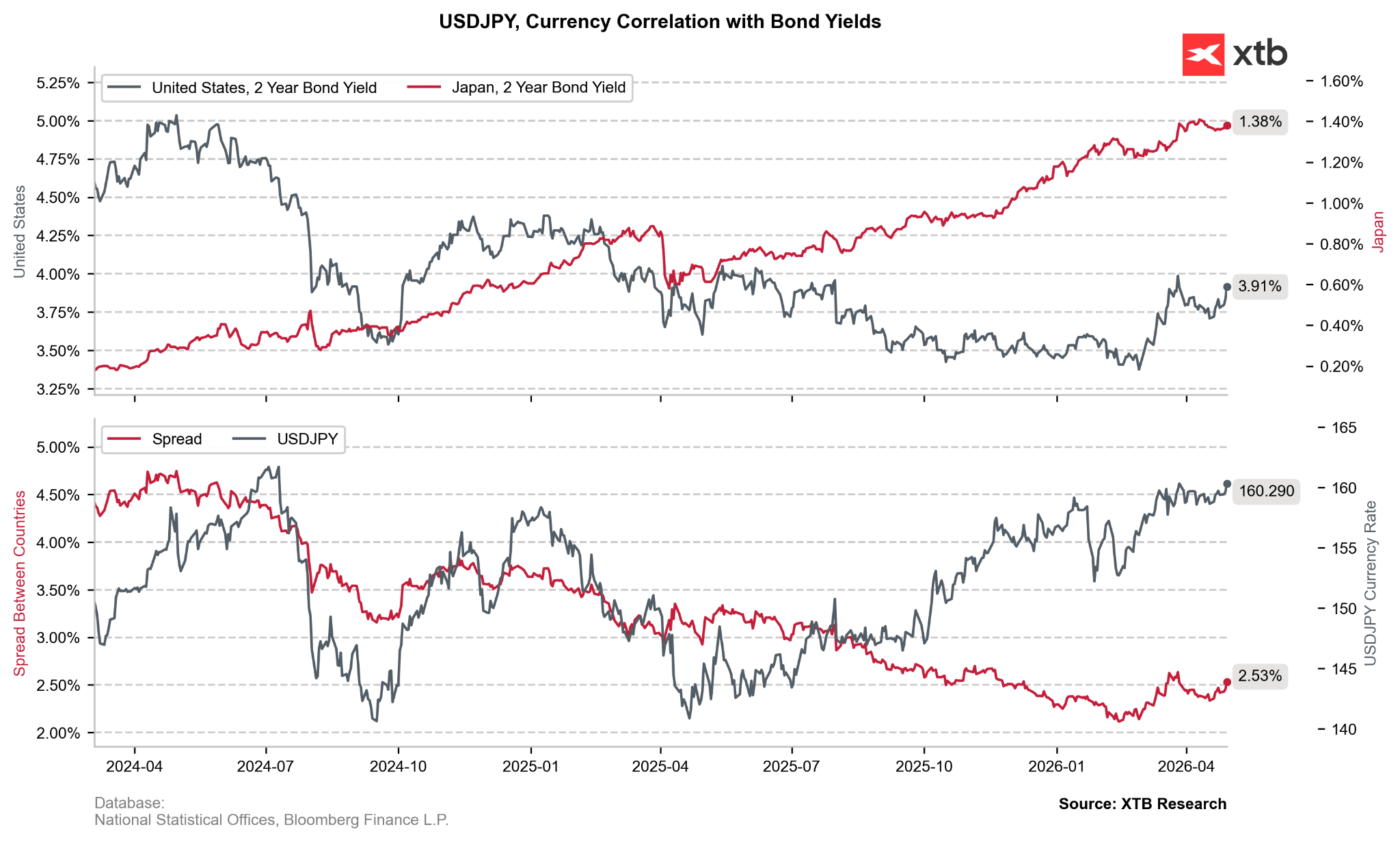 It is worth noting that the spread should have clearly favored the yen for nearly a year now, but the rise in yields in Japan is a result not only of higher interest rates but primarily concerns regarding the massive debt situation and further fiscal expansion plans. Source: Bloomberg Finance LP, XTB
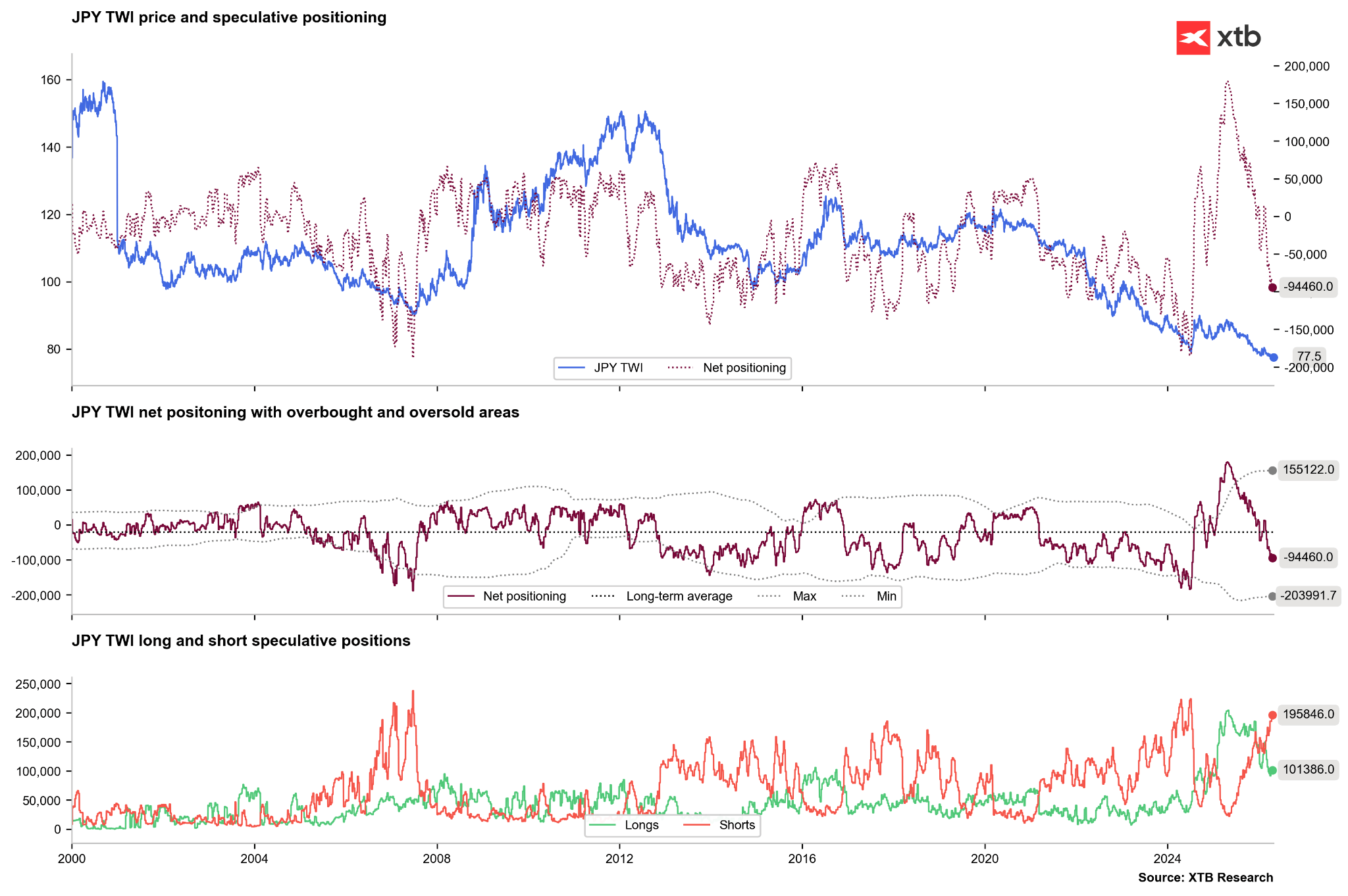 Furthermore, after the previous intervention in 2024, speculators changed their stance and a sharp short-squeeze on the yen began, with the market shifting from a net negative to a positive positioning for the first time since 2016. Currently, however, we are seeing an increase in short positions to almost the extreme high levels of 2024 or 2007. Source: xStation5
Bank of Japan Strategy: An Extremely Slow March Toward Normalization
While the Ministry of Finance fights on the front line with billions of dollars from reserves, the Bank of Japan (BoJ) is conducting an operation to normalize monetary policy after decades of maintaining extremely low interest rates. Nevertheless, due to the state of the Japanese economy, this process is very slow.
-
Where are we? After the December hike in 2025, the main interest rate in Japan stands at 0.75%—its highest level in three decades, yet still one of the lowest in the world. Japan is still being used for carry trade transactions.
-
Divisions in the board: Recent meetings have shown a growing hawkish camp. As many as three out of nine board members favor an immediate move to the 1.0% level. This means that the probability of a hike this year is high.
-
Inflationary pressure: The BoJ forecasts core inflation (core CPI) for 2026 at 2.8%, which, with current rates, means that real interest rates remain deeply negative.
What’s Next for Rates?
The base scenario assumes that the BoJ will raise rates to 1.0% still in 2026. The weak yen is a key catalyst here: expensive energy and food imports are draining the wallets of the Japanese people, becoming a political issue that the central bank cannot ignore.
Does the Yen Have a Chance for a Permanent Recovery?
The intervention at the end of April is a clear sign that Tokyo's threshold of patience lies around the 160 level. However, the fundamentals remain relentless. For the yen to gain value permanently, the market must believe in two factors: a change in BoJ communication to a more hawkish tone, which must be handled cautiously to avoid a crisis in yields; and a change in sentiment regarding the dollar. If the crisis in the Strait of Hormuz ends, the dollar will no longer be as necessary as a safe haven. On the other hand, if the Fed begins to communicate possible hikes, USDJPY could permanently find itself above 160.
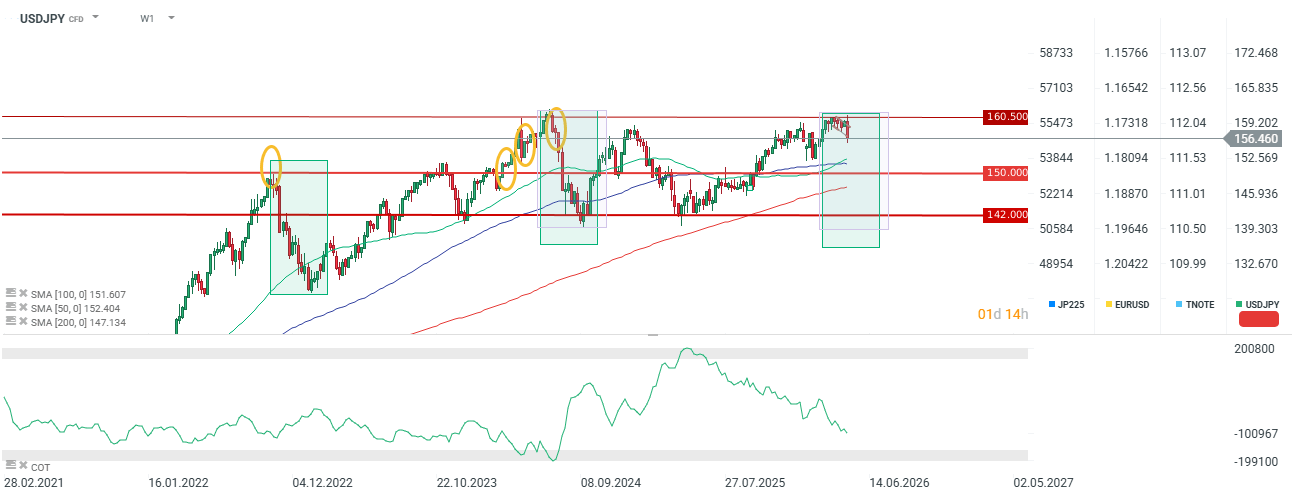 The pair is currently in an important area of potential extreme overbought conditions. Interventions would need to be carried out regularly, and additionally, we would need to see a fundamental shift on both the Japanese and global sides. Source: xStation5



Daily Summary: Nasdaq, Gold, and Bitcoin benefit from lower bond yields (03.09.2026)


Gold recovers losses


US Open: Dovish Waller supports the stock market (03.09.2026)



Market wrap: The US Strikes Iran, Oil hits the markets
The material on this page does not constitute as financial advice and does not take into account your level of understanding, investment objectives, financial situation or any other particular needs.
All the information provided, including opinions, market research, mathematical results and technical analyses published on the website or transmitted to you by other means is provided for information purposes only and should in no event be interpreted as an offer of, or solicitation for, a transaction in any financial instrument, nor should the information provided be construed as advice of legal or fiscal nature.
Any investment decisions you make shall be based exclusively on your level of understanding, investment objectives, financial situation or any other particular needs. Any decision to act on information published on the website or transmitted to you by other means is entirely at your own risk. You are solely responsible for such decisions.
If you are in doubt or are not sure that you understand a particular product, instrument, service, or transaction, you should seek professional or legal advice before trading.
Investing in OTC Derivatives carries a high degree of risk, as they are leveraged based products and often small movements in the market could lead to much larger movements in the value of your investment and this could work against you or for you. Please ensure that you fully understand the risks involved, taking into account your investments objectives and level of experience, before trading, and if necessary, seek independent advice.
