


In market terms, airlines are among the most obvious losers of the war in Iran. This conflict has not only shut down an extremely important air corridor through the Middle East, but has also triggered an explosion in jet fuel prices.
Jet fuel is a far more scarce energy carrier than other petroleum products. This is clearly visible in airlines’ financial statements, fuel accounts for roughly 30% of their operating costs on average.
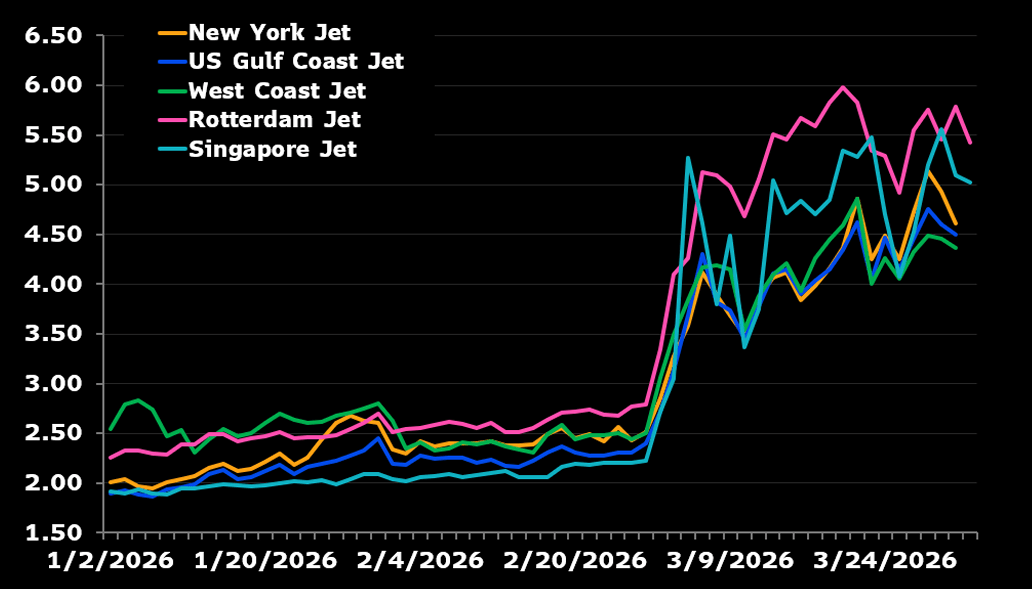
Source: Bloomberg Finance
Given that the Middle East had accounted for a disproportionately large share of global jet fuel supply, the blockade of the strait and attacks on infrastructure pushed jet fuel prices up by 100% to as much as 200%, depending on the region. The natural consequence would be strong cost pressure on airlines—i.e., a cost increase of around 30–60%.
But is that really the case?
Airlines do not rely solely on the whims of the market and producers when planning budgets. They use financial instruments that allow them to eliminate 70–80% of fuel price volatility. This means that an increase of several dozen percent, in real terms, may shrink to just a few percent.
This is positive from the perspective of potential airline results; however, such a strategy makes price and demand less tightly linked, and in the context of persistently reduced supply, this can imply a physical shortage.
Analysts at Cirium and Bloomberg indicate that, for now, major airline operators in Europe are not showing signs of a supply/fuel shock.
It is not possible, however, to determine to what extent these entities are anticipating political decisions and market reactions, and to what extent this is simply “putting on a brave face.”
What cannot be hedged against, though, is physical congestion in air corridors. The wars in Ukraine and Iran leave a very narrow belt over the Caucasus through which aircraft can travel from East Asia to Europe and vice versa. Here too, the market may still be caught off guard. An escalation of the conflict in the Middle East does not have to eliminate demand for travel, but it may shift it elsewhere—something that will be reflected in travel volumes.
The analyst consensus on companies’ results is deeply negative. For example, following Lufthansa’s Q1 results, a net loss and a nearly 10% decline in revenue are expected. A more plausible scenario is that airlines, especially those in Europe, may defy the market’s grim expectations and positively surprise with results for a difficult quarter. If, however, results for some reason turn out worse than pessimistic expectations, it could trigger a genuine flight of capital from the sector.
LHA.DE (D1)
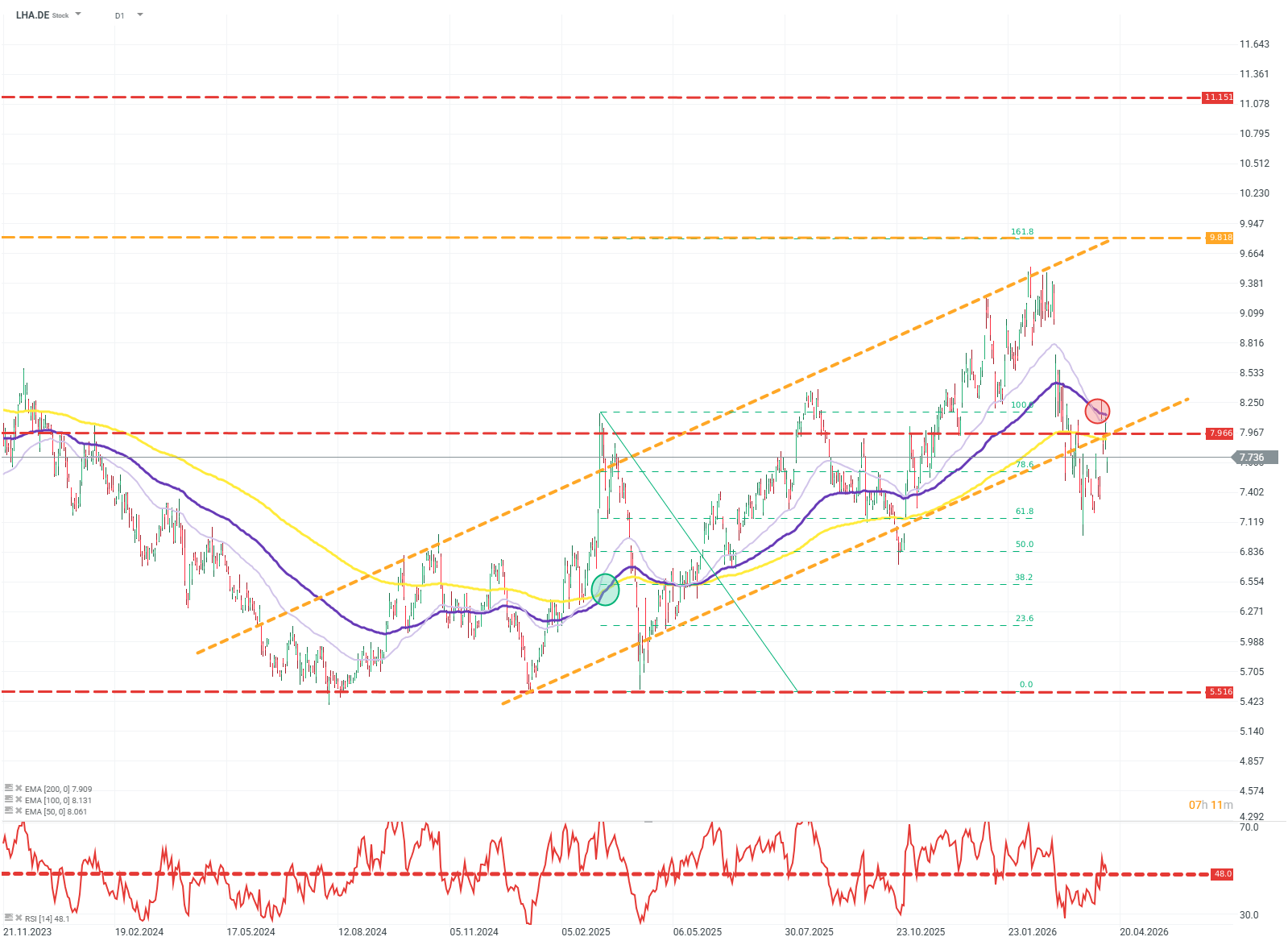
The share price continues to maintain a shallow uptrend. The momentum of EMA100 and EMA200 remains bullish, but the crossover of EMA50 and EMA100 points to clear short-term pressure. Defending the trendline will be crucial to sustaining the uptrend and potentially recouping losses. If sellers take control, the target level for further correction is around €7.1. Source: xStation5



Daily Summary: "Heat" of the NFP Print Cools Market Sentiment ⬇️


Three Markets to Watch Next Week (04.09.2026)

🟡Gold drops sharply following strong NFP

BREAKING: NFP with a massive upside; EURUSD dips 🚨
The material on this page does not constitute as financial advice and does not take into account your level of understanding, investment objectives, financial situation or any other particular needs.
All the information provided, including opinions, market research, mathematical results and technical analyses published on the website or transmitted to you by other means is provided for information purposes only and should in no event be interpreted as an offer of, or solicitation for, a transaction in any financial instrument, nor should the information provided be construed as advice of legal or fiscal nature.
Any investment decisions you make shall be based exclusively on your level of understanding, investment objectives, financial situation or any other particular needs. Any decision to act on information published on the website or transmitted to you by other means is entirely at your own risk. You are solely responsible for such decisions.
If you are in doubt or are not sure that you understand a particular product, instrument, service, or transaction, you should seek professional or legal advice before trading.
Investing in OTC Derivatives carries a high degree of risk, as they are leveraged based products and often small movements in the market could lead to much larger movements in the value of your investment and this could work against you or for you. Please ensure that you fully understand the risks involved, taking into account your investments objectives and level of experience, before trading, and if necessary, seek independent advice.
