

Reports circulating in the media suggesting that Microsoft may have withdrawn from a potential data center capacity leasing agreement with Oracle, valued at approximately $3 billion, should at this stage be treated primarily as unconfirmed, speculative market information. Importantly, Oracle has publicly challenged parts of these reports, pointing to inconsistencies and emphasizing that its cloud relationship with Microsoft remains ongoing. At the same time, Microsoft has not commented on the matter, which leaves room for interpretation and maintains an elevated level of uncertainty around the situation.
Markets react to narrative, not just facts
Even in the absence of a confirmed termination of the contract, the mere emergence of such reports carries market significance, as it fits into the broader narrative surrounding Oracle’s aggressive expansion in AI and cloud infrastructure. The company is currently in a phase of very intensive investment in data centers and computing capacity, which translates into significantly higher capital expenditures and increasing pressure on the balance sheet and cash flow profile.
In this environment, investors are particularly sensitive to any signals related to demand stability and the pace of monetization of the expanding infrastructure base. The issue is therefore not limited to a single contract, but rather its role as part of a larger framework in which Oracle must simultaneously scale computing capacity while securing sufficiently large and stable demand.
The importance of contract size in Oracle’s current model
Although the contract in question is valued at approximately $3 billion, it is not a marginal figure in the context of Oracle’s current strategy. The market is primarily valuing the company through expectations regarding growth in its cloud infrastructure segment, backlog expansion dynamics, and its ability to effectively monetize that backlog. In this setup, any information suggesting potential delays, changes in scope, or the risk of losing a major customer affects perceptions of future cash flow quality, even if it does not immediately alter the long-term growth trajectory.
In practice, such reports operate mainly through sentiment and expectations rather than direct fundamental impact. During periods when Oracle’s valuation is strongly driven by AI and infrastructure growth narratives, any signal of uncertainty in the pipeline can be further amplified by the market.
Broader investment context and capital intensity pressure
Oracle is currently in a highly capital-intensive phase of development, aggressively expanding its data center footprint and computing infrastructure in an effort to strengthen its competitive position against hyperscalers such as Microsoft, Amazon, and Google. This business model requires large and often forward-looking investments that must be justified within a relatively short time frame through growth in cloud and AI-related revenues.
In this context, the speed of converting investments into actual revenues and the stability of the contract pipeline become particularly important. The market is increasingly focused not only on the size of the backlog, but also on its quality, durability, and execution risk. For this reason, even unconfirmed reports about potential issues in large contracts can affect short-term sentiment and increase investor caution toward the stock.
Key takeaways
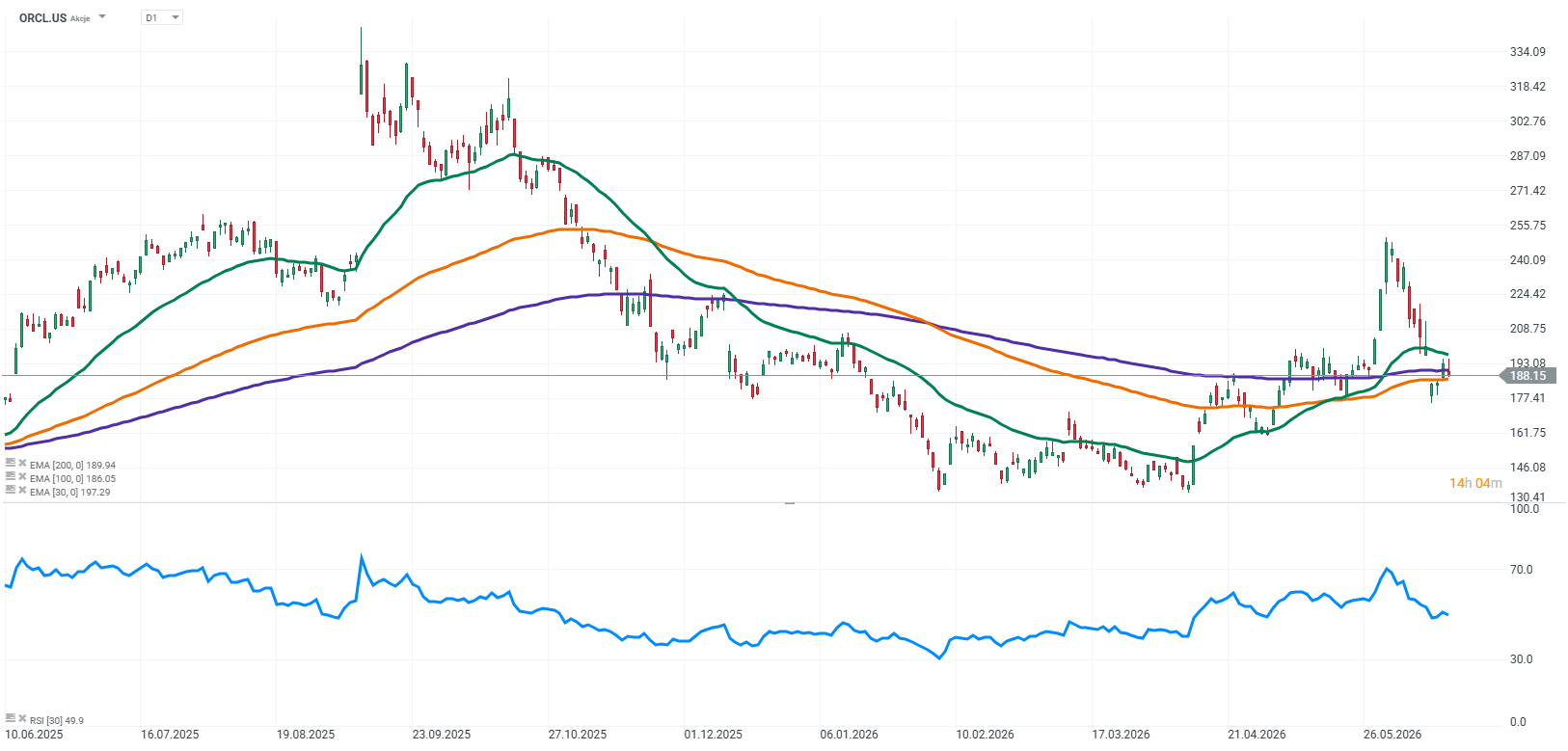
At this stage, there is no confirmation that the contract has been canceled or materially changed, and neither Oracle nor Microsoft has issued statements that would allow these reports to be treated as fact. Nevertheless, the emergence of such a narrative in the media space may still be relevant for the market, as it aligns with growing investor sensitivity to the pace of monetization of Oracle’s massive infrastructure investments.
As a result, even if these reports ultimately prove to be exaggerated or inaccurate, in the short term they may contribute to higher volatility and reinforce a more cautious stance toward the company’s broader growth narrative.
Source: xStation5


European auto industry under pressure - BMW at its lowest since 2020



Morning Wrap: Emotions Subside After the Truce. The Fed Takes Center Stage in the Markets


US OPEN: SpaceX pushes Amazon off the TOP 5 podium. Wall Street awaits Warsh's debut

SpaceX Acquires Cursor for $60 Billion. Why Musk Needed Cursor So Badly
The material on this page does not constitute as financial advice and does not take into account your level of understanding, investment objectives, financial situation or any other particular needs.
All the information provided, including opinions, market research, mathematical results and technical analyses published on the website or transmitted to you by other means is provided for information purposes only and should in no event be interpreted as an offer of, or solicitation for, a transaction in any financial instrument, nor should the information provided be construed as advice of legal or fiscal nature.
Any investment decisions you make shall be based exclusively on your level of understanding, investment objectives, financial situation or any other particular needs. Any decision to act on information published on the website or transmitted to you by other means is entirely at your own risk. You are solely responsible for such decisions.
If you are in doubt or are not sure that you understand a particular product, instrument, service, or transaction, you should seek professional or legal advice before trading.
Investing in OTC Derivatives carries a high degree of risk, as they are leveraged based products and often small movements in the market could lead to much larger movements in the value of your investment and this could work against you or for you. Please ensure that you fully understand the risks involved, taking into account your investments objectives and level of experience, before trading, and if necessary, seek independent advice.
