


Geopolitical developments: Tensions in the Middle East are escalating rapidly following an attack by Iraqi drones on Saudi infrastructure and the closure of the key East-West pipeline, which bypasses the Strait of Hormuz. Due to a shortage of spare parts, the outage could last for over a month, and Saudi Arabia’s export reserves could be depleted in as little as 5 to 7 days, cutting off the market from around 4 million barrels of oil per day. The situation is exacerbated by an unknown projectile striking a vessel in the Strait itself and the postponement of a meeting between the Gulf states and Iran [cite: Vessel struck in Strait of Hormuz, UKMTO says, as prospects for US-Iran diplomacy appear elusive; Oil prices rise after Saudi Arabia shuts down critical pipeline that bypasses Strait of Hormuz].
Economic events: Turmoil in the commodities markets coincides with a crucial week for global monetary policy. Goldman Sachs has revised its forecasts and now expects a one-off interest rate rise of 25 basis points at the US central bank’s upcoming meeting on Wednesday. Meanwhile, Christine Lagarde of the European Central Bank warns that the inflationary shock in the eurozone will persist for longer than previously anticipated. Today’s macroeconomic calendar is light, and attention will focus on Canada’s CPI inflation reading, scheduled for 14:30.
Key markets: The combination of rising oil prices and fresh concerns over regulation of the artificial intelligence sector is clearly weighing on global stock markets. Major US futures contracts are opening the week with sharp falls: the technology-heavy US100 is down 1.31 per cent, whilst the broad-based US500 is down 0.57 per cent. Pessimism is also spreading to Europe, where the German DE40 is down 0.29 per cent and the EU50 is down 0.37 per cent.
Asian markets: The trading session in the Asia-Pacific region was characterised by widespread sell-offs in the wake of growing concerns about stability in the Middle East. Futures on the Japanese JP225 index are down 2.12 per cent. The South Korean market was also hit hard by the sell-off, with the Kospi index opening 3.45 per cent lower. Stock markets in China are holding up somewhat more steadily, whilst the People’s Bank of China has set today’s USD/CNY reference rate at 6.7698.
Currencies: At the start of the week, capital is flowing into safe-haven assets, which is clearly supporting the US dollar. The US Dollar Index (USDIDX) is up 0.22 per cent, putting pressure on other major currencies. The EUR/USD exchange rate is down 0.23%, whilst the British pound (GBP/USD) is down 0.11%. Weakness is also evident in emerging markets, and the dollar is rising by 0.37% against the Polish zloty (USD/PLN).
Commodities: The commodities market is dominated by sharp spikes in energy prices due to the transport blockade around Saudi Arabia and the Strait of Hormuz. US WTI crude is up 2.71 per cent, reaching $102.69 per barrel, whilst European Brent tested the $107 mark overnight. At the same time, natural gas (NATGAS) is rising significantly, by 2.70 per cent, whilst gold is seeing a slight correction of 0.42 per cent, remaining at around $4,329.
Companies: Leading AI firms (Anthropic, OpenAI and Google) have been negotiating since July to set up an industry-wide safety body, whilst Anthropic’s chief executive has publicly called for the pace of innovation to be slowed. In the wake of these discussions, Sam Altman has ruled out an IPO for OpenAI this year, describing such plans as “ill-advised”. Elon Musk, meanwhile, has stated that he is “highly confident” that SpaceX will launch AI computers into orbit in 2027, built exclusively on the Nvidia Vera Rubin architecture as part of the Starmind programme. In China, shares in Z.ai plummeted by over 10 per cent following the announcement of another massive capital raise, totalling $5 billion.
Outlook for today: Investors are likely to be forced to factor in heightened geopolitical risks and ongoing pressure from high oil prices for the rest of the day. Delays and concerns surrounding the AI sector may pose a lasting barrier to a swift return of capital to the market for high-risk technology companies. Given the lack of broader macroeconomic data (apart from Canadian inflation), the market is likely to position itself ahead of Wednesday’s Federal Reserve meeting.
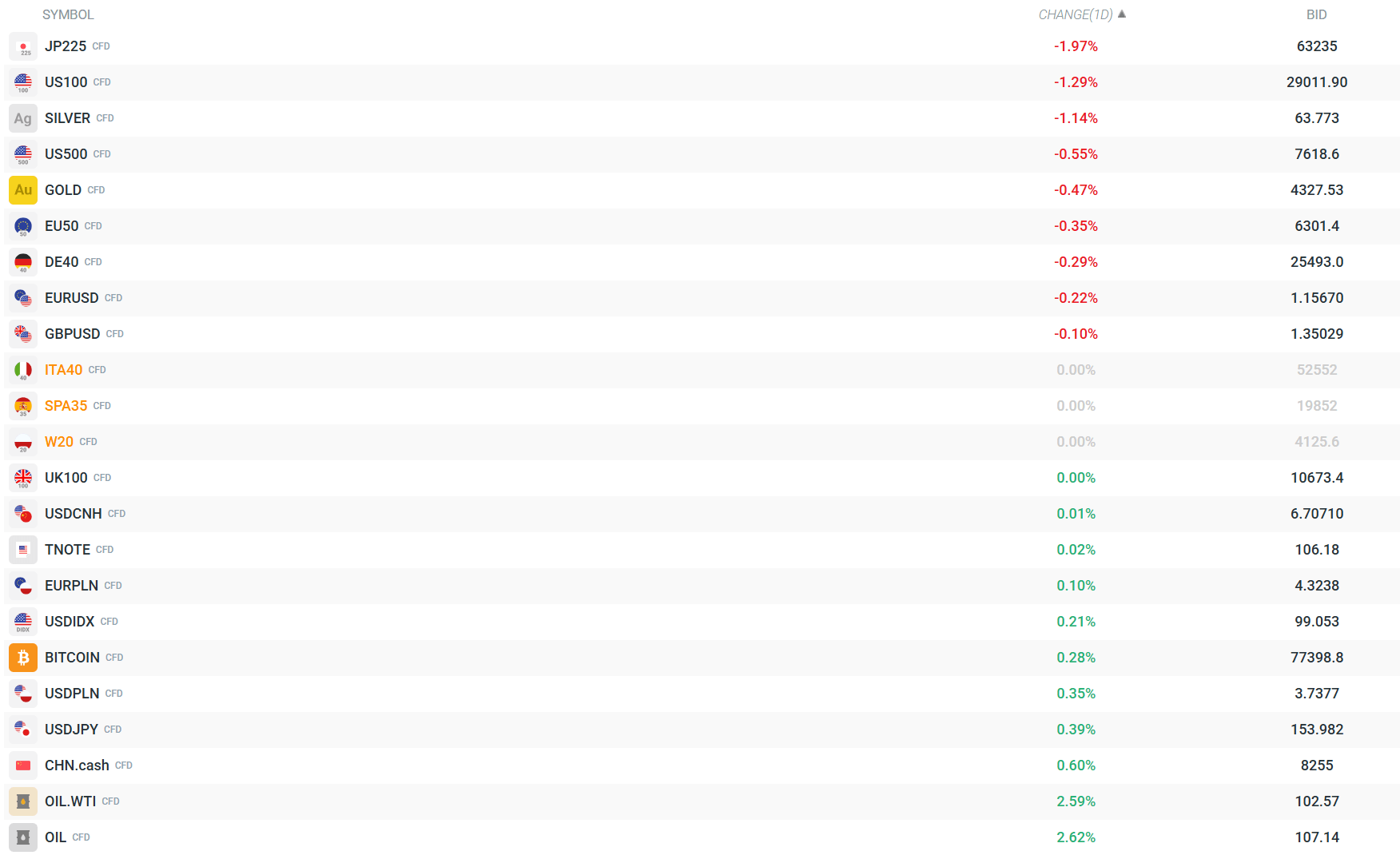 Volatility is currently evident across the main instruments, with selling pressure prevailing at present. Source: xStation



Daily summary: AI slowdown does not slow the rise in yields


The Yen weakens again 💴



Michael Burry’s portfolio: Revolution or rebalance?


US OPEN: AI slows, oil rises, markets fall
The material on this page does not constitute as financial advice and does not take into account your level of understanding, investment objectives, financial situation or any other particular needs.
All the information provided, including opinions, market research, mathematical results and technical analyses published on the website or transmitted to you by other means is provided for information purposes only and should in no event be interpreted as an offer of, or solicitation for, a transaction in any financial instrument, nor should the information provided be construed as advice of legal or fiscal nature.
Any investment decisions you make shall be based exclusively on your level of understanding, investment objectives, financial situation or any other particular needs. Any decision to act on information published on the website or transmitted to you by other means is entirely at your own risk. You are solely responsible for such decisions.
If you are in doubt or are not sure that you understand a particular product, instrument, service, or transaction, you should seek professional or legal advice before trading.
Investing in OTC Derivatives carries a high degree of risk, as they are leveraged based products and often small movements in the market could lead to much larger movements in the value of your investment and this could work against you or for you. Please ensure that you fully understand the risks involved, taking into account your investments objectives and level of experience, before trading, and if necessary, seek independent advice.