


🌍 Geopolitics
- The U.S.-Iran talks in Islamabad ended in failure over the weekend—the two sides were unable to reach an agreement on Iran’s nuclear program. The ceasefire is still formally in effect, but hopes for another round of dialogue are slim, especially following Washington’s latest escalatory moves.
-
President Trump confirmed this morning on Truth Social that the blockade of Iranian ports will take effect at 10:00 a.m. ET (2:00 p.m. GMT). The U.S. will intercept all ships entering or leaving Iranian ports that are carrying Iranian goods, including oil and gas.
-
CENTCOM clarified that the blockade does not mean the Strait of Hormuz will be closed to transit traffic; however, Iran has warned that any approach by U.S. ships to the Strait will be considered a violation of the ceasefire. Israel has raised its alert level.
-
Reports have indicated that Trump and his advisers are considering resuming limited strikes against Iran if the blockade proves ineffective. Analysts view the blockade primarily as a means of exerting pressure, but the market is pricing in the risk of further escalation.
🗳️ Politics—Hungary
-
In Sunday’s parliamentary elections in Hungary, the opposition party Tisza Péter Magyar won approximately 53% of the vote amid a historically high turnout. With 98.93% of the votes counted, Tisza holds 138 seats, Fidesz 55, and Mi Hazánk 6 out of the 199 seats in parliament.
-
Magyar has secured a constitutional majority (the threshold is 133 seats), bringing an end to Viktor Orbán’s 16-year rule. Europe has sent its congratulations, and the markets are interpreting the result as a sign of Hungary’s rapprochement with the EU—up to €90 billion in aid for Ukraine, previously blocked by Budapest, could now be released.
-
The EUR/USD pair reacted only slightly to this news—it is under pressure from a stronger dollar and rising energy prices in Europe. In the long term, however, the election result is positive for the euro and EU assets.
📉 Asian Markets
-
The Asian session was marked by risk-off sentiment: the Nikkei 225 fell 1.0%, weighed down by rising energy prices and a 29-year high in yields on Japanese 10-year bonds, which rose amid inflation concerns. The Hang Seng fell 1.5%, and the Shanghai Composite dropped 0.3%.
-
The ASX 200 fell 0.5%—technology and mining stocks dragged the index down, although the energy sector posted gains.
-
Euro Stoxx 50 futures are down 1.8% after closing up 0.5% on Friday. U.S. futures are also down: US500 -0.70%, US100 -0.81%.
💱 Currencies
-
The dollar is strengthening on the back of demand for safe-haven assets and higher oil prices: DXY +0.3%, USD/JPY +0.3% (around 159.7). The yen remains weak despite hawkish signals from the BoJ, as higher energy prices pose a structural problem for the Japanese economy.
-
EUR/USD is down 0.3%, falling below the 1.1700 level. GBP/USD is down 0.4%, struggling to hold above 1.3400.
-
Currencies from the Southern Hemisphere under risk-off pressure: AUD/USD -0.3% (support at 0.7000), NZD/USD -0.2% (support at 0.5800). Zloty: USD/PLN -0.13% (3.6394), EUR/PLN +0.12% (4.2531) — relatively stable.
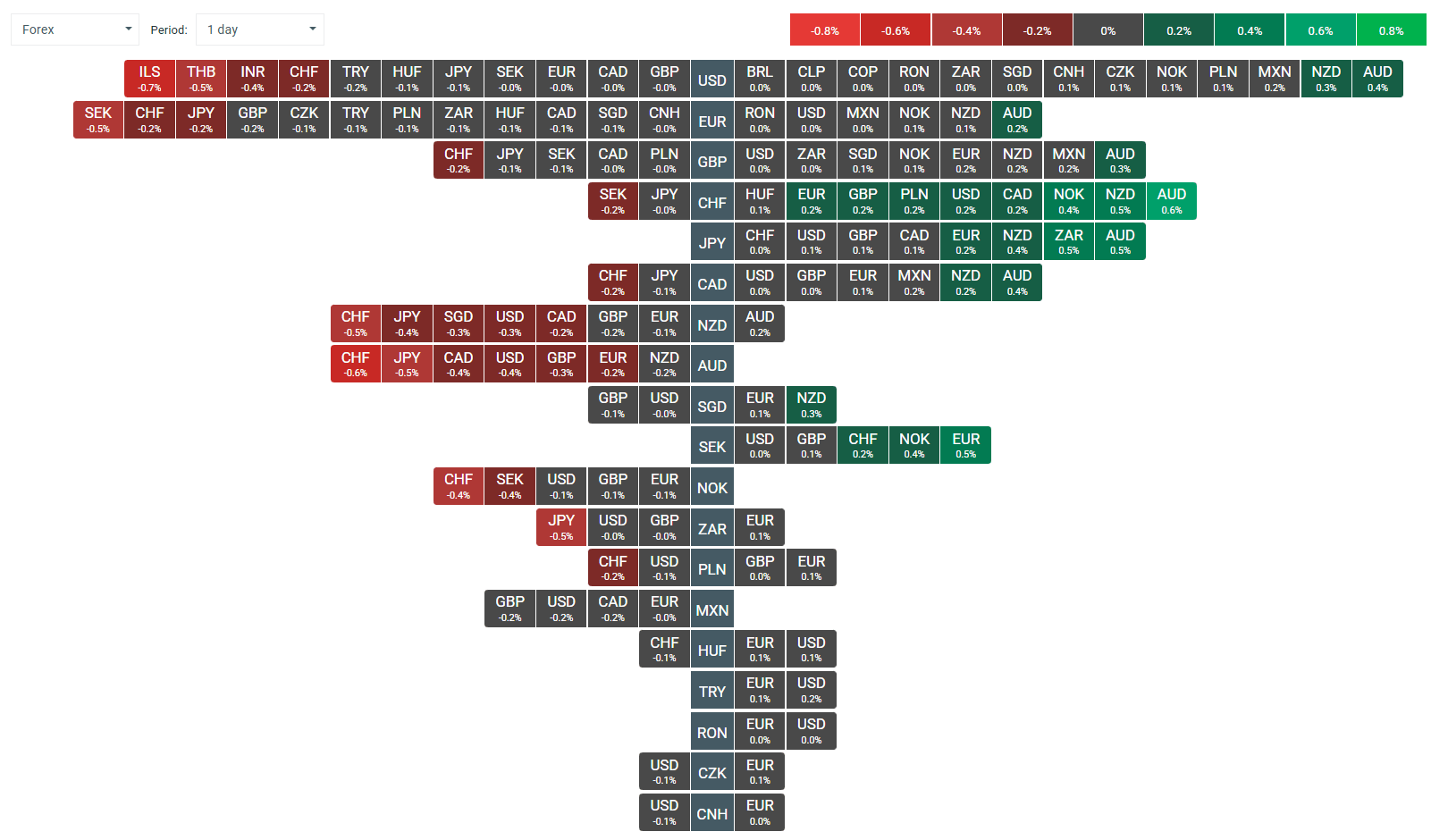
FX market volatility. Source: xStation
🛢️ Commodities
-
Crude oil is the clear leader today: WTI +8.95% (~$104.76/bbl), Brent +6.8% (above $102). This marks a return above the psychological $100 threshold following the breakdown of talks and the announcement of a blockade.
-
Analysts point to an additional risk factor: the expiration of the May WTI contract on April 21. The lack of a diplomatic breakthrough could trigger a sharp speculative rally—some predict a possible move toward $120 by the end of the week.
-
Gold is down between -0.5% and -0.81% (around $4,720/oz) due to a strong dollar and a rally in oil prices—but remains well above its low of $4,700. Silver is down 2.52%. Copper is down 1.3%, under pressure from weaker growth sentiment and the risk of a slowdown.
📊 Stocks and sectors
-
The prevailing scenario is a flight from cyclical sectors: banks, airlines, industrial companies, and retailers will come under pressure due to higher energy costs. Energy companies and the defense sector are the natural beneficiaries.
-
The DE40 is down 1.16%, the EU50 1.15%, the JP225 1.37%, and the CHN.cash 0.84% — a clearly negative picture globally.
₿ Cryptocurrencies
-
Bitcoin -0.69% (approx. $70,800) — is behaving like a risky asset, not like "digital gold," which is a weakness in the current environment.
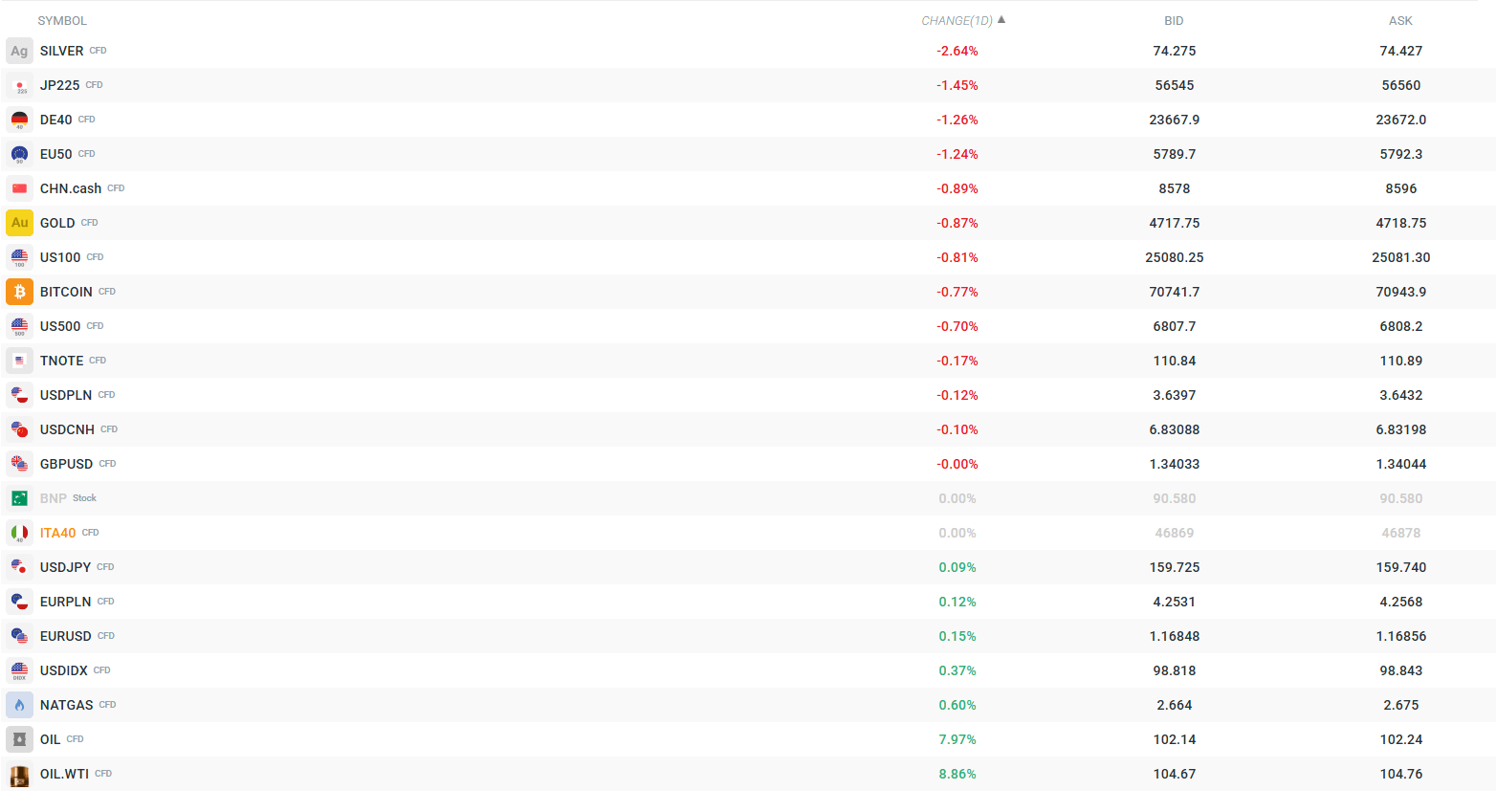
Volatility in major markets. Source: xStation
🎯 What can we expect today?
-
The European session is likely to open sharply lower, with the key moment being 2:00 p.m. GMT — the official start of the blockade of Iranian ports. If a maritime incident occurs or Iran responds militarily, oil prices could spike higher, and stocks could extend their losses.
-
On the macroeconomic calendar, it’s worth keeping an eye on any diplomatic announcements (with Pakistan and China acting as mediators) and any statements from the ECB following the political upheaval in Hungary. Any signs of de-escalation from the U.S. or Iran would be the biggest positive surprise of the session. On the data front, the calendar is empty today.



Daily Summary: "Heat" of the NFP Print Cools Market Sentiment ⬇️


Three Markets to Watch Next Week (04.09.2026)

🟡Gold drops sharply following strong NFP

BREAKING: NFP with a massive upside; EURUSD dips 🚨
The material on this page does not constitute as financial advice and does not take into account your level of understanding, investment objectives, financial situation or any other particular needs.
All the information provided, including opinions, market research, mathematical results and technical analyses published on the website or transmitted to you by other means is provided for information purposes only and should in no event be interpreted as an offer of, or solicitation for, a transaction in any financial instrument, nor should the information provided be construed as advice of legal or fiscal nature.
Any investment decisions you make shall be based exclusively on your level of understanding, investment objectives, financial situation or any other particular needs. Any decision to act on information published on the website or transmitted to you by other means is entirely at your own risk. You are solely responsible for such decisions.
If you are in doubt or are not sure that you understand a particular product, instrument, service, or transaction, you should seek professional or legal advice before trading.
Investing in OTC Derivatives carries a high degree of risk, as they are leveraged based products and often small movements in the market could lead to much larger movements in the value of your investment and this could work against you or for you. Please ensure that you fully understand the risks involved, taking into account your investments objectives and level of experience, before trading, and if necessary, seek independent advice.
