


- The RBNZ kept the OCR rate at 2.25%, but the message was clearly more hawkish than in February.
- Inflation is already at 3.1%, and the central bank forecasts 3.0% in Q1 2026 and a rise to 4.2% in Q2 2026, mainly due to higher fuel and transport costs.
- At the same time, economic growth in New Zealand remains weak, with GDP increasing only 0.2% in Q4 2025, so the bank is trying to avoid tightening monetary policy too early.
- NZDUSD was also influenced by geopolitical developments, including the US–Iran ceasefire, which weakened the dollar and supported pro-cyclical currencies such as the NZD.

- The RBNZ kept the OCR rate at 2.25%, but the message was clearly more hawkish than in February.
- Inflation is already at 3.1%, and the central bank forecasts 3.0% in Q1 2026 and a rise to 4.2% in Q2 2026, mainly due to higher fuel and transport costs.
- At the same time, economic growth in New Zealand remains weak, with GDP increasing only 0.2% in Q4 2025, so the bank is trying to avoid tightening monetary policy too early.
- NZDUSD was also influenced by geopolitical developments, including the US–Iran ceasefire, which weakened the dollar and supported pro-cyclical currencies such as the NZD.
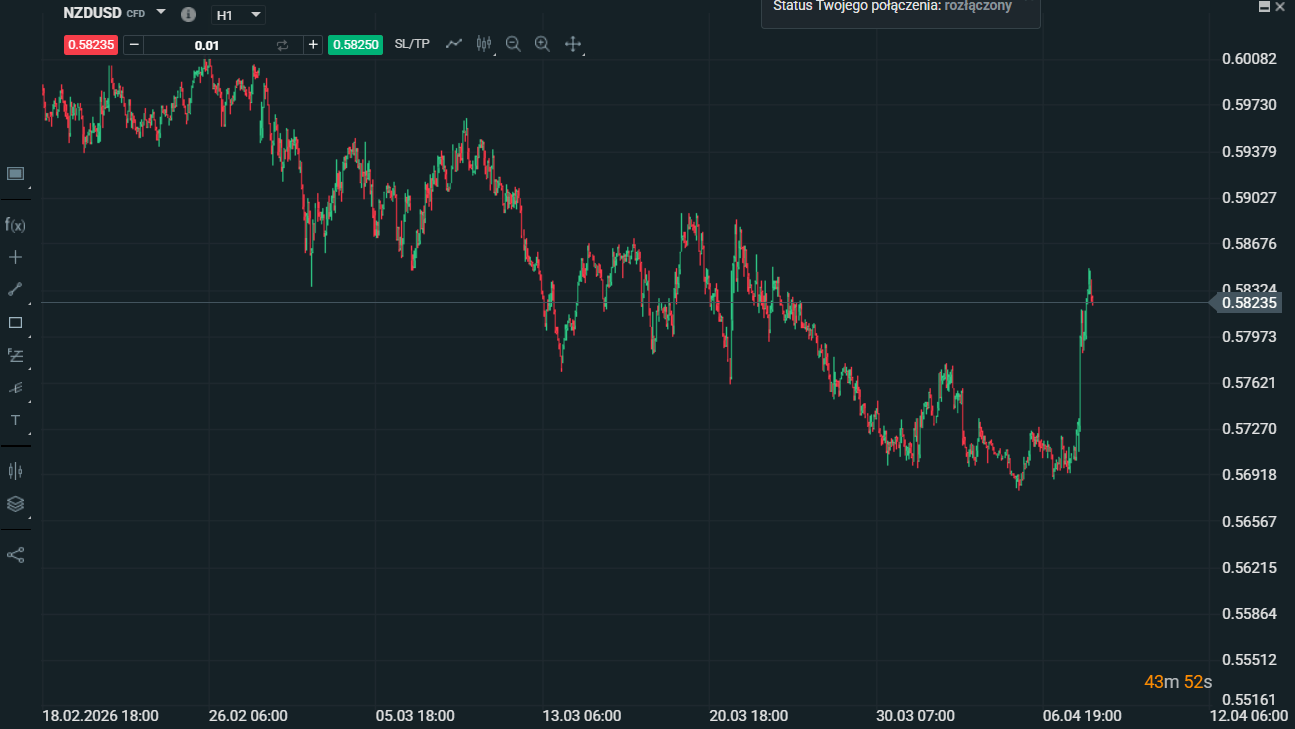
NZDUSD gained as much as 2.00% following the RBNZ decision, supported both by the more hawkish tone of the central bank and the global move after the de-escalation of US–Iran tensions. The kiwi reached around 0.5844 (currently 0.5824). Investors interpreted the decision as a hawkish pause. The RBNZ emphasized that if inflationary pressure spreads beyond energy and begins to affect wages, pricing behavior, or inflation expectations, decisive and rapid rate hikes may be necessary.
The core message from the RBNZ is that the inflation outlook has worsened, even if growth conditions have not improved. The bank indicated that the conflict in the Middle East has significantly altered the outlook through supply chain disruptions and rising oil and fuel prices, which will translate into higher inflation in the short term. Official forecasts point to inflation at 3.0% in March and 4.2% in June, above the 1–3% target range, with key transmission channels including transport, airfares, and food.
At the same time, the RBNZ does not want to overreact to what may be a temporary supply shock. The bank stressed that the situation differs from 2022, as demand in the economy is currently much weaker and spare capacity should limit second-round inflation effects. This is important because domestic activity remains weak: GDP growth is minimal, financial conditions have tightened, and mortgage rates have increased. In other words, the RBNZ faces a difficult trade-off between rising inflation and a still fragile recovery.
Therefore, the decision was perceived as hawkish despite no rate hike. The committee considered more preemptive action to prevent inflation expectations from becoming unanchored but ultimately chose to wait for more data. There are also growing expectations that July could be the first possible timing for rate hikes if inflation pressures persist.
The market backdrop further strengthened the NZD move. The two-week US–Iran ceasefire triggered a strong risk-on move — US500 futures rose around 2.5%, oil prices declined, and the dollar weakened. This supported cyclical currencies, with the NZD standing out thanks to an additional domestic catalyst. At the time of writing, NZDUSD is gaining 1.67%.



Daily Summary: "Heat" of the NFP Print Cools Market Sentiment ⬇️


Three Markets to Watch Next Week (04.09.2026)

🟡Gold drops sharply following strong NFP

BREAKING: NFP with a massive upside; EURUSD dips 🚨
The material on this page does not constitute as financial advice and does not take into account your level of understanding, investment objectives, financial situation or any other particular needs.
All the information provided, including opinions, market research, mathematical results and technical analyses published on the website or transmitted to you by other means is provided for information purposes only and should in no event be interpreted as an offer of, or solicitation for, a transaction in any financial instrument, nor should the information provided be construed as advice of legal or fiscal nature.
Any investment decisions you make shall be based exclusively on your level of understanding, investment objectives, financial situation or any other particular needs. Any decision to act on information published on the website or transmitted to you by other means is entirely at your own risk. You are solely responsible for such decisions.
If you are in doubt or are not sure that you understand a particular product, instrument, service, or transaction, you should seek professional or legal advice before trading.
Investing in OTC Derivatives carries a high degree of risk, as they are leveraged based products and often small movements in the market could lead to much larger movements in the value of your investment and this could work against you or for you. Please ensure that you fully understand the risks involved, taking into account your investments objectives and level of experience, before trading, and if necessary, seek independent advice.
