

- Oil (OIL) rises 3.50% to 90 USD, WTI up 4.50% to 87 USD
- Strong price increase after new attacks on commercial vessels in the Strait of Hormuz
- Iran announced a renewed closure of the strait and warned ships against approaching
- US forces seized an Iranian-flagged vessel, increasing escalation risk
- Tehran may not participate in the next round of talks with the US in Pakistan
- The current US–Iran ceasefire expires on Wednesday, with uncertainty over extension
- Traffic through Hormuz remains significantly constrained, sustaining pressure on global energy supply
- The UAE is considering financial support from the US amid risks to oil exports and dollar flows
- Oil (OIL) rises 3.50% to 90 USD, WTI up 4.50% to 87 USD
- Strong price increase after new attacks on commercial vessels in the Strait of Hormuz
- Iran announced a renewed closure of the strait and warned ships against approaching
- US forces seized an Iranian-flagged vessel, increasing escalation risk
- Tehran may not participate in the next round of talks with the US in Pakistan
- The current US–Iran ceasefire expires on Wednesday, with uncertainty over extension
- Traffic through Hormuz remains significantly constrained, sustaining pressure on global energy supply
- The UAE is considering financial support from the US amid risks to oil exports and dollar flows
Oil prices are rebounding after the weekend, with (OIL) up 3.50% to 90 USD, while WTI is gaining 4.50% to 87 USD. Market concerns have returned, and the risk of renewed, more serious disruptions in the Middle East has increased. Initially, prices surged much more strongly following attacks on commercial vessels in the Strait of Hormuz, new Iranian threats toward shipping, and the seizure of an Iranian vessel by US forces. Prices later partially pulled back from their intraday highs.
The situation in the Middle East has deteriorated again after a brief period of optimism. Iran has withdrawn earlier signals about reopening the strait, blaming the ongoing US naval blockade, while ceasefire negotiations are becoming increasingly fragile. Tehran suggested it may not participate in the next round of talks in Pakistan, accusing the US of unrealistic demands, and the current two-week ceasefire expires on Wednesday. The lack of clear diplomatic progress and rising military pressure are leading investors to increasingly view the region as a persistent source of geopolitical risk rather than a temporary news-driven shock.
For markets, it is no longer just about rhetoric, but the real impact on energy flows, confidence in maritime transport, and financial stability in the Gulf region. Vessel traffic through Hormuz remains well below normal levels, fuel prices are rising globally, and some governments are beginning to tap reserves or introduce conservation measures. There are also signals that Gulf states are preparing for prolonged disruptions — the UAE is considering financial support measures and even the potential use of alternative currencies in oil trade under stress scenarios. For now, OIL around 90 USD and WTI near 87 USD indicate that the oil market remains tight, although hopes for a resolution to the conflict are still significant.
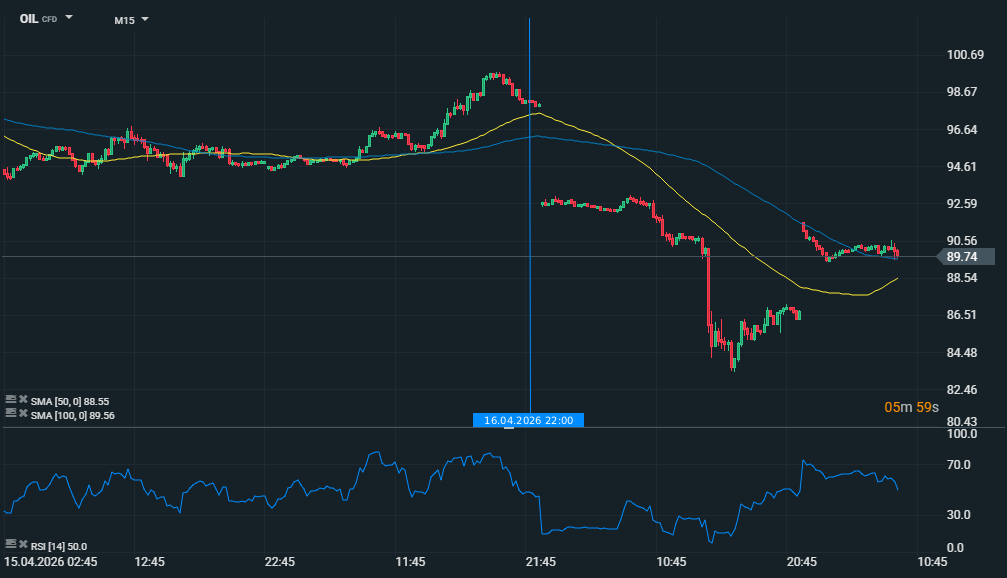


⚫Brent Oil Above $90 per Barrel



Three Markets To Watch (20.04.2026)


⬇️WTI Oil declines nearly 9%
OIL dips below $90 first time in a month🛢️ 📉 Iran will hand uranium to the US❓
The material on this page does not constitute as financial advice and does not take into account your level of understanding, investment objectives, financial situation or any other particular needs.
All the information provided, including opinions, market research, mathematical results and technical analyses published on the website or transmitted to you by other means is provided for information purposes only and should in no event be interpreted as an offer of, or solicitation for, a transaction in any financial instrument, nor should the information provided be construed as advice of legal or fiscal nature.
Any investment decisions you make shall be based exclusively on your level of understanding, investment objectives, financial situation or any other particular needs. Any decision to act on information published on the website or transmitted to you by other means is entirely at your own risk. You are solely responsible for such decisions.
If you are in doubt or are not sure that you understand a particular product, instrument, service, or transaction, you should seek professional or legal advice before trading.
Investing in OTC Derivatives carries a high degree of risk, as they are leveraged based products and often small movements in the market could lead to much larger movements in the value of your investment and this could work against you or for you. Please ensure that you fully understand the risks involved, taking into account your investments objectives and level of experience, before trading, and if necessary, seek independent advice.
