


Photronics (PLAB.US) has come under significant pressure following its fiscal Q2 earnings release, leaving the company with a market capitalization of approximately $1.8 billion despite holding nearly $650 million in cash. The stock has fallen almost 50% from its all-time high near $56 per share, as investors reacted negatively to weaker-than-expected results and cautious Q3 guidance.
Many market participants have effectively viewed Photronics as a laggard within the semiconductor sector, shifting capital toward faster-growing AI and chip-related names. The company attributed the weakness primarily to a slowdown in semiconductor tape-outs, the stage at which new chip designs move toward commercial production.
Photronics generates much of its revenue when new semiconductor designs enter production, creating demand for photomasks used in the manufacturing process. Management linked the recent slowdown to geopolitical tensions in the Middle East, which weighed on customer activity and reduced demand for photomasks.
At the same time, management noted that conditions began improving as early as May. The number of new chip projects has started to recover, suggesting that the current weakness could prove temporary rather than structural. The company also emphasized that it expects to benefit from long-term AI-related semiconductor demand.
What Could Support Future Growth?
One potential growth driver is the company's advanced display mask business. Samsung Display is beginning mass production of next-generation G8.6 AMOLED panels, which are expected to be used in future Apple MacBook Pro models. Higher production volumes of advanced displays should translate into increased demand for high-quality photomasks, a core Photronics product.
Another opportunity comes from the growing outsourcing trend among major memory manufacturers such as Samsung and SK hynix. Outsourcing now extends to increasingly advanced semiconductor nodes, including processes as small as 7 nanometers. This trend could significantly expand Photronics' long-term addressable market.
The company is also investing heavily in new production capacity in both South Korea and the United States. These expansion projects are expected to be completed by fiscal 2027, with benefits likely beginning to appear in financial results as early as next year.
Valuation and Investment Thesis
Following the sell-off, Photronics is trading close to book value and at a price-to-earnings ratio of around 10, which is unusually low for a semiconductor-related company. While short-term volatility remains possible, the company continues to generate profits, maintains healthy double-digit net margins, and carries no meaningful debt burden. Its balance sheet remains one of the strongest among small- and mid-cap semiconductor suppliers.
The core investment thesis is that the current slowdown is cyclical rather than permanent. A recovery in semiconductor design activity, continued growth in AI and memory markets, and rising photomask outsourcing could support revenue and earnings growth over the coming years. The key risks remain the pace of demand recovery, the company's ability to utilize its expanding manufacturing capacity efficiently, and maintaining margins in a more competitive environment.
Historically, Photronics shares have been highly volatile. The stock is currently trading roughly 30% below its 200-day exponential moving average (EMA200), underscoring both the severity of the recent sell-off and the challenge of re-establishing a sustainable long-term uptrend. The biggest risk facing the company is a broader economic slowdown or recession that could further delay semiconductor tape-outs and new chip design activity. Such a scenario would likely weigh on demand for photomasks and could signal that the company's current earnings power may not be sustainable in the coming years.
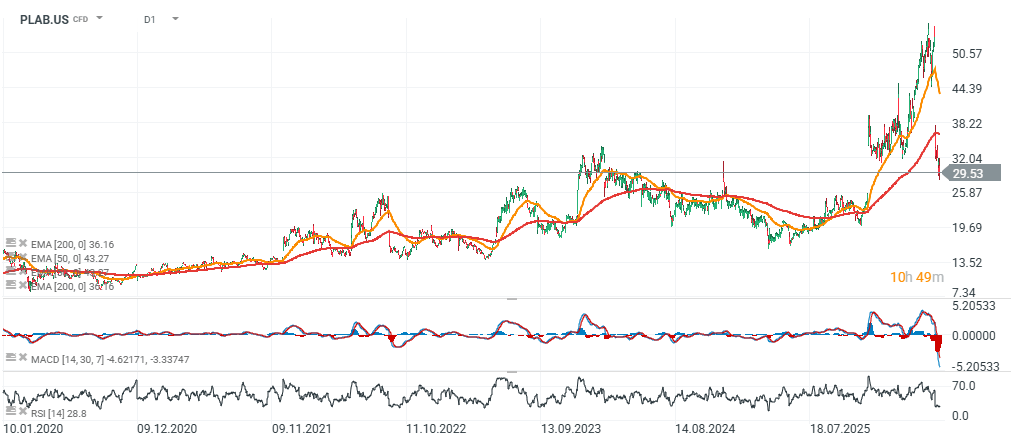
Source: xStation5



Market Wrap: Nervous wait for U.S. Inflation

Super Micro bets on AI. The market is shaken by the share issuance but may be overlooking a more important signal


Oracle drops 3% ahead of earnings 📉 Is this a major stress test for the AI bull market?



Market Wrap: The “Bulls” Are Back on the European Trading Floor 💥
The material on this page does not constitute as financial advice and does not take into account your level of understanding, investment objectives, financial situation or any other particular needs.
All the information provided, including opinions, market research, mathematical results and technical analyses published on the website or transmitted to you by other means is provided for information purposes only and should in no event be interpreted as an offer of, or solicitation for, a transaction in any financial instrument, nor should the information provided be construed as advice of legal or fiscal nature.
Any investment decisions you make shall be based exclusively on your level of understanding, investment objectives, financial situation or any other particular needs. Any decision to act on information published on the website or transmitted to you by other means is entirely at your own risk. You are solely responsible for such decisions.
If you are in doubt or are not sure that you understand a particular product, instrument, service, or transaction, you should seek professional or legal advice before trading.
Investing in OTC Derivatives carries a high degree of risk, as they are leveraged based products and often small movements in the market could lead to much larger movements in the value of your investment and this could work against you or for you. Please ensure that you fully understand the risks involved, taking into account your investments objectives and level of experience, before trading, and if necessary, seek independent advice.
