



Summary of NFIB data for March
- NFIB Optimism Index: down 3 points to 95.8 (below the historical average of 98), vs. 97.9 expected and 98.8 previously
- Uncertainty Index: increased to 92 (well above the historical norm of 68)
- Business profitability: sharpest deterioration – balance fell 11 points to -25%
- Business expectations: third consecutive decline, to 11% (lowest since October 2024)
- Labor market:
- Employment Index declined to 101.6 (still above historical averages)
- Wage pressures are easing (fewer firms raising or planning wage increases)
- Investment and activity:
- Capital expenditure plans: 16% of firms (lowest since 2009)
- Sales: balance fell to -5% (ending a four-month improvement trend)
- Inventories: decline in investment plans (also -5%)
- Costs and prices:
- Rising oil prices → margin pressure and cost pass-through
- Actual prices are rising (25%), but planned increases are declining → signal of weakening demand
- Supply chains:
- 62% of firms report disruptions (increase m/m)
- Disruptions are predominantly moderate and mild
- Business conditions assessment:
- Decline in “good” ratings, increase in “fair” → erosion in growth quality
NFIB data indicate that the economy is entering a cost-driven cooling phase. Weakening investment and expectations point to downside risks for growth in the coming quarters—consistent with the recent decline in U.S. GDP estimates. The labor market remains relatively stable for now, but leading indicators are already deteriorating.
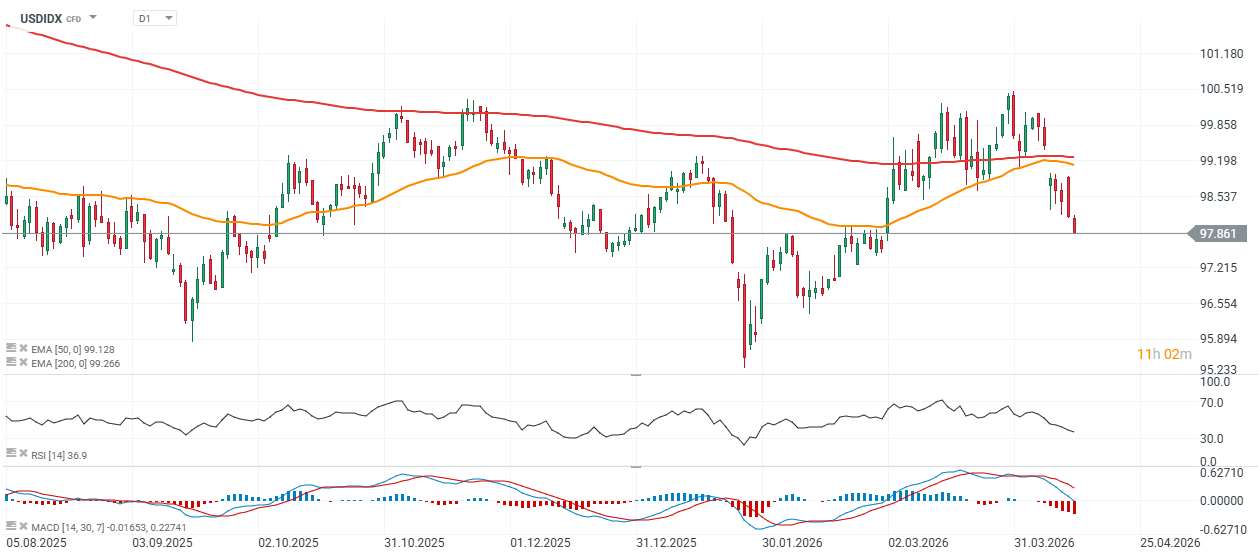
Source: xStation5


Daily summary: Wall Street falls as oil prices rise 🚩 10-year Treasury yields hit their highest level since 2023


EIA raises oil price forecasts 🍳 What did the STEO report show?


Treasury triples bond buybacks, but yields keep rising 🚩 TNOTE at its highest since November 2023


📈 Oil climbs above $100
The material on this page does not constitute as financial advice and does not take into account your level of understanding, investment objectives, financial situation or any other particular needs.
All the information provided, including opinions, market research, mathematical results and technical analyses published on the website or transmitted to you by other means is provided for information purposes only and should in no event be interpreted as an offer of, or solicitation for, a transaction in any financial instrument, nor should the information provided be construed as advice of legal or fiscal nature.
Any investment decisions you make shall be based exclusively on your level of understanding, investment objectives, financial situation or any other particular needs. Any decision to act on information published on the website or transmitted to you by other means is entirely at your own risk. You are solely responsible for such decisions.
If you are in doubt or are not sure that you understand a particular product, instrument, service, or transaction, you should seek professional or legal advice before trading.
Investing in OTC Derivatives carries a high degree of risk, as they are leveraged based products and often small movements in the market could lead to much larger movements in the value of your investment and this could work against you or for you. Please ensure that you fully understand the risks involved, taking into account your investments objectives and level of experience, before trading, and if necessary, seek independent advice.