


Wall Street enters the last Monday of the month, which also marks the start of a week characterized by elevated market sensitivity. At the same time, three key factors are converging: the geopolitical situation involving Iran, expectations for earnings from the largest technology companies, and Wednesday’s Federal Reserve meeting. Such a combination typically does not create a single dominant market driver, but rather an environment where markets react more quickly to incoming information and show significantly lower tolerance for deviations between expectations and actual data.
The most immediate factor remains the situation around Iran, where reports suggest possible attempts at de-escalating tensions. Media coverage points to proposals that could include a temporary easing of the conflict and postponing more direct nuclear negotiations in exchange for opening the Strait of Hormuz. Any signal of stabilization or escalation has a direct impact on commodity prices and overall geopolitical risk sentiment, translating into short-term moves across financial markets.
The second key focus is earnings from the largest technology companies, which currently act as the main driver of equity market sentiment. This week, results will be reported by Microsoft, Meta, Amazon, and Google. Expectations for the sector are extremely high, as investors are no longer focused solely on earnings beats, but primarily on whether the scale of growth confirms the artificial intelligence narrative. According to consensus, the technology sector is expected to deliver very strong profit growth, significantly outperforming the broader market, alongside continued revenue expansion and margin improvement, despite massive investment spending in AI infrastructure. In such an environment, even solid results may not be enough if they fail to match elevated expectations, while any disappointment could trigger sharp valuation adjustments.
The third major factor shaping sentiment is Wednesday’s Federal Reserve meeting. Fed decisions and communications have a direct impact on global financial conditions, as they determine the cost of capital and expectations for future monetary policy. The key question at this stage is whether the central bank will maintain a cautious stance on inflation and economic growth or signal greater flexibility going forward. For the technology sector, which is highly sensitive to interest rates, even subtle changes in tone can have a meaningful impact on valuations.
Overall, this creates a week in which three independent forces are acting simultaneously on markets. On one hand, geopolitical risk related to Iran influences commodity prices and overall risk appetite. On the other hand, the earnings season for major technology companies tests the credibility of the artificial intelligence growth narrative. The third component is Federal Reserve policy, which shapes global asset pricing through the cost of money. In such an environment, markets are unlikely to move in a single direction and instead react dynamically to shifting expectations, with volatility driven more by interpretation of information than by the data itself.
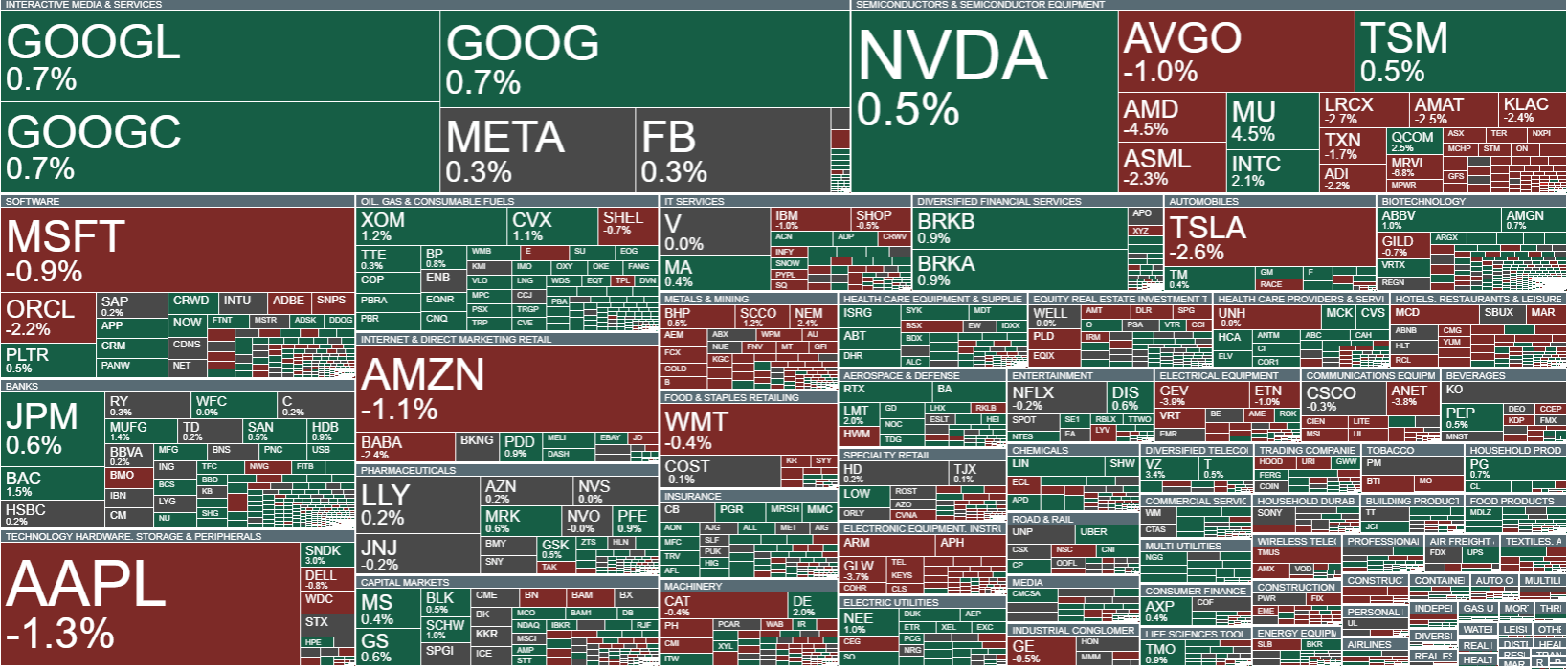
Source: xStation5
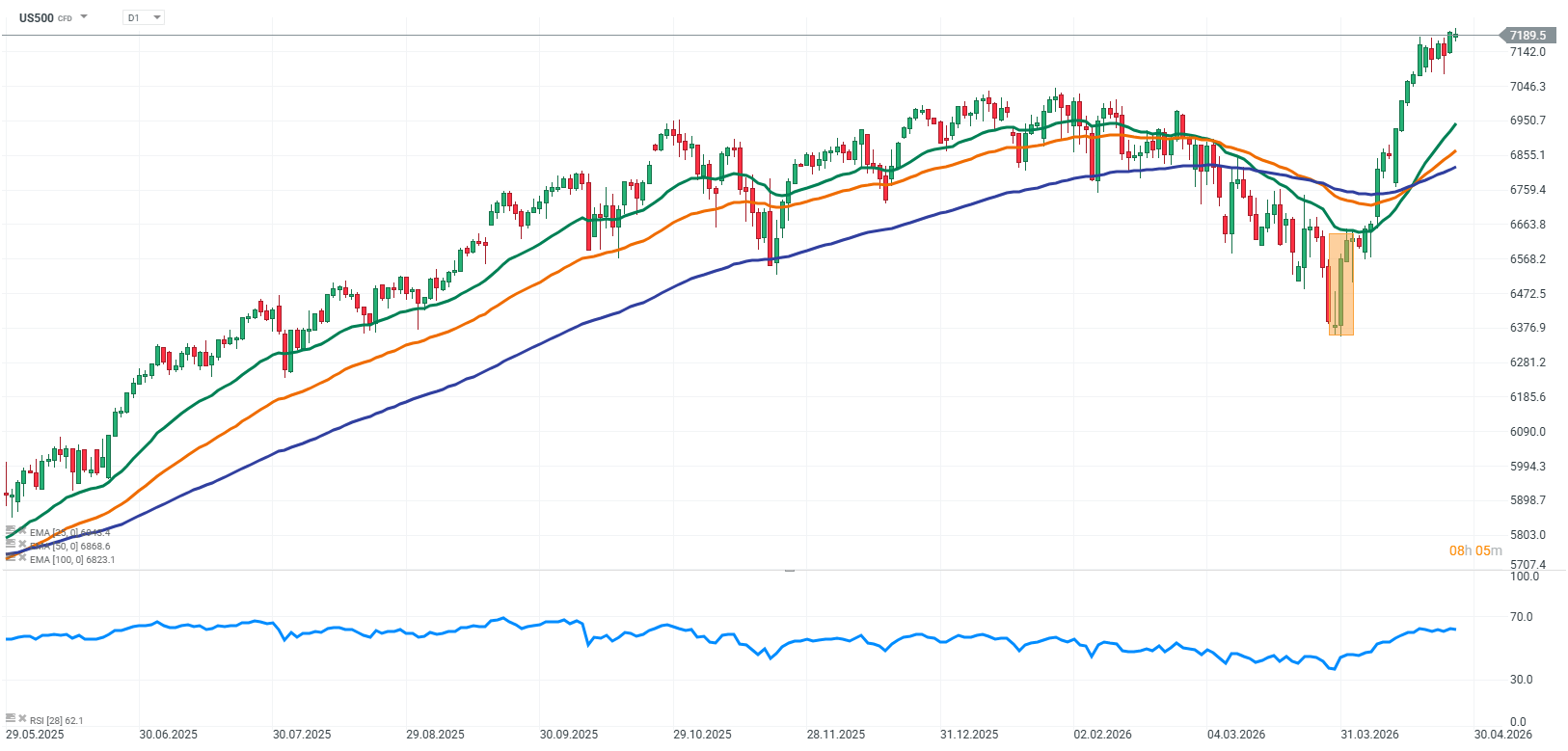
US 500 futures are trading slightly lower today, with markets showing caution despite a relatively strong earnings season that continues to support a broadly positive equity backdrop. Investors are modestly reducing exposure ahead of Wednesday, when results from major technology companies such as Microsoft, Meta, Amazon, and Google will be released, alongside the Federal Reserve decision. As a result, a wait and see attitude dominates, and short term sentiment remains slightly defensive.
Source: xStation5
Company news
Microsoft (MSFT.US) is declining after reports that OpenAI is restructuring its partnership terms and that Microsoft will no longer receive a revenue sharing agreement from OpenAI’s business. Previously, this arrangement was one of the key financial benefits Microsoft derived from OpenAI’s growth. The market interpreted this as a partial reduction in the direct financial upside Microsoft receives from the artificial intelligence boom, even though the overall partnership between the companies remains very close.
Domino’s Pizza (DPZ.US) is falling after first quarter 2026 results disappointed mainly in comparable same store sales, which came in below market expectations. The reading was interpreted as a sign of weaker consumer demand. The biggest disappointment came from the US market, alongside slightly softer international performance.
Verizon (VZ.US) is rising after surprising the market with net positive wireless subscriber additions. In Q1 2026, the company added around 55,000 postpaid subscribers versus expectations for a decline. Verizon also raised its full year 2026 earnings guidance, which investors interpreted as a sign of improving operational trends and effective promotional strategy.
Supermicro (SMCI.US) is announcing the opening of its largest campus to date in Silicon Valley, designed to accelerate delivery of next generation AI data center infrastructure. The expansion is expected to significantly increase the company’s production and integration capacity in servers and AI systems.
Alphabet (GOOGL.US) is in focus after reports that it may cooperate with MediaTek on the production of 8th generation TPU chips.



Daily summary: Wall Street climbs higher as oil falls 📈 SpaceX surges 28%

📈 SpaceX shares surge 20%


Oil slides 2.5% to $88 as Middle East tensions ease 📉 Is the uptrend over?



Wall Street Rebounds as Oil Prices Fall 📈 Adobe Shares Drop 8% After Earnings
The material on this page does not constitute as financial advice and does not take into account your level of understanding, investment objectives, financial situation or any other particular needs.
All the information provided, including opinions, market research, mathematical results and technical analyses published on the website or transmitted to you by other means is provided for information purposes only and should in no event be interpreted as an offer of, or solicitation for, a transaction in any financial instrument, nor should the information provided be construed as advice of legal or fiscal nature.
Any investment decisions you make shall be based exclusively on your level of understanding, investment objectives, financial situation or any other particular needs. Any decision to act on information published on the website or transmitted to you by other means is entirely at your own risk. You are solely responsible for such decisions.
If you are in doubt or are not sure that you understand a particular product, instrument, service, or transaction, you should seek professional or legal advice before trading.
Investing in OTC Derivatives carries a high degree of risk, as they are leveraged based products and often small movements in the market could lead to much larger movements in the value of your investment and this could work against you or for you. Please ensure that you fully understand the risks involved, taking into account your investments objectives and level of experience, before trading, and if necessary, seek independent advice.
