


The latest results from Alibaba (BABA.US) do not inspire optimism, and the market is reacting nervously (with share prices falling by 1–3%). Although the company is trying to argue that its huge expenditure on artificial intelligence (AI) will eventually pay off, the figures for the quarter ending in March 2026 paint a picture of stagnation. Revenue for the entire group grew by a mere 3%, falling short of analysts’ forecasts, and worse still, Alibaba recorded its first operating loss in five years (i.e. since the pandemic). This is a direct result of the drastic increase in spending on AI development and the aggressive battle for new users.
The main problem lies at the heart of Alibaba’s business, namely domestic e-commerce (Taobao/Tmall). This segment has been the biggest disappointment, growing only marginally. Chinese consumers seem to have ‘burned out’ – no one else in the world is bombarded with so many discounts and promotions, and China’s economy does not encourage the purchase of more expensive products, which is holding back growth in transaction values. At the other end of the spectrum is the Cloud Intelligence segment. Here, there is a light at the end of the tunnel: revenue from external customers jumped by 40%, and AI-related products already account for 30% of this figure. This shows that demand for AI services is real. Unfortunately, the dynamic cloud segment is still too small a part of the business to pull the entire, sluggish group along with it.
The long-term outlook raises concerns about the company’s financial health. Alibaba finds itself in a difficult predicament. Firstly, it is hard to make money from AI software in China, as companies there are not in the habit of paying for software as they are in the West – they need to be ‘educated’ and encouraged over a long period. Secondly, Alibaba is burning through cash at an alarming rate: negative free cash flow this quarter amounted to as much as $2.5 billion. This is due to a costly price war in fast e-commerce (e.g. Ele.me) and expenditure on promoting the Qwen AI app (the battle with ByteDance). As a result, investors are left with the same dividend and no news of a share buyback. At the moment, the market sees primarily rising costs, rather than the promised profits from the AI transformation.
RESULTS FOR THE FOURTH QUARTER
- Revenue: 243.38 billion yuan, +2.9% year-on-year, forecast: 246.51 billion yuan
- Alibaba International Digital Commerce Group revenue: 35.43 billion yuan, up 5.5% year-on-year; forecast: 35.93 billion yuan
- Cloud Intelligence Group’s revenue stood at 41.63 billion yuan, up 38% year-on-year, against a forecast of 41.44 billion yuan
- Revenue for the China E-commerce Business Group stood at 122.22 billion yuan, compared with a forecast of 126.03 billion yuan
- Adjusted earnings per American Depositary Receipt (ADR) stood at 62 cents, compared with 12.52 yuan year-on-year; the forecast was 6.04 yuan
- Adjusted EBITDA stood at 16.44 billion yuan, representing a 61% year-on-year decline; the forecast was 24.06 billion yuan
- Adjusted net profit stood at 86 million yuan, compared with 29.85 billion yuan year-on-year; the forecast was 15.08 billion yuan
- Revenue from other activities amounted to 65.46 billion yuan; the forecast was 64.61 billion yuan
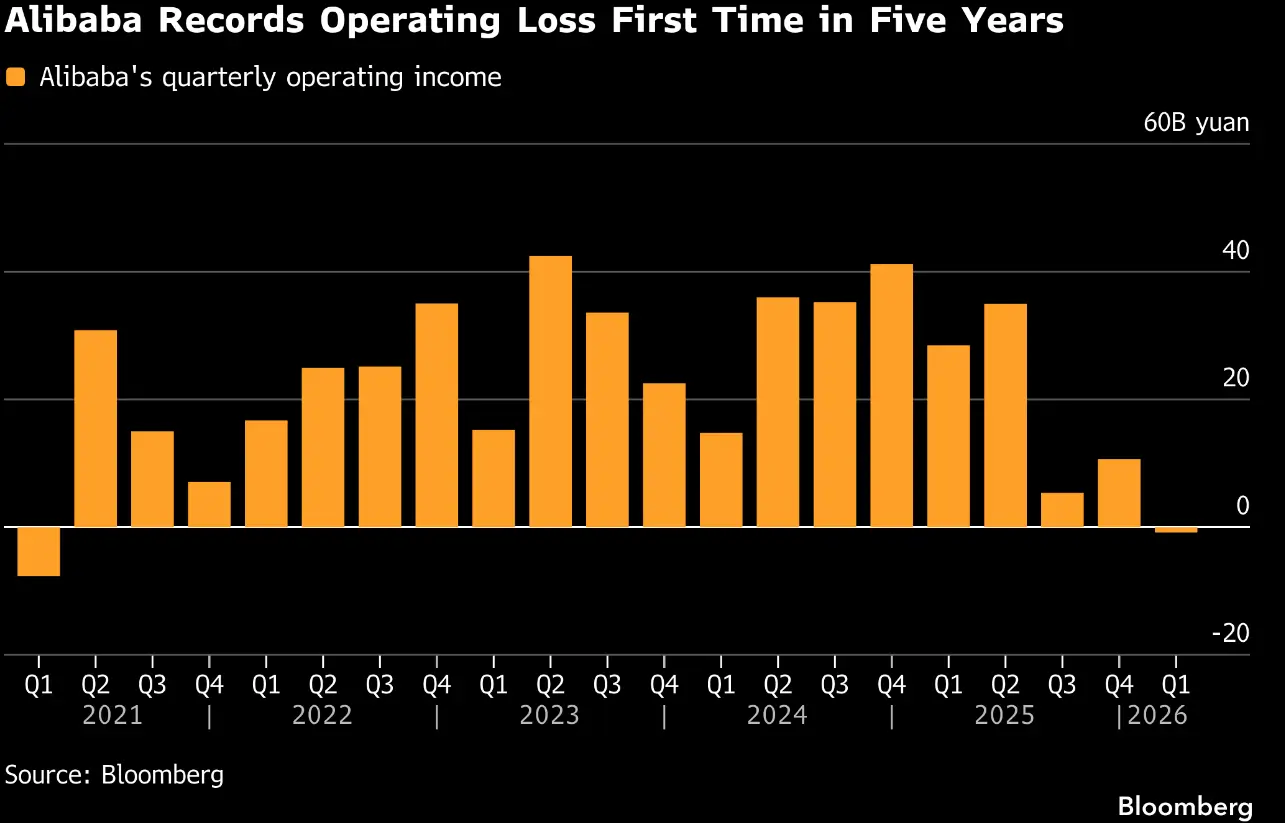
The company has been recording a historical loss that has gone unnoticed for several quarters. Source: Bloomberg Financial Lp
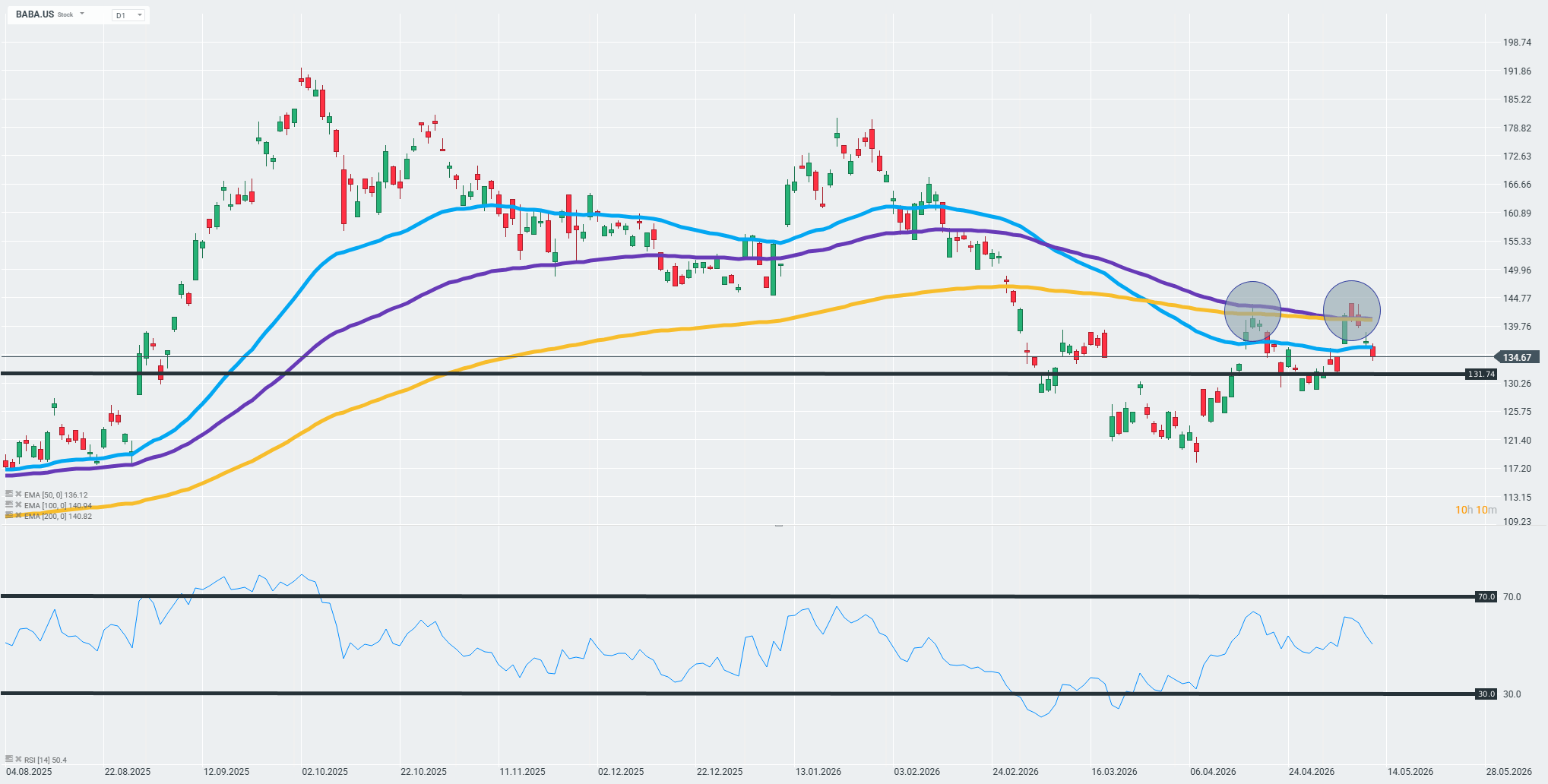
The daily chart for Alibaba (BABA.US) continues its long-term downtrend, remaining consistently below the key 200-day EMA. A local rebound was brutally halted in the ‘resistance zone’ (EMA 50 and 100), which pushed the price in pre-market trading straight down to the key support level at $131.74. Defending this horizontal level at the opening of the main session will be critical to avoiding a capitulation of demand and a test of the psychological barrier at $130. Source: xStation


Russia is taking over Nestlé's domestic assets 🍫 Shares are down nearly 3% 💥



Market warp: Rate Forecasts and Semiconductors in the Spotlight


Daily Summary: Hawkish Fed fails to scare the markets (17.09.2026)

Nasdaq 100 Up 1.7%
The material on this page does not constitute as financial advice and does not take into account your level of understanding, investment objectives, financial situation or any other particular needs.
All the information provided, including opinions, market research, mathematical results and technical analyses published on the website or transmitted to you by other means is provided for information purposes only and should in no event be interpreted as an offer of, or solicitation for, a transaction in any financial instrument, nor should the information provided be construed as advice of legal or fiscal nature.
Any investment decisions you make shall be based exclusively on your level of understanding, investment objectives, financial situation or any other particular needs. Any decision to act on information published on the website or transmitted to you by other means is entirely at your own risk. You are solely responsible for such decisions.
If you are in doubt or are not sure that you understand a particular product, instrument, service, or transaction, you should seek professional or legal advice before trading.
Investing in OTC Derivatives carries a high degree of risk, as they are leveraged based products and often small movements in the market could lead to much larger movements in the value of your investment and this could work against you or for you. Please ensure that you fully understand the risks involved, taking into account your investments objectives and level of experience, before trading, and if necessary, seek independent advice.