


Growth disappoints, but the details are more nuanced
Australia’s economy slowed in the first quarter of 2026, with GDP rising just 0.3% q/q, below market expectations of around 0.5% and well down from 0.9% in Q4. On an annual basis, growth held at 2.5%, but the report points to a clear loss of economic momentum.
For investors, however, the data is not unequivocally negative. The weaker GDP reading was driven primarily by a significant drag from external trade, while private investment remained strong. This leaves the Reserve Bank of Australia (RBA) facing a more complicated picture: growth is slowing, but domestic demand has not collapsed.
Trade and weather disruptions weighed on growth
Net trade subtracted 0.8 percentage points from quarterly GDP growth. Exports fell 1.1%, marking the largest quarterly decline in two years. The sharpest drops came from coal exports (-6.8%) and mineral ores (-1.3%). Cyclone-related disruptions also weighed on mining and transport activity, with mining output declining 1.5%.
At the same time, imports increased 2.1%, partly due to stronger inflows of investment goods linked to data center development. This suggests that part of the GDP weakness reflected temporary disruptions and import-intensive investment activity rather than a broad deterioration in domestic economic conditions.
Data centers support investment, consumers remain cautious
The strongest component of the report was business investment, which rose 6.0% q/q. Spending on machinery and equipment surged 16.3%, the largest increase in three decades. A key driver was continued investment in data center infrastructure across New South Wales and Victoria.
Consumers, however, remain more cautious. Household spending increased 0.5%, but discretionary spending rose by just 0.1%, while essential spending increased 0.8%. The household saving ratio fell from 7.0% to 6.2%, suggesting consumers are increasingly feeling the impact of higher interest rates, elevated fuel costs, and the gradual expiry of energy subsidies.
What does the report mean for the RBA and markets?
The GDP release slightly weakens the case for another near-term RBA rate hike, as economic growth is clearly slowing and GDP per capita declined 0.1%.
However, the central bank is unlikely to view the report as a distinctly dovish signal. Inflation risks remain elevated, private demand is still relatively resilient, and energy prices continue to stay high.
Key market implications:
- Interest rates: Lower probability of an immediate rate hike, but still little justification for rate cuts.
- Bond market: Slower growth may limit further increases in yields, although inflation risks reduce the scope for a meaningful decline.
- Equities: Consumer-related sectors remain under pressure, while data center investment continues to support infrastructure, technology, utilities, and construction companies.
- AUD: The currency reaction was limited, suggesting the weaker GDP outcome was largely anticipated by the market.
AUDUSD reaction
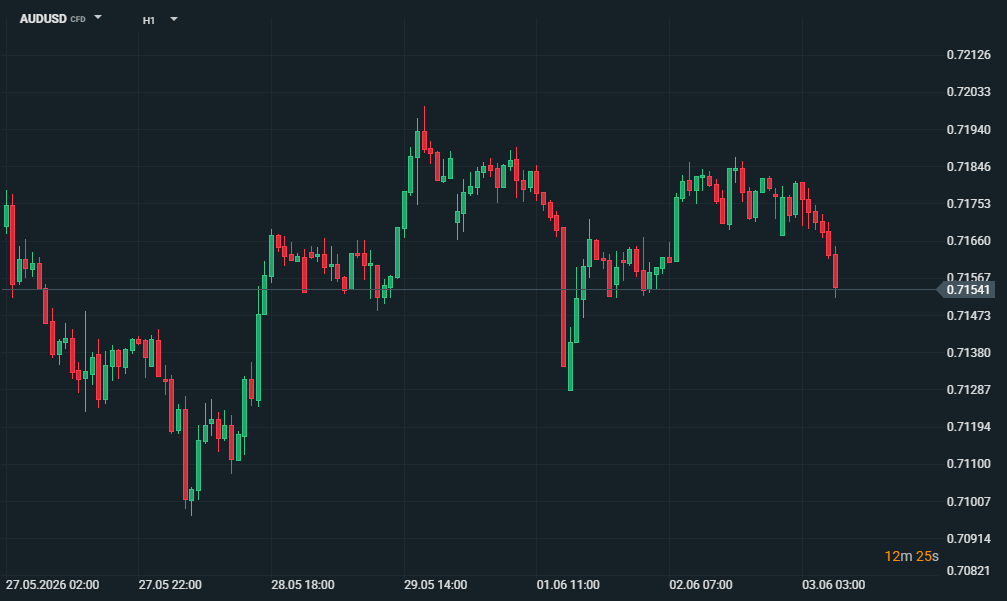
Following the release, AUDUSD edged slightly lower and is currently trading around 0.7150–0.7160. The muted reaction suggests investors viewed the report as weak, but not weak enough to materially alter expectations for RBA policy.
For now, AUDUSD is likely to be driven more by global risk sentiment, commodity prices, the direction of the US dollar, and upcoming inflation data than by the GDP report itself. The release is moderately negative for the Australian dollar, but it is not a major catalyst for a change in the longer-term trend.



Morning Wrap: Weaker Sentiment for AI and Geopolitical Tensions Weigh on Markets



US Open: weaker labor market and AI weigh on Wall Street ❗



EU Wrap: session remains stable amid sector rotation 🔎


US100 runs out of steam above the 30,000 level? 📌
The material on this page does not constitute as financial advice and does not take into account your level of understanding, investment objectives, financial situation or any other particular needs.
All the information provided, including opinions, market research, mathematical results and technical analyses published on the website or transmitted to you by other means is provided for information purposes only and should in no event be interpreted as an offer of, or solicitation for, a transaction in any financial instrument, nor should the information provided be construed as advice of legal or fiscal nature.
Any investment decisions you make shall be based exclusively on your level of understanding, investment objectives, financial situation or any other particular needs. Any decision to act on information published on the website or transmitted to you by other means is entirely at your own risk. You are solely responsible for such decisions.
If you are in doubt or are not sure that you understand a particular product, instrument, service, or transaction, you should seek professional or legal advice before trading.
Investing in OTC Derivatives carries a high degree of risk, as they are leveraged based products and often small movements in the market could lead to much larger movements in the value of your investment and this could work against you or for you. Please ensure that you fully understand the risks involved, taking into account your investments objectives and level of experience, before trading, and if necessary, seek independent advice.
