


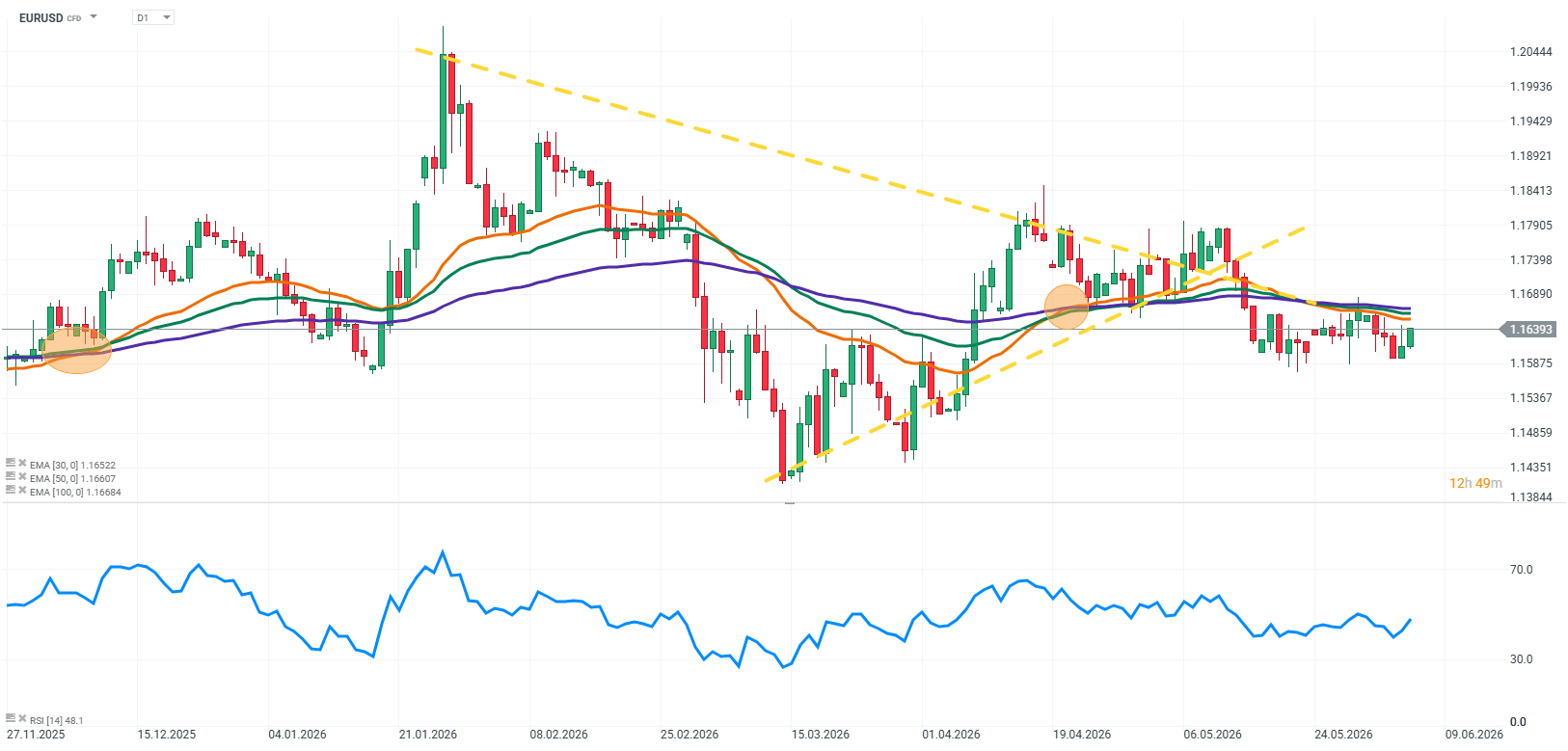
EUR/USD trading resembles a tug-of-war on the edge of a cliff, with one side – the eurozone – suddenly losing its footing. This morning brought a harsh reality check for Europe, while the upcoming U.S. labor market report could ultimately determine which side gains the upper hand in this battle.
Source: xStation5
What Is Driving EUR/USD?
NFP Takes Center Stage
The most important event of the day is the release of U.S. labor market data. The Non-Farm Payrolls (NFP) report has remained one of the Federal Reserve’s key indicators for months, offering valuable insight into the strength of the economy and underlying wage pressures.
For the currency market, the significance of these figures is difficult to overstate. A stronger-than-expected reading could reduce expectations for future rate cuts in the United States, supporting Treasury yields and boosting the U.S. dollar. Conversely, weaker data would increase the likelihood of a more accommodative Fed stance, potentially weighing on the greenback and providing support for EUR/USD.
In practical terms, today’s release could become the primary catalyst for market moves before the week comes to a close.
A Disappointing Picture of the Eurozone Economy
At the same time, investors are paying increasing attention to incoming data from Europe. The final estimate of first-quarter GDP came in significantly weaker than expected. The eurozone economy contracted by 0.2% quarter-on-quarter, compared with market expectations for a 0.1% expansion. The annual reading was even more disappointing, slowing to just 0.3% versus forecasts of 0.8%.
Such a substantial miss suggests that the region’s economic recovery remains far more fragile than previously assumed. For the euro, this is an unfavorable signal, as weaker growth may limit the European Central Bank’s ability to maintain a restrictive monetary policy stance.
Consumers Are Sending Warning Signals
Pressure on the single currency has also been reinforced by recent retail sales data, which pointed to softer consumer activity and added to concerns about slowing economic momentum across the eurozone.
This is particularly important because household consumption remains one of the key pillars of economic growth. If consumers continue to cut back on spending, it becomes increasingly difficult to expect a meaningful acceleration in economic activity in the coming quarters. As a result, markets are beginning to assess whether the weakness in Europe is merely temporary or a sign of deeper structural problems.
Fed Versus ECB
Another key focus remains the divergence in monetary policy expectations on either side of the Atlantic. Just a few months ago, investors were primarily focused on the timing of the first rate cuts. Today, attention is shifting toward a different question: which central bank will ultimately be forced to ease policy more aggressively?
If the U.S. economy continues to show relative resilience while European data remain weak, the divergence in expectations between the Federal Reserve and the European Central Bank could once again provide support for the dollar. This remains one of the most important medium-term drivers for EUR/USD.
Geopolitics and Investor Sentiment
Another source of uncertainty stems from ongoing geopolitical tensions in the Middle East. Markets continue to monitor developments in the Persian Gulf region and assess their potential impact on energy prices and global trade flows.
During periods of heightened risk aversion, capital tends to gravitate toward the U.S. dollar, which remains one of the world's primary safe-haven assets. As a result, even if macroeconomic data fail to provide a clear directional signal, geopolitical developments could continue to offer underlying support for the greenback.
Market Outlook
EUR/USD is currently being pulled in several opposing directions. On one hand, investors are awaiting crucial U.S. labor market data that could significantly reshape expectations for future Fed policy. On the other hand, increasingly weak economic data from the eurozone are fueling concerns about growth prospects and the outlook for ECB policy.
Adding to the uncertainty is the geopolitical backdrop, which continues to keep investors cautious across global financial markets. In the short term, the combination of macroeconomic releases and shifting central bank expectations is likely to remain the key driver of EUR/USD direction.



Morning Wrap: Weaker Sentiment for AI and Geopolitical Tensions Weigh on Markets



US Open: weaker labor market and AI weigh on Wall Street ❗



EU Wrap: session remains stable amid sector rotation 🔎


US100 runs out of steam above the 30,000 level? 📌
The material on this page does not constitute as financial advice and does not take into account your level of understanding, investment objectives, financial situation or any other particular needs.
All the information provided, including opinions, market research, mathematical results and technical analyses published on the website or transmitted to you by other means is provided for information purposes only and should in no event be interpreted as an offer of, or solicitation for, a transaction in any financial instrument, nor should the information provided be construed as advice of legal or fiscal nature.
Any investment decisions you make shall be based exclusively on your level of understanding, investment objectives, financial situation or any other particular needs. Any decision to act on information published on the website or transmitted to you by other means is entirely at your own risk. You are solely responsible for such decisions.
If you are in doubt or are not sure that you understand a particular product, instrument, service, or transaction, you should seek professional or legal advice before trading.
Investing in OTC Derivatives carries a high degree of risk, as they are leveraged based products and often small movements in the market could lead to much larger movements in the value of your investment and this could work against you or for you. Please ensure that you fully understand the risks involved, taking into account your investments objectives and level of experience, before trading, and if necessary, seek independent advice.
