


EURUSD remains under considerable pressure during Tuesday's session. The main currency pair has approached the 1.0900 level, while the US dollar is trading near its highest levels in several months. The recent decline in the euro is not solely the result of weaker economic data from the eurozone. Changing expectations surrounding Federal Reserve policy are becoming increasingly important, with the central bank potentially entering another phase of interest rate hikes.
The tone of Fed officials has become considerably more hawkish. Alberto Musalem, President of the Federal Reserve Bank of St. Louis, said that several rate hikes may be needed before spring 2027 to bring inflation closer to the central bank's target. In his view, current interest rates are not restrictive enough, particularly given the continued strength of the US economy. Similar concerns about persistent inflation were also reflected in the minutes of the Fed's October meeting.
The shift in expectations is already evident in market pricing. A 25-basis-point rate hike in December is now almost fully priced into derivatives markets. There are also early bets on the possibility of a larger move. For the dollar, this creates a significant advantage through the prospect of higher returns on US assets.
Developments surrounding Nvidia have provided an additional boost. Jensen Huang's return to the company's leadership triggered a powerful rebound in US equities and renewed interest in the artificial intelligence sector. Interestingly, the improvement in stock market sentiment has not translated into dollar weakness this time. Quite the opposite. The US currency has gained as stronger prospects for the technology sector have reinforced confidence in the resilience of the US economy and the Fed's ability to continue tightening monetary policy.
Slightly weaker PMI data have not yet changed this picture. Economic activity in the US continues to expand, although at a slower pace than in the previous month. The situation in Europe is also mixed. Germany is showing a clear improvement, while France remains in contraction territory.
Markets will also be watching the minutes of the European Central Bank's October meeting this week. With expectations of further monetary tightening in Europe, the publication could provide important insights into the extent of divisions within the Governing Council.
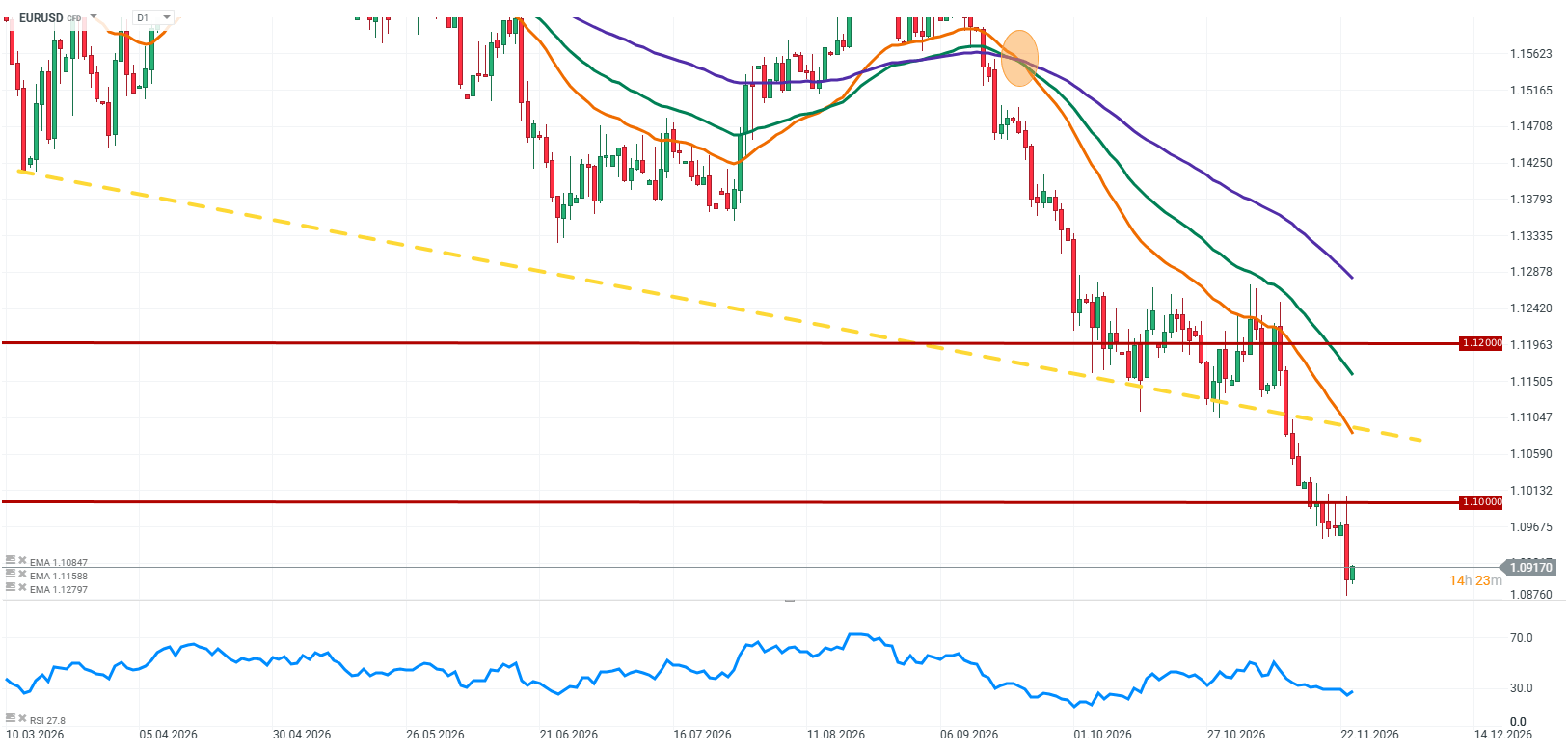
Source: XTB Research
Key Factors Currently Shaping EURUSD
The Fed Turns Increasingly Hawkish. Rate Hikes May Be Only the Beginning
The biggest shift in the currency market currently concerns expectations for US monetary policy. Alberto Musalem's comments represent one of the strongest endorsements of further monetary tightening in recent weeks.
The St. Louis Fed President believes inflation remains too high and that current interest rates are not doing enough to contain price pressures. In his view, several additional rate hikes may be necessary before spring 2027. This is a considerably more decisive position than simply emphasising the central bank's willingness to respond to incoming economic data.
It is worth noting that Musalem is not currently a voting member of the FOMC. His comments therefore do not determine the committee's overall decision. A broader picture of the Fed's stance can be found in the minutes of its October meeting. These suggest that a clear majority of central bank officials favour a 25-basis-point rate hike in December. Some participants even believed rates should have been raised in October.
Markets have taken these signals very seriously. A December rate hike is now almost fully priced in, while attention is shifting towards whether the Fed will continue tightening in early 2027.
For EURUSD, this creates pressure not only from the prospect of a December rate decision, but also from the possibility that interest rates will remain higher for longer. If Fed officials maintain their current tone, the dollar could retain its advantage even without further positive surprises in economic data.
Nvidia Reignites Optimism About the US Economy
One of the more unusual developments during the latest trading session was the dollar's reaction to events surrounding Nvidia.
The company's board decided to reinstate Jensen Huang as Chairman and Chief Executive Officer. The announcement triggered a sharp reaction in equity markets. Nvidia shares gained more than 30%, while US stock indices recovered a significant portion of their earlier losses.
For the currency market, however, the significance lies not simply in the rebound of one company, but in renewed interest across the entire artificial intelligence sector. In recent days, concerns about technology stock valuations and the scale of investment in AI infrastructure had weighed on US equities. Huang's return improved sentiment and restored some optimism surrounding the American technology sector.
Importantly, the stock market rebound did not trigger an outflow from the dollar this time. Markets interpreted the improvement in sentiment as another indication of the resilience of the US economy. A stronger technology sector also increases the likelihood of sustained investment and economic activity.
Combined with the Fed's hawkish communication, this has created favourable conditions for the dollar. The US currency is benefiting not only from expectations of higher interest rates, but also from the perception that the US economy continues to outperform its European counterpart.
US PMI Data Weaken Slightly, but There Is Little Sign of an Economic Downturn
November's US PMI data brought a modest disappointment. The Composite Business Activity Index fell to 54.6 from 55.9 in October. The Services PMI declined to 54.7 from 56.1, while the Manufacturing PMI slipped to 54.5 from 54.9.
The slowdown is visible, but the scale of the decline should not be overstated. All three indicators remain above the 50-point threshold, signalling continued economic expansion. According to S&P Global, the latest readings are consistent with US GDP growth of around 3% in the fourth quarter on an annualised basis.
From the Fed's perspective, the more important issue remains inflation. Businesses continue to report elevated operating costs, making it difficult to determine whether inflationary pressures are genuinely beginning to ease on a sustained basis.
This matters because the Fed's current policy stance depends largely on whether inflation continues to surprise to the upside. A modest deterioration in PMI readings alone is unlikely to change the central bank's position. A more pronounced slowdown in economic activity, preferably accompanied by improving inflation data, would be needed.
Europe Presents Two Different Economic Pictures. Germany Recovers, France Slows
Eurozone data do not paint as convincing a picture as those coming from the United States. The Composite PMI for the currency bloc remained unchanged at 51.7 in November, but figures from individual economies reveal significant differences.
Germany is the biggest positive surprise. The Manufacturing PMI rose to 55, while the Services PMI reached 54. This represents a clear improvement, particularly in manufacturing, which has been one of the biggest challenges facing the German economy for an extended period.
France, however, finds itself at the opposite end of the spectrum. Its Composite PMI fell to 46.2, pointing to a deeper contraction in private sector activity. Weak economic conditions, political uncertainty and fiscal challenges continue to weigh on the single currency.
In practice, the improvement in Germany is not yet sufficient to significantly change the outlook for the entire eurozone. Furthermore, the gap between the US Composite PMI at 54.6 and the eurozone reading of 51.7 highlights the continued advantage enjoyed by the US economy in terms of growth momentum.
ECB Minutes Could Reveal Whether December's Rate Hike Will Be the Last
The minutes of the European Central Bank's October meeting will be released on Thursday, November 26.
Markets will primarily look for indications of where individual members of the Governing Council stand on further interest rate increases. The possibility of additional ECB tightening is no longer a major surprise. Much more important will be whether the central bank sees room for further moves in 2027.
Persistent inflationary pressures could justify maintaining a restrictive policy stance. On the other hand, weakness across parts of the European economy, particularly in France, may encourage greater caution among ECB officials.
If the minutes reveal broad support for further tightening, the euro could receive some support. However, such a reaction is not guaranteed. A December rate hike is already largely reflected in market pricing, meaning that the ECB's guidance on the months ahead will be more important for the single currency.
EURUSD: The Dollar's Advantage Reflects Both Interest Rates and Economic Growth
The current weakness in EURUSD has solid fundamental foundations. The Fed is increasingly preparing markets for further rate hikes, while the European economy continues to expand unevenly. Germany is showing signs of improvement, but weak French data are limiting optimism about the eurozone as a whole.
The US economy also remains relatively resilient. November's PMI readings point to slower growth, but not an economic downturn. The rebound in Nvidia and the broader US technology sector has further reinforced confidence in the strength of the American economy.
Over the coming days, particular attention will be paid to Fed communication and the ECB minutes. If US central bank officials maintain their hawkish tone while the ECB signals caution following its December rate hike, the divergence in monetary policy expectations could continue to weigh on the euro.
This does not rule out a recovery in EURUSD. With such a significant shift in Fed expectations, some of the positive developments are already reflected in market prices. A stronger signal from Europe or weaker US inflation data could trigger a correction. For now, however, there are few arguments supporting a sustained shift in the balance of power between the two currencies.
Key Takeaways
-
The dollar remains close to its highest levels in several months, while EURUSD has approached 1.0900.
-
Alberto Musalem believes several Fed rate hikes may be needed before spring 2027. His position is consistent with the broader hawkish stance reflected in the FOMC minutes.
-
A 25-basis-point Fed rate hike in December is now almost fully priced in by the market.
-
Jensen Huang's return as Nvidia's CEO triggered a strong rebound in US equities and improved the outlook for the technology sector.
-
US PMI readings declined slightly but continue to indicate solid economic expansion.
-
Germany is showing a clear improvement in economic activity, while the French economy remains in contraction territory.
-
Thursday's ECB minutes will be important in assessing whether the central bank sees room for further rate hikes beyond its December meeting.
-
The fundamental advantage remains with the dollar, primarily due to diverging monetary policy expectations and the stronger performance of the US economy.



US OPEN: Market gives back some of the gains, the dollar extends losses
EURUSD gains 0.5% 🔼 BlackRock sees excessive Fed rate hike bets for 2027


Markets cool down after yesterday's surge 💥


Economic Calendar: After Wall Street’s Rally, Markets Turn Their Attention to Ifo and US Consumer Confidence
The material on this page does not constitute as financial advice and does not take into account your level of understanding, investment objectives, financial situation or any other particular needs.
All the information provided, including opinions, market research, mathematical results and technical analyses published on the website or transmitted to you by other means is provided for information purposes only and should in no event be interpreted as an offer of, or solicitation for, a transaction in any financial instrument, nor should the information provided be construed as advice of legal or fiscal nature.
Any investment decisions you make shall be based exclusively on your level of understanding, investment objectives, financial situation or any other particular needs. Any decision to act on information published on the website or transmitted to you by other means is entirely at your own risk. You are solely responsible for such decisions.
If you are in doubt or are not sure that you understand a particular product, instrument, service, or transaction, you should seek professional or legal advice before trading.
Investing in OTC Derivatives carries a high degree of risk, as they are leveraged based products and often small movements in the market could lead to much larger movements in the value of your investment and this could work against you or for you. Please ensure that you fully understand the risks involved, taking into account your investments objectives and level of experience, before trading, and if necessary, seek independent advice.